Home Blog Page 4

CompactLogix Gen 1: Automation Tech Talk for August 19, 2025

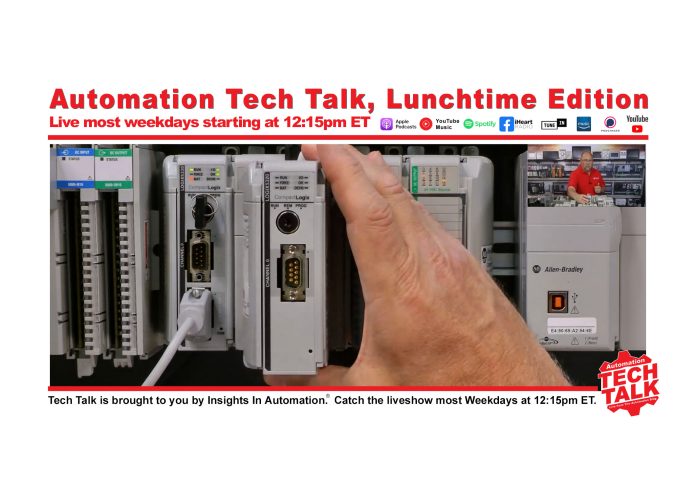
Shawn discusses the First Generation of Compactlogix Controllers in today’s Automation Tech Talk, Lunchtime Edition:


Watch Automation Tech Talk on The Automation Blog:


Listen to Automation Tech Talk on The Automation Blog:


Automation Tech Talk Show Notes:

Thanks for listening! If you’d like to join the show sometime, don’t hesitate to use the contact us link.

Links mentioned in video:

– Article: https://theautomationblog.com/compactlogix-gen-1/
– Course: https://theautomationschool.com/courses/015-cpx-l12/


Read the transcript on The Automation Blog: (automatically generated)

Shawn Tierney (Host): Hey everybody. Hope you can hear me. I’m trying something a little bit different here. Welcome to automation tech talk lunchtime edition, and, I hope you guys can hear me. I hope, you can see me because I’ve changed everything around.

But, because I have all the equipment here for my new twenty twenty five courses on the workbench, and I don’t have any of the other studio set up for what I want to cover today, I decided to cover generation one of the CompactLogic. So I’m just gonna look over here. It seems like audio is working. Okay? It seems like the video is okay.

So in any case, feel free to say hi in the chat if you’re watching. But, lots going on here. I just had, three vendors send in, samples for me to look at. Actually, one is a trade show demo from Automation Fair, so I’m looking forward to, covering that. The other is a brand new line of IO.

Very exciting. And then the third are some Ethernet push buttons. So I hope to have more about that. Plus, I have, more boxes of stuff donated to the automation museum. So, just so much to cover in the coming weeks and days.

And, but in any case, one thing I do every day too is work on my courses, not only, answer questions, but also work on my courses. And I’m getting ready to update them all for 2025. And I just wanted to say if you are already enrolled in any of my Compact Logics, whether it’s level one, level one, two, you get the new cost for free, so don’t worry about that. So in any case, today, I wanna talk about, though, is the first generation of CompactLogix because a lot of people have never even seen them, not even know they exist, but have never seen them. And, just some real interesting stuff here.

And, let me first show you with the, overhead cam here. Let’s see if I can do this. Do I still have audio? Yep. Okay.

So, in any case, you can see here, this is the l 30, and I’m actually connected through a serial port. I’m using a USB, a USPS rev three from Rockwell that I bought years and years ago. And, let me see if I can zoom in on that. You can see I don’t have everything wired up for the new courses yet. So, be spending some nights and weekends doing that.

But you can see there, I have one of just my, sample program in there. This is the one I use. If you’re in my VUE course, you’ll be very familiar with this program. But in any case, with all the molding simulators, code in there and whatnot. So but I also wanna get on here.

I’m just gonna stick it off top of the Polysplike, the l 20. And in the description of today’s show, I have an article I wrote years ago that kinda detailed some of these things, but the l 20 was the very first CompactLogix to come out. Now I had sourced its release to late twenty I’m sorry, late two thousand or twenty zero zero in any case. But, but, you know, whether it came out early two thousand one or late, February, you know, that was almost directly after, like, a year after the ControlLogix l one, the 5550, controller. So pretty quick.

And, this, unit came in either a single serial port or dual serial port. Now the, the, l 30 I have written down here is, came out the following year, okay, about a year later. And so if we look at that, I mean, it may have been six months later, but, I have one coming down at, one coming out in February, one coming out in 02/2001. And these were known. I’m trying to get close so you can see the label there.

This one was known as the 5320. See it up there? And this one was and I know it’s hard to see because it’s at a different level there, but maybe it’ll zoom in better if I take it off. 5330. And so we talk a lot about fifty three seventies and fifty three eighties.

Right? But this is where that whole nomenclature, began way back when. And, yeah, so 25 years old, 24 years old. And, there were some interesting things about that. Now first of all, this guy had no removable memory, no SD card, none of that stuff.

It did have a battery in here. Oh, that’s noisy. See the battery in there? And I believe this is the same battery we were using in the slick one hundreds. I’m sorry.

Slick five hundreds, the seventy forty seven b a, but I think it was had a seventeen sixteen maybe a 17, 69 b a one. But I’m not gonna take it out just to see it. I always leave them unplugged because they would just go dead. So screechy. You can see there some of the pinouts on the side of the unit.

And, you know, the one cool thing about them is is kinda like the the original ControlLogix. This particular unit had built in a EEPROM. In other words, there was a flash or EEPROM equivalent soldered to the board, and so you could actually store your program internally. So if the battery died or if you get a lightning strike and a power surge, sometimes that’ll make these guys forget what their program is, then you would have, you still have your program there. Now a lot of times, people would make changes to their program, and they would forget.

They would forget to, to update the, the internal memory. So but, hey. That’s gonna happen with every PLC that has flash or, you know, removal of memory or, you know, built in memory. Now the problem with that was that, you know, OEMs typically like the lower, less expensive version of the controller, like, for instance, CompactLogix versus ControlLogix. And without removable memory, how do you how do you set them an update?

That was one of the big problems with the l 23, but that’s the next generation. We’re not gonna get into that. But still, it was a great it does take a long time to download the serial at nineteen two, which is kinda what everybody defaults to. A serial at ’21, I’ll tell you what. It I was really annoyed because I had to download it to reset some things, and I had to download it again to change some things and so on and so forth.

So, it was like, I actually brought the air conditioner in here because it was getting so hot with the lights on. I’m like, how long are these downloads gonna take? But in any case, in the days of Ethernet, serial just is so hard to go back to, but, it works. And, in any case, so these guys were very interesting. Now the l 20, besides only having a single serial port, it has no isolated ports.

Right? So if you want to take the communications out of that serial port, maybe you wanna do d h 45, you definitely have to go through an AIC plus to May to give you an isolated port because NEC says you can’t have a network that runs to your POC that’s not isolated. Okay? So if this port’s not isolated, then you need an isolator, and the AC plus is the ice isolated link coupler, I think, or something like that. Anyways, so, that was one of the limits of the l 20.

The speed uploading and downloading to it was a limit, and they picked up something from the from the, Micrologist guys, this port reset. Right? And we’ll we’ll take a look at that in a minute. But, this channel zero default button, it wasn’t a toggle. It was a reset.

A reset channel zero settings, it didn’t toggle them. Like, in the Micrologix, it toggles between default and what you had to set at. So if you had to set at d h 45 or a modbus, you press the button, it toggles back to d f one full duplex. You press it again, it goes back. Well, not on this guy.

It kinda, like, erases it. And we’re gonna test that out, but that’s what that’s what the manual says, and that’s been my experience. But in any case, so no removal merit memory, only serial, I e very slow. And then this guy only could do the l 20 can only do eight modules where the l 30 could do 16. L 20 can only do one extra bank, so two banks total.

The l 30 could do three banks. So if you had a very narrow enclosure, and and these are not rated. I I I tell these just to people. I know a lot of proud panel builders are showing their panels on, on, LinkedIn, and, a lot of times when I see them put a product, vertically instead of horizontally, there’s not many Rockwell products you can put vertically. So always check the manual, but I always, like, secretly send them an instant message saying, hey.

You may wanna take that that picture down because you have it mounted incorrectly. So in any case and and most of these products, something like a like VFDs and other products, you get derate them when you mount them vertically. Most of the rockwove’s POCs, you can’t just can’t mount them vertically. They’re just not designed for that because you don’t get the convection airflow. Now, I mean, you could do whatever you want.

It’s a free country. Right? Free world. But if you want a warranty, don’t tell them you’d mount it incorrectly. Right?

So in any case, so that is the l 20 and the l 30. And, I wanna take a look at the, l 30 specifically, when it comes to, defaulting that serial port. Okay? So what I did is, I I uploaded the program. I changed this party.

It was DH45. I changed it to DF1FullDuplex nineteen two. BCC is the default for this line. I know a lot of the products Raquel makes is CRC. And then I changed this guy to DH45.

Let’s go over to the computer and check that out because I’m doing everything live, so I’m hoping you guys are seeing everything okay and you can hear me fine. In any case, alright. So here, you could see I’m in the program, and let’s go to control the properties. And I’ve never tried this live. I’ve never tried to do this live, but let’s go to channel zero.

You can see it’s DH45. Right? So let me go back out here into the field and find my what did I do with it? Okay. It’s over here.

Let’s go ahead and do this live, and let’s change this, channel zero. We’ll press it. There’s no there’s no, notice behind the press it for so long. Just press it. So now let’s go back over to the computer and look at it.

You see it changed. Right? That updated. Now I’m gonna stay here, and I’m gonna press it again. And from what I’ve read, it will not go back to the d h 45, but who knows?

Now I’m running version 13. Probably should tell you that first. That is the latest version this will run. The newest version it will run. And so whenever I have a legacy product like this, I always try to get the latest.

And the 13 was actually a very popular version. There was some real big add ons, I think, in motion, as well in 13, because people think 13 is a unlucky number. K. So I just did it again, and you see it’s not changing back. Right?

It’s not changing back. I’m gonna try it one more time. K. Let me just make sure it’s not because it’s not refreshing. I’ll close it and reopen it.

K. Now look at channel zero. It did go back. So is it making a liar out of us? I don’t know.

Nope. No. It was just reading all the information. So it finally caught up and read from the controller. So, offline, it’s d H 45, but it was took a while to read from the controller.

So that’s a downside of it. Right? And I don’t think having four tasks will be limited to four tasks is a downside. Most of the systems I’ve seen out there, four tasks are fine, but in any case, I do wanna throw that out there. And what else did I wanna talk to you about this guy?

The speed. Oh, well, let’s talk about what replaced it, which was really popular. So, you know, no Ethernet, serial only. You know, the l 20 didn’t even have an isolated serial port. Right?

The l 30, the second port is isolated. You know, the comp the nonremovable memory, you know, all those kind of things. Now they sold this as being able to be upgraded to Ethernet device that and ControlNet. Ethernet device that and d h four eighty five, not ControlNet. But, yeah, that was through, like, an AIC or an ENI or a DNI.

And, yeah, that’s not really DeviceNet, d h 45. Yeah. For sure. That’s a 100% d h 45, but a d n I is really messaging. It just encapsulate encapsulates that, that, d f one packet into a, a device that packet.

So it’s not like you’re, you know, mapping, you know, like a scanner. You’re mapping things things in. Now there is a scanner, seventeen sixty nine device that scanner. I got a few of them here. And, do plan on adding a section on device that in the new course.

Probably that’ll probably be 2026. I do have a device set lecture for $10 if anybody wants to go pick that up and learn about the device set basics. But the hands on just requires so much room that it’s like, I gotta get through all the basic stuff for us. Right? So, in any case, but I I don’t know if this guy could actually support the SDM.

I I have a feeling it can’t. Maybe I can. I don’t know. But, I was so old and obsolete that, that, you know, we never tried by the time the SDN came out. So and I’d love if you guys if I say anything wrong or you know I’m wrong about something, let me know.

But in any case, what replaced this? Right? So this is what I call generation one. Right? And what replaced it?

I mean, I call it generation one because it these two controllers share so much in common. Right? They’re really of the same family. But, the next generation totally is different. Right?

And so if we come out, some of you guys may know this. This product was extremely popular. It’s the l three x, the l 35 e, the l 32 e, l 35 c, l 32 c, and l 31. L 31 was not very popular. The l 31 was was like the l 35, but it it it had two serial ports.

And I know somebody who was using it, and I was very unhappy because of the serial ports. So if you think, and I’m not gonna pull it out of the box. I’ll do it for the course, but you think an l 31 e, an l 31 is like an l 30, like, you know, two serial ports, but has this it’s the same size as the l 35, and it has the compact flash port. Now that was huge. Now I have removable memory, and I have Ethernet built into the controller so much faster.

And I think these guys go up to, I’m gonna say, 16. I could be wrong about that. Do they go all the way up to 20 or just to 16? You know, I don’t remember. But I’m guessing they only go to you know, I think they do go to 20.

Maybe they do. In any I think they do. In any case, I’m trying to convince myself. What do they do? But in any case, these guys were extremely popular.

The ability to have the ether ethernet port plus, you know, making that just makes online edit so smooth. You know, you’re editing so fast. You know, you could online edit these other guys, but it was so slow. In any case and the CompactFlash removable memory, Same battery on the side. You can see here that we have, I don’t know if we can see that from there.

If it says isolated, you can see there isolated. So every serial port was isolated. You know? That was really nice. It had still had the same flaw with the, the reset button for the serial port, but you know what?

In this unit did not have any built in no built in, flash card. You you had to buy, and it did not unlike the fifty three seventies, these did not come with the flash card. You had to buy them, and they were pretty expensive because they were heavy duty industrial. Now some people would say, well, can I just buy one at the store? Absolutely.

Just buy a Compact Flash from the store and use it. But here’s the thing. If this product, you know, costs a million dollars when it’s down, are you really gonna put yourself at jeopardy of use or or your company at jeopardy for losing a million dollars because you want to save $50 on a Compact Flash card? If you wanna roll the dice, go for it, man. It’s a free world.

But, in most cases, if you were gonna leave the compact flash in there, you know, you weren’t in a jam, you would order the the official one from Rockwell, get one with a warranty and a guarantee and, you know, an industrial version. A lot of the cheap comp a lot of cheap memory just does not hold up. You know, same thing with anything cheap. I I bought a lot of cheap stuff over the years. You know?

And, you know, I I say I’m doing it for my students to see if it’ll work or not, but a lot of times I’m penny pinching. Right? And, a lot of times I regret it too. Right? So, I have to go back and buy the the higher level.

One place that is is inexpensive, pilot lights. So I’ve had so much problems with the, hey. You get 10 for $10 and they’re just, you know, you’re you’re screwing the wires on, and then the the brakes. It’s like, yeah. I’m not doing that anymore.

But, in any case, I digress. This is generation two. We’re not gonna talk about that today, but I did wanna just show you what the next generation was. So l 31, l 32, l 35, and l 23, which is a shoebox version of this, has really all the same features and functions except they took the compact flash cut out again. We’re talking about that when we are filming the the, History of Automation podcast this weekend.

I gotta get a copy of that to the guest, my guest hosts, so they can, give me the thumbs up on publishing it, but we had a lot of fun doing that. And, we hope to record another episode. This is all to raise money for the automation museum, so we have a place where we can go and and see all the legacy automation out there, like the stuff I showed you in the first three videos. But in any case, we have another one coming up this Sunday. Jeremy’s gonna be talking about, the history of Rockwell.

He should send me not everything. Right? I mean, the cut the the company the company is, like, over a 100 years old. Right? So not gonna cover the entire history.

You know, five hours later, then we get to 1924. No. That’s not what we’re gonna do in this podcast. But in any case, I think that’s it for today. I gotta eat lunch.

I hope you guys are having a great day. Let me see if anybody commented. Nope. I think most of you are either driving or maybe my video and audio is not going out there, but I do wanna wish you guys all good health and happiness. Again, if you wanna pick up my CompactLogix course, it is, you know, $20.20 prices.

We’re gonna keep those until mid September, and then I have to put the prices up to $20.25. I wish I didn’t, but the bill collector’s chasing me down. So we gotta we gotta start, you know, you know, keeping up with everybody else. Right? All the, inflation.

But in any case, if you do, like, let’s say you pick up level one, you will get the new level one at no charge. So don’t worry about it. The the the cost does not you know, it it was filmed before version 35, ’36, and ’37 were out. So if you’re looking for the for the latest, you’ll you’ll get that when the the new course comes out. But with that, I wanna wish you all good health and happiness.

And until next time, my friends, peace.


If you have any questions about Shawn’s in-person or online courses, please don’t hesitate to setup a time to meet with Shawn via MSTeams, or drop him an email using his contact form here: https://theautomationschool.com/question/


Until next time, Peace ✌️ 

If you enjoyed this content, please give it a Like, and consider Sharing a link to it as that is the best way for us to grow our audience, which in turn allows us to produce more content 🙂

Shawn M Tierney
Technology Enthusiast & Content Creator

Support our work and gain access to hundreds members only articles and videos by becoming a member at The Automation Blog or on YouTube. You’ll also find all of my affordable PLC, HMI, and SCADA courses at TheAutomationSchool.com.

Shawn Tierney

(no views)
Automation Museum Update for August 18, 2025: SyMax

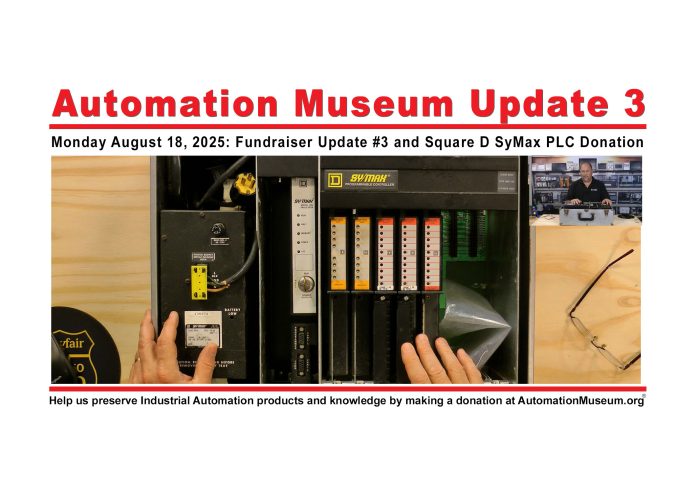
Shawn Tierney shares an update on the Automation Museum fundraiser, as well as a look at one of the items the community has donated, a Square D SyMax PLC.

For information about donating to the Automation Museum, please click here.


Listen to Automation Tech Talk on The Automation Blog:


Read the transcript on The Automation Blog: (automatically generated)

Shawn Tierney (Host): Hey, everybody. Thank you for tuning back in. Shawn Tierney here from Insights, and I wanted to give you an update on the automation museum. So let me go over to the computer screen here, and you can see we’re still stuck at about 7%. We’re at about $200 of our $3,000 goal to get this unit set up, this, you know, new nonprofit set up.

And a couple of things we’re doing to drive attention to this across this video, but we’re also launching a history of automation podcast to try to drive awareness to this goal of actually setting up maybe first a virtual museum and then a physical museum. And I got a ton of stuff I wanna donate to it, and I really would look enjoy having people come in and teaching them what I know, but also learning what they know. And with that in mind, I wanna talk about some of the, samples that have been sent in over the years. And I’ve actually told people to kinda keep things in your attic or in your storage unit because I’m just out of space. And when the town comes in here, they wanna tax everything they see.

You know? It’s hard to explain to them that this is a donation or whatever or it’s personal. Right? So in any case, I wanna share with you this particular unit. Now I did send a very kind gentleman who sent this in a few years ago.

I did send him a message on LinkedIn and, to try to get some backstory and learn a little bit more about it, But, he must be very busy, because I haven’t heard back from him. But this is again, this is not a POC that I, started programming back when I got into the into this business back in the nineties. I gotta make sure I do this correctly here. But this is a really old Symax and, yeah, I’m gonna have to put the glasses on. But, check this thing out.

This is a Symax demo. Have I have no idea how old this is. I have no idea what I’m even looking at, but I think it’s super cool. You know? Square d PLC.

Right? And, if you guys know anything about this, I’d love to have any links or any literature, PDFs, or anything you have. But this is something I could see that we could restore and set up in the nonprofit automation museum and, actually teach people how what this unit used to do, how it used to work, and so on and so forth. But, it is very reminiscent to the PLC five in my opinion or PLC two and, 1771. So, just one of the very cool things that I’ve been sent here over the years that, that I would like to get into a real, physical museum.

And a Cuesta Museum would have, like, computer technology in it. It would have all the other technologies in it. But the focus here is the automation museum and that’s what we’re fundraising for. I think can I go back to the screen here? Yeah.

So, if you look here, this is, give sengo.com/automationmuseum. You can go to also go to automationmuseum.org, and it’ll transfer here. I don’t even have a bank account set up to withdraw the stuff because if, you know, if we can’t reach the goal, then I’ll just return everybody’s money. But, I’m not gonna touch any of this money. It’s gonna go directly into a 5013 c, charity fund, to set up the, to set up the the organization.

So in any case, if you have an extra $20 maybe this week and, you know, you’re you’re doing good at work and you, you know, you’re interested in industrial automation, which I think you are because you’re watching this channel, consider, helping us get to that $3,000 so we can actually, get the five zero one three c set up and we can start sending when people send us stuff, we can start sending them official, you know, tax deduction letters and whatnot. I know it differs between where you live and and what you’re working on, but, in any case, I just wanted to share that with you and give you a quick update on how things are going. And keep your eyes out for the new History of Automation podcast that I’m working with, couple of other older guys, and I’m pretty excited to bring that to you. And I think the the first episode will be an author who’s coming on and talks about the history of Wonderware and Triconics. And, then we have somebody coming on and talking about the history of Allen Bradley.

And then I want you to come on too. If you’re an older folk and you know some how to use or maybe you’re younger, but you learn how to use some older stuff, I’d like to get you on, including everybody who’s donated. You guys, put some great comments in the donations. We’d love to get you guys on as well. But with that, I’m gonna wrap up this week’s update on the Automation Museum Fun Drive.

Really look forward to having you guys, join us in this journey to preserve our, automation history. And with that, I wanna wish you all good health and happiness. And until next time, my friends. Peace.


Show Notes:

Special thanks to everyone who already donated! You can see the current status of our fundraiser at:

Until next time, Peace ✌️ 

If you enjoyed this content, please give it a Like, and consider Sharing a link to it as that is the best way for us to grow our audience, which in turn allows us to produce more content 🙂

Shawn M Tierney
Technology Enthusiast & Content Creator

Support our work and gain access to hundreds members only articles and videos by becoming a member at The Automation Blog or on YouTube. You’ll also find all of my affordable PLC, HMI, and SCADA courses at TheAutomationSchool.com.

Shawn Tierney

(no views)

Building Systems with CompactLogix vs Micro800s: Automation Tech Talk for August 15, 2025

Shawn meet’s up with Giovanni Mendoza of GM  Automation and Controls in today’s episode of Automation Tech Talk, Lunchtime Edition:


Watch Automation Tech Talk on The Automation Blog:


Listen to Automation Tech Talk on The Automation Blog:


Automation Tech Talk Show Notes:

Thanks for listening! If you’d like to join the show sometime, don’t hesitate to use the contact us link. You’ll also find Giovanni’s website here.


Read the transcript on The Automation Blog: (automatically generated)

Shawn Tierney (Host): Giovanni, thank you for coming on the show. I really appreciate you coming on. I know we’ve talked a lot about ControlLogix and CompactLogix over the months and years, But I recently saw you did a project, and I know your company and you guys do a lot of different projects. But I noticed you recently did a project on the micro eight hundreds. And I wanted to ask you, well, just a bunch of questions.

It just really got me curious. So if you don’t mind, I would like to start off with why you chose the micro 800. And I just for so everybody knows, I teach both Logix, you know, Compact Control Logix micro 800. You know, I teach other brands as well. And, you know, I like them all.

But I a lot of times people who use Logix never use the micro 100. So this really piqued my interest. So I wanted to start, asking you and, really, before we get to that, tell us a little bit about what you do. Tell us a little bit about yourself and your company.

Giovanni Mendoza (GMAC): Sure. Well, first thing, thanks a lot, Shawn, for, having me here. It’s, it’s an honor to be on your podcast. Yeah. So I am a systems integrator, essentially.

A, I’m a business owner here in California. And so we do a lot of, bakery automation, but we just dug into the, foam molding industry with this project. So that one was very cool. Yeah. You know, I know that’s pretty much all we do as far as our typical projects, you know, logic stuff.

But we pretty much had to ask the customer what was their budget.

Shawn Tierney (Host): Yep.

Giovanni Mendoza (GMAC): And, you know, I have used the micro eight hundreds at home. And I know they were very, you know, versatile as far as what you can do with them. So and the cost was awesome. You know? The Yeah.

Very justifies the cost for the customer and whatnot. And so we sat down with the customer, and we were like, hey. Like, what are you guys expecting with this project? What are you expecting it to do? What do you wanna see on, like, a screen?

What is it that you guys want? And the application was very simple. It’s a hydraulic press, essentially, that was, automated with a MicroLogix 1,100. But

Shawn Tierney (Host): Okay.

Giovanni Mendoza (GMAC): The entire program wiped out, and the person that programmed it was long gone and actually passed away many, many years ago. Ugh. The there was no records or anything that we can pretty much use for, essentially, just to get kinda, like, a picture of what was going on.

Shawn Tierney (Host): Mhmm.

Giovanni Mendoza (GMAC): So, thankfully, the process was very basic.

Shawn Tierney (Host): Mhmm.

Giovanni Mendoza (GMAC): And so, you know, the customer was a little bit on a tighter budget, and so we couldn’t really justify the cost to put in, like, a CompactLogix in there. So we picked out the micro 800. And, the environment I know there’s a lot of people that don’t really like CCW for Mhmm. You know, many reasons. Sometimes the software is a little different in certain aspects.

Right?

Shawn Tierney (Host): It is. Yeah.

Giovanni Mendoza (GMAC): But, it wasn’t bad for the application. You know, we had a lot of inputs, but only a couple outputs. So that was pretty nice. And it was cool in the aspect that we we were able to combine the HMI and the PLC program into one file, right, all in CCW.

Shawn Tierney (Host): Yeah.

Giovanni Mendoza (GMAC): So pretty much it you know, it was very cool to just you’re working on your your programming, and then at the same time, you got the HMI popped up in the same file.

Shawn Tierney (Host): Yep. You know,

Giovanni Mendoza (GMAC): you don’t have to open up a separate software. You know, it’s all conjuncted into one. So it was very easy as far as, you know, integration goes. You know, we were, you know, jumping around two softwares and, you know

Shawn Tierney (Host): Mhmm.

Giovanni Mendoza (GMAC): Doing all that stuff. So it was it was cool. You know? It was all in one whole piece. And it was nice because we were able to just, you know, put it in a small file, email it out.

It’s just one just one simple file they have to save in there. So, yeah, I I definitely, this was the first time we cut our teeth into really providing a micro 800 for a process. So, you know, definitely not as bad as, you know, some people say as far as the software platform goes. Definitely did its job. I I really did enjoy the migrate 100.

I think it was it’s very, very powerful controller indeed.

Shawn Tierney (Host): Yeah. You know, I was surprised how powerful it was when I did my training course on it. Gee, it must be almost going on ten years now. I’m actually in the process of upgrading, all my training courses. But one of the things I wanted to do first was solve the Factory IO lessons.

So I did three factory IO courses. And so I decided to do them in the order of Micrologix, controller CompactLogix, and then Micro 800. And I really get to see the differences between the three packages. And the micro 800, you know, I think, like, an eight twenty, if somebody’s out there thinking of getting one for a small project, I just looked up the list price today. It’s August, you know, 2025, and it’s it’s about $3.97 list price.

Now this doesn’t have, like, a huge discount off it typically. This product line, you gotta call your local representative, and they’ll give you your actual price. But don’t expect, like, 50% off that price. Right? That’s been my experience anyways.

But, still at that price, you know, list price on the $400, it’s you know, when I started this, it was $2.50. So, you know, you know, over time, over the decades, it goes up over time, of course. But, it can do a lot. Now, you know, I there are some people out there who say, if it’s not a lot if it’s not Studio five thousand we used to say Logix. If it’s not Studio five thousand, I won’t use it.

And, you know, I I really found there are some things in the ladder editor that are just great, drag and drop. You know? You can change, you can change, you know, different instructions and do do the things you’re used to doing. They added in the where you can edit the rung in text. They added that a few years ago.

So if you’re one of those guys who do that a lot, I just happen to be one of those guys who like to do that. Because in the June Micrologix, we kinda had to do that because you couldn’t just toggle a destruction from XIC to XIO or latch to unlatch or whatever. But, you know, I really like that feature. They do have a, a a a Logix theme, which I love the idea behind, but I’ve had some students get in trouble with that when they did a lot of subroutines and the way it handled those subroutines. I haven’t I haven’t done a lesson on that yet.

But, you know, there are some usability things that I’m just used to, you know, like, putting in the tag values, right, into different instructions. So if I have a bunch of rungs that are very similar, I just wanna go through and change each of the tag values. I find that tag browser did you find this as well? The tag browser is a little clunky. It depends on where you click, which browser you get, and then it just seems a little bit harder to navigate than the other packages.

Did did you find the same thing, or was that not a big deal for you guys?

Giovanni Mendoza (GMAC): Yeah. It it was. You know, it is kind of a challenge with tag browser that they have, even just to kind of, put in descriptions on the tags

Shawn Tierney (Host): Yeah.

Giovanni Mendoza (GMAC): They have to open up the tag browser and then kinda just pop up another page and then put all your info in there. So, yeah, it was a little clunky, compared to, you know, the Logix environment where you could create a tag on the fly and then, you know, just open up the tag properties and just put in your descriptions or, you know, do the alias tags if you’re you’re gonna do that. So, yeah, in that aspect, it was a little bit, challenging, but, you know, it’s it wasn’t too bad.

Shawn Tierney (Host): Yeah. And for those people who say and I know the MicroLogix says only the 1,400 left and, you know, it’s end of life. Right? And or active and mature, I think, is the correct way to say it. You know, talk to your Rockwell people to get actual information.

I’m just a I’m just a, instructor. But, you know, the Micro 800 supports, you know, function blocks and structured text, and I think it does a good job at it. So, you know, as much as I love my old MicroLogix and I use the 1,100 in, 14 and here’s the thing too. If you wanna you program the 1,400, you’re gonna have that $300 package of, software. You know?

The software is free for the, for the, 1,100, and it has an emulator built in, a simulator built in. Yeah. With the free software, it only runs for ten minutes, but still, you don’t get that with Logix. Right? You don’t get a free simulator built in.

Other vendors do that. The other big vendors include that for free. And with Rockwell’s Studio 5,000, they don’t. And I also, you know, I also like the integration of the panel view 800, formerly the panel view component or, the what we used to call the PVC slow because it was so slow. But the 800 has been very of a very good product line.

You know, and and, did you do the HMI on that as well? Did somebody else do it? Did you we did you do the HMI? Yep. What did you think of that?

I mean, it’s simple, but functional. Right? Yeah.

Giovanni Mendoza (GMAC): You know what? I’ve I’ve used their, the eight hundreds, the panel v eight hundreds a lot more than the micro eight hundreds.

Shawn Tierney (Host): Okay.

Giovanni Mendoza (GMAC): So it’s yeah. You know, it’s a very it’s a very good platform, and, and I’m sure you know this. But with the eight hundreds, you can also connect to certain, Logix controller. So it’s very cool where, you know, you can just you know, if the customer is on a budget and you just they want something simple, then you can just get, like, an 800 and, you know, do everything on there. And it it’s very it works well.

You know? I I I personally do like the, HMI environment. There is a couple things that I feel like it, you know, it is missing out, you know, like, you know, you have on, you know, factory talk to you

Shawn Tierney (Host): Yeah.

Giovanni Mendoza (GMAC): Is, like, you know, animations. Right? You don’t have any animations. Yeah. That would be the only downside that I don’t like on, creating HMIs on, CCW.

But otherwise, you know, it’s it’s not too bad. I like it.

Shawn Tierney (Host): I remember when it first came out, maybe fifteen, twenty years ago, I recreated the, demo that’s in the panel view plus in CCW. And the animation thing was painful, so you had to use, like, a multi state indicator and Yeah. Have multiple pictures of what you wanna do. And, but but aside from and and that animation feature is just, you know, the panel view plus, gee, it must be 30 years old now, but, well, maybe not that old. 25 years old.

But, it was alright. Maybe, well, maybe 20 years old. Alright. 20. I keep going down.

I’m like, oh, not that old. But, the Panelview Plus was just because RSVUE, you think RSVUE predated the Panelview Plus. RSVUE was, like, ninety five ish. I was a beta user. Then FactoryTalk View, I’m thinking early two thousands.

So and don’t quote me on that. I’m not looking at my notes. But, you know, it really pull force all all of that same that same technology with the animations as identical. So if you go back to ’28 let’s say, nineteen ninety five, ninety six, you open up RSVU, which is the predecessor RSVU 32, the animation window looks almost identical to what you’re using today in factory talk view. And it just kick it’s it’s I don’t wanna say any bad words, but it’s really cool.

And and and some of the features, you know, very powerful features that even comp the competition don’t have yet, is still in that product. Kinda, you know, I understand why they’re doing the factory talk optic. Have you used any factory talk optics?

Giovanni Mendoza (GMAC): I have not. Okay. You know, I I I have definitely seen it and, you know, it’s it’s talk of the town at the moment, but I haven’t really dug into it.

Shawn Tierney (Host): Yeah. I, you know, I it’s kinda sad that with it almost feels like we’re seeing the end of an era of the panel views, because of factory talk optics, and I have not used it. I do like that the development is free for, you know, especially for students who wanna play around with it and try it. That we used to give away demo discs for the panel view plus software, Effector Talk Vue Machine Edition. Now you gotta call somebody to get a demo, and they get you an email.

And it still runs for two hours, you know, in demo mode forever, but you still have to call somebody and and, you know, and and do all that. So it’s there’s a little friction there to get a demo of it. But, you know, I think you also recently did if I if I’m following you, correct me if I’m wrong, I also saw your company did something with Logix, and I think you had some servos on it as well. Was that something you recently posted on LinkedIn?

Giovanni Mendoza (GMAC): That was about a month ago. Yeah.

Shawn Tierney (Host): Yep. Can you tell us a little about that project and what you used on that?

Giovanni Mendoza (GMAC): So that was actually just a troubleshoot. But, it yeah. It was just a it was a tissue paper line

Shawn Tierney (Host): Okay.

Giovanni Mendoza (GMAC): With, well, I’m sure you saw the panel. It’s, like, twenty, twenty five servos in there. So, yeah, very big system. Yeah. No.

Definitely not something I integrated. Just working on the line. But Just

Shawn Tierney (Host): working on the line.

Giovanni Mendoza (GMAC): A really interesting, production environment, though. That was the first time I ever been to a, tissue paper manufacturer, so that was pretty cool to see.

Shawn Tierney (Host): Oh, yeah. They do some cool stuff. We have some tissue mills in the area, like, with an hour of where I am, and it’s just amazing to watch them run. And and I think all paper machines actually, the building I’m in that at least my office is out of used to be a paper, a a paper mill. And, then it was a printing press for the Berkshire Eagle.

So, and, I don’t know if they I don’t think they print the paper here anymore. I don’t quote me on that. But in any case, they do have so the big printing press in the in in in the side of the building. But in any case, you know, I think when it when it comes to the the micro 800, I think you summed it up. It is nice working in one environment.

Have you had a chance to use the Panelview 5,000 at all?

Giovanni Mendoza (GMAC): I have. Yes. I used it recently, first time on a cookie mixer. Oh. So that yeah.

That one was pretty cool. That wasn’t on my LinkedIn, so that that’s why, no one’s really seen it yet.

Shawn Tierney (Host): So Tell us a little bit about that project. You know, in comparison to the micro 800, you know, PanelView 800 using that was probably a CompactLogix or a ControlLogix? Okay. It was. And so both of them did they both they kinda both lived in the same GUI.

Right?

Giovanni Mendoza (GMAC): Yeah. Yeah. Pretty much.

Shawn Tierney (Host): So how did you find the Panelview 5,000 as a new user?

Giovanni Mendoza (GMAC): A little bit of a small learning curve, but it wasn’t really that different from, you know, like, a Panel v plus environment. We I where I kinda struggled a little bit was, making a recipe selector. So that one was pretty interesting. Yeah. Because you have to use pretty much, like, indirect addressing to really, go through a list to see your recipes.

Shawn Tierney (Host): Mhmm.

Giovanni Mendoza (GMAC): So that one was kinda fun to figure out. And, of course, you know, as far as the rest of the whole programming was for that line, I thought it to be very easy, you know, as far as there’s a lot of, features to it that, you know, I thought were pretty cool. So, you know, there’s, like, ways to pretty much like, if you bring in a, like, an image of, an object that’s in there Mhmm. And I’m sure you probably do this in the panel view. I just really haven’t spent too much time on it, but, it it’s already preset so that you can if you wanna make, like, the level indicator on the tank Yeah.

You just put the tag in there for your level indication, and it automatically already does, you know, all the, logic for you, in other words. So, yeah, definitely a cool environment. You know? It wasn’t too bad other than the recipe stuff.

Shawn Tierney (Host): Mhmm.

Giovanni Mendoza (GMAC): I find it to be, pretty pretty, pretty useful as far as if I were to consider those, on another project.

Shawn Tierney (Host): You know, I, when when they were getting ready to launch it years ago, I was really excited for it. Yeah. And and it really it took a while to come out. There was some hardware changes. There was a lot of going on in the industry at that time.

And when they decided to make it Ethernet only and make it Logix only, it’s kinda like, well, what what kind of life can this product have? You know? And and I’ve had the product manager on the show, and we’ve talked to him. I think it’s a great product. But for the longest time, it didn’t have some of the basics, that you think of an HMI having, like alarming.

Right? And I think that really hurt its development. Not a Rockwell bought the, ASIM or ASIM, however you wanna say it, company, and they had the factory tuck optics. I could I could definitely see that. It seems to me that their their focus is on optics and not on the 5,000.

And quite honestly, again, I’ll say it. I’m sad that we won’t have a Panelview Plus product because that product is, you know, a a Panelview Plus, you know, nine or 10 or 11 or because I just such a favorite product that has you know, so many people know how to use that product inside and out, you know, parameters and, you know, just, and and they’ve you know, I was just working in version 10. So one of the things I’m doing is I’m giving away a free panel view plus project with my PLC courses. It’s not out yet, but it’s coming soon. So I have a lot of students, and I I know you have a lot of stuff in your office.

You guys are building stuff, so you can hook up buttons and lights and switches if you need to. But I’ve had a lot of students over the years where they’re either using an emulator or a simulator or a VectorTalk echo or, you know, they just don’t have the physical hardware that when they wanna learn everything on their laptop, maybe they’re on a plane or or they’re you know, they do it during lunch. And so, I’m releasing simulation code that goes with the the that students can use to simulate the hardware. So I wrote the code. It’s like a subroutine.

It’s like, don’t touch this, but this will simulate what I have in the videos. Right? And that way, they can write the programs and test it in whatever. You know, if you’re using a MicroLogix, then it would be emulate. If you’re using the micro 800, it’d be the simulator that’s built in for free, the CCW.

And then if you’re using I actually show how to get Factor Talk Echo. It’s only a thirty day license, but you can get it for free right from Rockwell’s website. I wish they would do that with more products because it it really was easy to get a free thirty day trial right from their website. And I’m gonna be the first one I did just because I know it so well is the panel view plus. So it’s a a little screen that, you know, with a bunch of buttons and pilot lights, kinda like the simulator you would have if you were in a classroom.

And, the the thing the reason I did that one first, of course, I know it first, but, also, the, PanelView plus development software, it goes into a demo mode if you don’t have a license, which is great

Giovanni Mendoza (GMAC): Yeah.

Shawn Tierney (Host): You know, great for students. But the PanelView five the the the Studio 5,000, you know you know, what they call view designer, right, instead of Logix designer. It is it comes with if you have a Studio five thousand’s license, you know, you get that software. So Yeah. There’s that about it.

And I do like like you said, all of they have all these canned objects that are smart objects, like the tank. You put it in there. You just put level into it and boom. You don’t even have to do the animation. So I I really like that.

Did you use any of, like, the direct to PLC push buttons? They have, like, some high speed push buttons you can integrate directly to the PLC.

Giovanni Mendoza (GMAC): No. I did not. Okay. No. Yeah.

So we just had a couple, you know, just regular momentary push buttons on the screen

Shawn Tierney (Host): Mhmm.

Giovanni Mendoza (GMAC): And, a recipe selector. So it was very, very basic. Mhmm. But definitely, it was, you know, I know I noticed there was a couple other things that kind of, got me a little curious to pretty much test it when I had a chance.

Shawn Tierney (Host): Was it a customer request for the 5,000, BMW 5,000?

Giovanni Mendoza (GMAC): It was. Yeah. They actually That’s interesting. Yeah. Yeah.

They have a 5,000 on their, laminator line. So I guess the operators are already used to that kind of environment and, you know, they didn’t wanna really teach anyone a new, like, I guess, a new platform. I tried to explain the customer. I was like, you know, Amity plus isn’t gonna be too far off away from what the 5,000 looks like. But, you know, they just wanted to standardize on just

Shawn Tierney (Host): having Totally. You know?

Giovanni Mendoza (GMAC): Right. So

Shawn Tierney (Host): that will

Giovanni Mendoza (GMAC): not all do. Right?

Shawn Tierney (Host): Especially if you can have just one spare or one platform to teach people on. So Right. You know, I know I know you’re a busy guy. I don’t wanna take up too much of your time. I do appreciate you coming on the show.

Was there anything else that you’ve used that you wanna share your experience with, maybe to the other students or to any of the people listening to the podcast, any of the products you’ve run into, any any insight you can share with us?

Giovanni Mendoza (GMAC): You know what, Shawn? I just started getting into IO Link. First time I ever cut my teeth into IO IO Link. And, I have sent off this

Shawn Tierney (Host): Yes.

Giovanni Mendoza (GMAC): Little IO Link of

Shawn Tierney (Host): Oh, yeah. That’s a small one. It looks like an eight port or six port.

Giovanni Mendoza (GMAC): The four port. Yeah.

Shawn Tierney (Host): Four port. Yeah. Yeah. Power, Ethernet, and then four ports. How did you like integrating that?

You use the, they have add on blocks for that, add on instructions?

Giovanni Mendoza (GMAC): They do. You know what? They have pretty much all the AOIs for every almost every sensor that IFM has to offer that’s, that works on IO Link. So it was totally awesome. Just I mean, I I was only integrating a a a little laser photo eye, but it was very cool, all the data that you can actually get and grab from all the sensors.

So, you know, and and I see this as something very innovative in the aspect that, you know, it cuts your labor costs. Right? You know, guys like me, we’re looking to, you know, try to do as least less physical work as far as pulling cables and having to have a contractor come in to run conduit

Shawn Tierney (Host): Yep.

Giovanni Mendoza (GMAC): And all these sorts of things. Right? So this is, like, something that I feel like is is gonna be a a a very good platform to use for for guys like us that, you know, all you need is communication, some power, and, you know, you just run-in all your sensors into the the hub and, you know, you pull all your data from them. Right? And, yeah, we we I pretty much got the starter kit for testing purposes.

Shawn Tierney (Host): Mhmm.

Giovanni Mendoza (GMAC): And I was able to finally use it at a bakery. Okay. So we finally used it in a real world application where we installed, three humidity sensors inside a proof box, and they were in different zones. And it was awesome. You know, we had a contractor come in just, you know, run a small three quarter inch pipe with, you know, a a shielded CAT six and then some 24 volt power on the hub master, and then all the humidity sensors go into the, the hub.

And, integration time, I did it in about two days. So it was very, very easy as far as, you know, bringing in all the data, setting up the AOIs, and, you know, installing the EDS files for, RS links. And, I I personally think it was awesome. You know? It was very cool.

Like I said, I’m very recent to IO Link, so I’m definitely yeah. I don’t have any expertise there yet, but it’s definitely something that I feel like a lot of people have been talking about, and it’s definitely very innovative.

Shawn Tierney (Host): You know, I glad I’m glad you brought that up. IFM, I worked with them a lot, especially early in the company’s, history and, just a great company. I’m I am adding, like, the unit you have, I have two two different units that will be added as lessons. They’re actually sitting in my garage on the workbench being mounted to a demo board, so I can actually add those lessons to all of the courses that I can add it to. So the the the problem I have with the micro 800 is the Ethernet IP capabilities of that.

It’s, I believe we’ve, find that it’s explicit on implicit. So, you know, with logic, she just add it to the IO tree, and it’s easy peasy. Right? So may not come to the micro 800 lessons right away unless I could find an easy how to to do that. But, you know, I I think I think, you know, IO Link just keeps growing.

And you may not know this because I didn’t tell you. But next week, I’m recording an episode of the podcast with the folks who are, who who are in charge of IO Link, the marketing group for IO Link. So they’re coming on, and they’re actually having hands on IO you know, for first time users, hands on IO Link sessions throughout the country. So that’s gonna be pretty exciting to to get that out there. So anybody interested in IO Link?

If you haven’t used it yet, check out that, upcoming episode. But what I would say is, you know, I really feel like your feedback is excellent because I’ve gotten the same feedback from some people I know personally in this area. And not only about IFM being easy to use and having great added instructions, but also about how much they like IO link and how much wiring it saves them, especially people I think people like it for stack lights because, you know, you think about if you don’t have a stack like on a network, then you got a bunch of signal wires you’re gonna send to it. Right? So it’s painful.

And now now the stack lights do, like, you know, bazillion different colors. Right? So, really cool stuff you could do with those and, and excellent. Yeah. Thank you for sharing that.

So if there was one tip you could share with the audience on using IO Link or using that IFM starter pack, what would it be?

Giovanni Mendoza (GMAC): Definitely, sometimes the, the manuals are a little clunky as far as, the setup goes.

Shawn Tierney (Host): Mhmm.

Giovanni Mendoza (GMAC): So I would just really recommend, you know, just using them to their their you know, like, as best as you can. But, really, you know, this the setup is is very easy to the point where you can probably avoid the manuals on certain things. But, yeah, definitely, there’s a couple things that I feel like the manual missed out as far as the setup goes for, you know, things like, the, sensor AOIs Mhmm. As far as setting them up. So So that would be the only thing that, I would just kinda look out for.

That that’s probably the only thing.

Shawn Tierney (Host): Did you salvage just through trial and error, or did you have to get in touch with them?

Giovanni Mendoza (GMAC): I had to get in touch with them for the, yes, the the radar. Sorry. Not the radar. The, laser photo eye because it I wasn’t really reading any, distance from it. So, I told them, hey.

You know, I I didn’t see this on the manual, and they’re like, oh, we haven’t updated the with the new the new, edited version of the new manual. So I was like, oh, okay. Could you send it out? And sure enough, you know, I got it sent out. And Yes.

So, really, I would just watch out for the versions of the manual.

Shawn Tierney (Host): Yeah. Yeah. Yeah.

Giovanni Mendoza (GMAC): Could be some updated ones that aren’t there yet.

Shawn Tierney (Host): But But you did find you found them helpful, though? They were responsive?

Giovanni Mendoza (GMAC): Oh, yeah. IFM’s customer support is probably the most awesomest customer support I’ve dealt with.

Shawn Tierney (Host): So That’s awesome. Yeah. I’ve heard that too.

Giovanni Mendoza (GMAC): Yeah. They’re very, very good. You know, any questions that, pretty much you need answered, they there’s always someone there as long as it’s in, between the the hours that they’re operating.

Shawn Tierney (Host): Right? So open hours. Well, that’s awesome. I’ve heard that from so many people too, so it’s good to hear it from somebody else. Else.

Well, I don’t wanna take up your whole day. Anything else you wanna, you wanna say to the show? You wanna tell them a little bit, how to get in, contact with your company if they need some, if they need some of your expertise?

Giovanni Mendoza (GMAC): Sure. If you guys wanna reach out, you could go to ww.gmautomationandcontrols.com. Okay. We service pretty much all of California. K.

So, of course, we have some travel work here and there. I just recently posted this. I’m sure you saw it. We’re kind of expanding over there to Omaha. So that’s

Shawn Tierney (Host): that’s been pretty good.

Giovanni Mendoza (GMAC): Yeah. So we’re trying to move over a little bit over there, as far as, you know, we know the area a little bit. I actually lived there for about a year and a half, with a couple cousins, a couple family members that were out there. And, you know, it was it was it was pretty nice to be out there, and now I’m trying to expand the company over there. So, definitely, if you guys need help, just reach out.

Shawn Tierney (Host): Yeah. And just for the video audience, he’s really not 16. I know he’s clean shaven, and he looks like he’s only 16. Yeah. But he’s he has a lot of experience under his belt.

He’s not a he’s not a teenager.

Giovanni Mendoza (GMAC): Yeah. Yeah. I get that a lot. I go to sites and then they look at me and they’re like, how old are you? Can you be in here?

I’m like, I Yeah.

Shawn Tierney (Host): Yeah. Yeah. So, in any case, it’s a blessing to look young. And, and so that’s good. That’s good.

And, you know, you got a great company, and I just wanna thank you for coming on the show and sharing your experiences. And we just kinda pulled this together last minute. It was like, hey. Let’s chat. And, you know, I think I learned some things, and hopefully, the audience enjoyed it too.

So, Giovanni, thank you again for coming on the show.

Giovanni Mendoza (GMAC): Thank you, Shawn. I appreciate you having me here.


If you have any questions about Shawn’s in-person or online courses, please don’t hesitate to setup a time to meet with Shawn via MSTeams, or drop him an email using his contact form here: https://theautomationschool.com/question/


Until next time, Peace ✌️ 

If you enjoyed this content, please give it a Like, and consider Sharing a link to it as that is the best way for us to grow our audience, which in turn allows us to produce more content 🙂

Shawn M Tierney
Technology Enthusiast & Content Creator

Support our work and gain access to hundreds members only articles and videos by becoming a member at The Automation Blog or on YouTube. You’ll also find all of my affordable PLC, HMI, and SCADA courses at TheAutomationSchool.com.

Shawn Tierney

(no views)

1756 Chassis Series B vs C: Automation Tech Talk for August 14, 2025

Let’s talk about how the Series C 1756 Chassis differs from the Series B in today’s Automation Tech Talk, Lunchtime Edition:


Watch Automation Tech Talk on The Automation Blog:


Listen to Automation Tech Talk on The Automation Blog:


Automation Tech Talk Show Notes:

Thanks for listening! If you’d like to join the show sometime, don’t hesitate to use the contact us link.


Read the transcript on The Automation Blog: (automatically generated)

Shawn Tierney (Host): Hey, everybody. Happy lunchtime. It is Shawn Tierney here from Insights and Automation. I’m actually back in the training room working on a bunch of different stuff, but, I did wanna jump on here at lunchtime. Actually, I have to, be in another meeting at 01:00, but still, I wanted to stop by and do a automation tech talk with you at lunchtime.

And, I was just thinking of something, like, I just learned. Well, I shouldn’t say I just learned it. But, in any case, guys, feel free to post any comments, questions, or in the in the chat. I don’t see the names when you post them on LinkedIn. I don’t know why this is a StreamYard limitation, but I should see your username if you post them from YouTube.

And, of course, afterwards, I do post these on the automation blog. I post them on the podcast channel, and I try to do the, the, the text version of the show afterwards when it’s ready. So So if you wanna read it the following morning or later that night, you can. So with that, in any case, I hope you’re having a great lunch. Today, I wanted to talk about a couple things here first.

The first one is if you’re in any of my courses, I wanted to talk to you about I’m adding a bunch of new lessons every day as I work on the new ones, the new courses, which you all don’t have access to yet, but you will get access to them, you know, and the appropriate ones. I updated the IO devices, lessons. So and I actually have all the updated IO here and addressing and whatnot. So I just wanted to make you guys aware of that. I’m doing that for all of the existing PLC courses.

I’m updating them all. Also, I have stop files coming too, updated stop files. So, keep your keep your eyes out for that. But now let’s get into today’s topic, and it’s about the series c chassis, the 1756 ControlLogix series c’s chassis. Let me go back to full screen here.

So recently, I’m I’m setting up a, an alternative, a filming studio in the house. Right? So if, you know, if we have a bad winter and I get snowed in, I wanna be able to film. Right? And so what I have had up to this date is, and, again, all these were purchased us on the secondhand market because of the expense of the new trying to keep my courses affordable.

But this is a series b seventeen fifty six chassis. I’m I’m sure most of you have seen these before, and this is actually getting mounted in this room. And I don’t know how good this webcam is. I don’t know if you guys will be able to see that label. I haven’t I didn’t try that before the show.

Everything on my screen is reversed, but that is definitely a series b. And I just wanna look at these patterns here. Right? Now one of the things that you may have noticed with newer products from Rockwell, and we’ve had them on the show that cover this stuff, and I hope to have them on the show many more times this year too. But in any case, I I love having all vendors on the show.

I think I was telling you guys early in the week. I met with, local, integrator who carries a lot of the brands that I have not had on the show, and I wanna get those people on the show. So they’re gonna they’re gonna I’m sorry. I should say a local reseller and panel shop, and they should, they’re gonna try to hook me up with them. So great guys over there, Chris and Amy.

But in any case, I wanted to, you know, when when we came out to the new modules like this guy, you could see they now have this huge I hope you guys can see this okay. Huge heat sink on them, and there’s a warning even on the, like, the LA. I don’t have an LA, but there’s actually a warning here. You can you probably can’t read it from there. But it’s like, hey.

This thing could be hot. So when you take it out, be careful. And they feel a lot heavier. If you compare this to, like, an l seven right? So here’s my safety l seven.

The partner’s still in the chassis. But look at that. You can you can see right through that. K? Not as beefy.

Right? It’s still a very powerful controller, but when you compare it to this guy, the heft of that that, heat sink And the l eights, I think, are even hell heavier than this. I don’t know about the l nines. I I hope to get my hands on one, in the near future, but, you know, they’re not even out yet. So I don’t wanna put myself too far ahead.

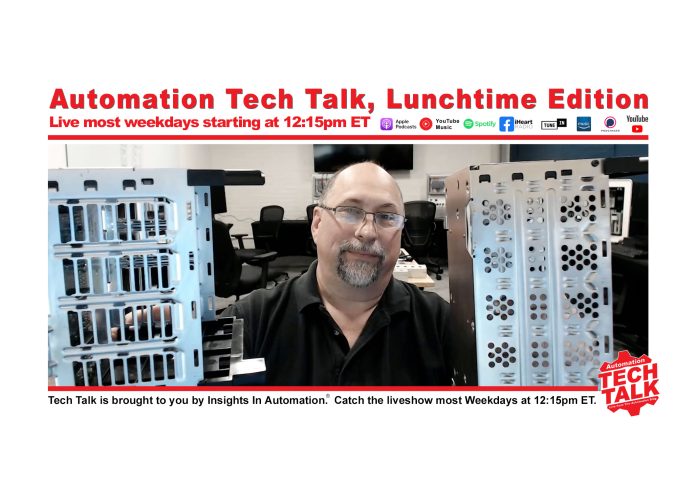
But in any case, you know, when when Rocco was releasing new chassis, they decided to increase the venting. So, again, just for comparison, here is the series b chassis. Okay? Right. And let’s see if I can hold these both up.

I haven’t practiced this. I it’s just lunchtime. And, look at the series c chassis. So I picked this up from my home studio. I had to drop a $110 on it, but, hey.

You know, now that I got it, I got it. Right? Look at the difference of the amount of airflow you can get through that baby. Okay? And now they say and I I you know, I didn’t test it.

I’m not consumer reports. I don’t have heat cycling ovens and all kinds of strain gauges and stuff that, you know, I could test this, but they say it’s just as strong as the other one. Right? I gotta be careful not to break it. I don’t wanna have to buy another one.

But, in any case, it’s a lot more venting. Right? And it makes sense because these newer products generate a lot more heat because it’s just the chipsets are in there. Now I thought it’d be fun, though, to let’s let’s see what Rockwell officially says about these new chassis. So now we’ll go back over to the stage here, and, I am logged in.

This is a free I do not have a tech connect. I don’t, like, need all the tech support they offer. So I had one a long time ago, but I let it expire because, well, I’m self employed. But in any case, I haven’t needed to call them. So here, this is a tech note I found just right before coming on.

I just typed in ControlLogic series c’s chassis. Boom. Came right up. I I love the simplicity of their and the ease of use of their knowledge base. I really do.

But in any case many companies have good knowledge bases. Those who don’t should look at the people who do because it it does make a difference from the user perspective. In any case, they say, hey. Series c, direct replacement for series b, and then they have a nice little story in here. So the difference is the ventilation, alright, the knockout pattern in the sheet metal for the convection airflow.

While the design team was making the sheet metal changes, they took the opportunity to incorporate a few other mechanical and physical enhancements, that have been received in the past. Improve card guide. Now I haven’t compared the two, but I can tell you sometimes those old chassis, the the guides were sticky, and it was very annoying because you’re spending a lot of money for something you want that card to slide in and out. New additional optional mounting hole for high shock vibrate slash vibration environments. That’s always good.

Improved ventilation for future high performance modules. I think somebody at Rocco told me they were getting to the point where you’re gonna have to start derating. These things were generating so much heat. They would have to start derating the you know, you know, a lot of companies do 20, you know, zero to 50 c or zero to 60 c without getting into the extreme products. So, but, yeah, they with with the they needed more airflow to avoid that derating.

So saying, hey. You only can go to 40 c or whatnot. What else do they have here? Improved stiffer mounting tab. I don’t know, I don’t know what what we’re talking about here.

The plastic seem the same. Maybe it’s the, maybe it’s the, the ears, the mounting ears here. I don’t know if they feel stiffer. Just trying it out now. Trying it out live.

They they feel the same. So I don’t know. I don’t know what I don’t know what that is. Because if somebody from Rock was wanting watching and you wanna join, join, let me know. New additional grounding screwed.

Is there a another grounding screw? Oh, yeah. There’s two now. Let me go back to full screen here. I didn’t notice that.

Full screen. Okay. So there is now two. I don’t know if this is coming out well on the camera. One, two.

Whereas before, there was only just the one. So, you know, two’s better than one. I mean, I I don’t know what that cost them to do that, but I’m thinking probably less than a buck of chassis when I don’t know. They sell for a lot new. I mean so you think that if people want it, give it to them.

Okay. So let’s go back to here. Please note, the series c’s chassis will carry all the same certifications as series b. Temper temperature ratings improved from zero to 60 to minus 25 to 60. You wonder I I I don’t wanna think the additional airflow would allow you to go cooler.

Right? Maybe I’m wrong. Maybe the additional the additional, no. It has to be something else. I don’t know.

You guys tell me. What do you think? Why can it go cooler now? Nonoperational shock will decrease from 50 g from 50 g to 30 g. Interesting.

Interesting changes. So, yeah, that’s it. Let’s see what techno this was. This was QA twenty three six eighty five. And so that is what I learned new today.

Actually, I knew about this back. I think it it happened back in 2015. And, you know, I think the the cool thing was that, you know, they told us ahead of time, it’s a 100% direct replacement except for this the the storage fee, I guess. But, I just wanted to share that with you because I finally got one in for the, for the home studio for those snow days or any other days that, you know, the car breaks down, or something else, I can still film out there at the home studio. So I’ve take actually taken a couple of the cameras out of Studio A, which I’m just using Studio B now, and, and bringing those home as well.

So, in any case, so that’s what I had. Now I’m looking over at the chat here. I want I wanna thank everybody who joined, by the way, and who watched. I’m not seeing anybody in the chat. So I think with that, what do we got coming?

Last yesterday, we had the PROFINA episode. I edited it yesterday. You know, I have you have to watch it a couple more times to edit it, and I really thought it was good. I really enjoyed it. They do have free seminars coming up, so keep that in mind.

Also, free IO Link seminars coming up, and the the episode I’m recording this afternoon is on IO Link. So pretty excited about that. Very popular product. I can’t wait to add some IO Link lessons to my courses, but, you know, everything has to everything comes in its own time. But I do have plenty of IO Link products here, and I have some IO Link shows coming out as well.

But with no questions, I think I’m gonna go get ready for my meeting. I wanna wish you guys all good health and happiness. I think tomorrow, I’m going to release, my interview with Giovanni for the lunchtime, show. So it’s about a thirty minute inter interview, and I had a lot of fun talking to Giovanni. And, again, if any of you wanna come on the show and hang out with me for a half an hour or forty five minutes during lunchtime, just get into contact with me.

But I’m gonna keep today’s show a little bit shorter because I have to run to another meeting. But with that, I wanna wish you all good health and happiness again. Until next time, my friends. Peace.


If you have any questions about Shawn’s in-person or online courses, please don’t hesitate to setup a time to meet with Shawn via MSTeams, or drop him an email using his contact form here: https://theautomationschool.com/question/


Until next time, Peace ✌️ 

If you enjoyed this content, please give it a Like, and consider Sharing a link to it as that is the best way for us to grow our audience, which in turn allows us to produce more content 🙂

Shawn M Tierney
Technology Enthusiast & Content Creator

Support our work and gain access to hundreds members only articles and videos by becoming a member at The Automation Blog or on YouTube. You’ll also find all of my affordable PLC, HMI, and SCADA courses at TheAutomationSchool.com.

Shawn Tierney

(no views)

Ethernet/IP vs PROFINET: Automation Tech Talk for August 13, 2025

Let’s talk about Ethernet/IP versus PROFINET in today’s Automation Tech Talk, Lunchtime Edition:


Watch Automation Tech Talk on The Automation Blog:


Listen to Automation Tech Talk on The Automation Blog:


Automation Tech Talk Show Notes:

Thanks for listening! If you’d like to join the show sometime, don’t hesitate to use the contact us link.


Read the transcript on The Automation Blog: (automatically generated)

Shawn Tierney (Host): Hey, everybody. Happy lunchtime. It is Shawn from Insights and Automation. I wanna welcome everybody who’s tuning in. Thank you for joining me.

Really wanna make these lunchtime sessions of the automation tech talk show, collaborative. So, please feel free to post questions or comments. For some reason, StreamYard has not taken those from LinkedIn, so my apologies. I don’t know why. But in any case, maybe, if somebody could do a test post there, it says can’t post comments to LinkedIn, so maybe I still can read them.

Who knows? In any case, I hope you’re having a great lunch. I’m giving myself thirty minutes to get ready for these things, and then, like, I was editing to this afternoon’s podcast, and I’m like, oh, I gotta hurry up and get over here. But I put together a little, presentation just to talk about, you know, Ethernet IP versus PROFINET. Right?

And so before we get into that, again, if you’re having problems hearing me or anything like that, it looks like everything’s working on my side. And and by the way, today, I’m coming to you from my office. It’s not very clean, but this is where the work gets done when I’m not in the studio or in the training room. But in any case, so, let me put some things out there. So as somebody who’s used Ethernet IP well since it came out.

Right? So, you know, we were back in the days in Data Hour plus and remote IO, and some people call it Rio. And I was like, Rio is a city. Call it remote IO or r I o. But in the case, that’s how my weird brain works.

Hey. Thank you, Emmanuel. Really appreciate it. It’s good to see you again. Great.

It’s been a while since we talked. So in any case, you know, one of the thing these vendors have done is made these things easy to implement in their products. And I gotta say, like all the major vendors I’ve used, they put that first in their thought process, at least from my perspective. And I can go into that programming software. I can add things on their network, and it works.

So and there’s a lot that goes on under the under the scenes behind the scenes in the software that makes that all work so well. I know with Ethan IP early on, we had the whole, you know, unicast with versus multicast. Everything was multicast. Some of you younger folks won’t even know what I’m talking about, but we had to run around saying, use a use a switch with IGMP snooping. Use a switch with IGMP snooping.

And then it was IG snooping and querying. And it’s like, but in any case, that’s all going away now with Unicast support. And, again, if you guys if I say something wrong, I’m just going off the cuff here. It’s just lunchtime, so let me know. But, long story short, you know, I use both, both networks in the house here with just commercial switches.

They run great. Of course, you wanna use industrial switches in an industrial environment. And I think most of you have the same the same experience with that. So, what I wanna do is kinda, like, take a look at them now. The one of the reasons I’m doing this today is I’m editing.

I’m not quite done. It takes about three hours to edit these shows and publish them. But I’m just at the final steps of editing today’s podcast, which will be on Profinet. And I thought, man, the this, this guy had some great slides, so I wanted to compare him to the slides I typically use for Ethan IP or at least one slide, which is, really based on a Rockwell slide that they were giving away for years and years and years. So without further ado, let’s go ahead and take that look at that slide.

And here you can see that it’s not showing the right thing. It’s supposed to be showing PowerPoint full screen. So let me fix that really quick. You know, I’m still getting used to let’s see here. Share screen.

Share window. Let’s share the full screen window. I’ve yeah. I haven’t used StreamYard in a few months, and they’ve changed it around quite a bit. So, yeah, that should be better.

Here we go. Somebody’s asking, hey. Before you go any further, can you explain unicast versus multicast? Yeah. Great question.

Now it’s not showing me your name, so I apologize. It’s a StreamYard issue. But multicast, basically, you send them you put the your information on the wire, and then those people who want it can grab it. But what happens is and I know for some of you, you’re probably rolling your eyes, Shawn, why are you talking about this stuff? But somebody asked about it.

So in any case, what happened is for the switch to route those pack typically, our standard switch routes packets based on the IP address. Right? The MAC address. Right? So it makes a list of and I won’t go into good gory details.

Let me try to keep this verbiage very simple. The the switch typically for IP addresses, right, will keep a list of what MAC addresses on what, port. Okay? So it knows that PLC number one at one nine two one six eight one dot one is on port one and maybe a PLC number three on port three and it’s dot three and so on. And so it can’t do that it can’t do that with multicast packets.

You need INGP snooping. In other words, you can open the packet, see which INGP group it belongs to, and querying so it can ask people what group they belong to to be able to route those packets. So in essence, if you use that if you use the multicast with a standard switch, it’s like turning that switch to a hub, and every message goes to every port. And we had a lot of people call up and say, hey. All my devices on my network has stopped stopped working because they’ve gone off hook because they’re getting a lot of messages that don’t belong to them.

So I hope I did that justice. Unicast is now the message is sent just to the person who needs it. It’s not broadcast to the whole network. There’s ups and downs about that, but that’s what I’m not what I’m here talking about. If you guys wanna see me talk about that in a future episode, I’d be happy to.

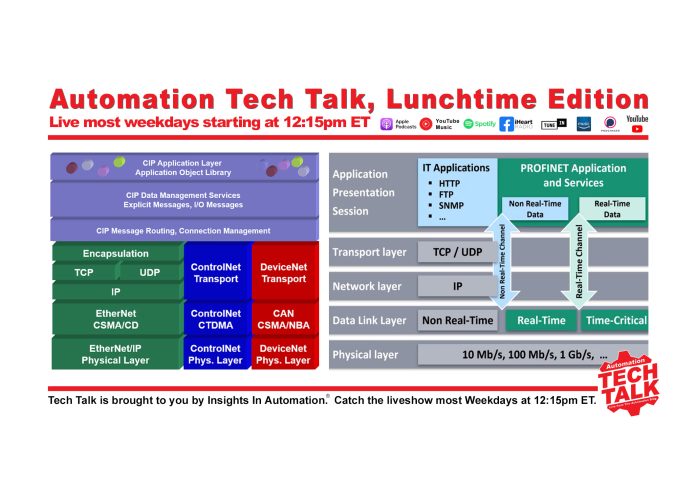
If you guys think I made that too simple of a description, let me know that as well. So in any case, here we are in, back in PowerPoint, and this is your typical layers. Right? So you have your OSI as, seven layer network model, and this is actually comparing this is for common industrial protocol. So this is comparing, Ethernet IP, ControlNet, and DeviceNet.

So you can see, you know, we have on the very lower end here down the the green area, we have the physical Sabrina’s Ethernet. So we have the physical media, bits and bytes. We have data links, frames, MACs, LLC. We have packets, path, IP addresses. So all of this, you know, if we think about that OSI seven layer network model, that’s that’s nothing to do with Rockwell or Siemens.

That’s just part of network design. And then we have, of course, the application layer. This is can be split into in the OSI model, application presentation and session layers. With, Rockwell. We’re just talking about the application layer.

Okay. So I thought this is a very interesting, slide, that kinda shows you how you can do the, seamless bridging or routing between Ethernet IP, control net, and device net. You can go in and out one or the other. You don’t have to do any, you know a matter of fact, we were kinda debating I should shouldn’t say debating this, but, I was trying to give people some insight on this last month or two months ago on LinkedIn. It’s like, look, When the 1756 ControlLogic stuff started coming out, we didn’t have any POCs.

And we were selling the racks with a data plus card and an Ethernet card so you could and it was a DHRO card. So you could seamlessly bridge between the two. And I don’t know how many plants I’ve been to, even, like, metal stamping plants where they’ll have one Ethernet card and a whole bunch of DHRIO cards so they could go Ethernet to all their their Data Highway pluses. And so not that Data Highway Plus supports CIP, but that kinda you know, when when you would do a control or a device that you could just go out Ethernet and go to those other devices and boom, everything worked. You didn’t have to set up a router like a k f two or a k e card if any of you guys have used those.

But in any case, and that’s kind of what you see when you use your USB cable with a with a Compact or ControlLogix or with the network cards. Those were added to the network cards after a while. You get that seamless bridging and routing. So that is the Rockwell side of the fence. Okay?

And I just thought, look at how similar it is to PROFINET. Now, again, different vendors, different formats of slides. And Tom from PI is gonna go through this in lots and lots more detail that I’m gonna cover here at lunch, when that releases, probably at 03:30 today if I finish it on time. I also am waiting for a trade show demo to show up for one of my, sponsors, so I may have to run out in the middle of the show and go let them in. But in any case, take a look at this.

We have the same OSI seven layer, network, model. Right? And you can see all these are the same things. Right? This is all the same.

But over here, now we have the PROFIDAT. You see how it lays right on top of that, you know, Ethernet. Right? And I just think it’s so cool. This is what makes Ethernet so cool is that so you know, it’s not a locked down network.

It’s an open network. Anybody can use it. Right? And so you can see they have their non real time data and their real time data. And in real time data, there’s also time critical data.

Right? And so you’ll notice, right, and and I’m not gonna go into this in great detail, but, you’ll notice, right, that, you know, time goes through this. What’s non real time? Anything a hundred milliseconds or unscheduled, real time, one to ten milliseconds. This is this is the PROFINET view, And then time critical, less than a millisecond.

Right? You see motion control. And in the Rockwell world, we often would talk about SIP sync, SIP motion, all these different pieces of SIP again. I’ll repeat what I said yesterday. I invited the Ethernet IP people on, and they said, we don’t like you.

So, well, that’s showing the conversation a little bit. But in any case, now I’m I’m joking about that they don’t like you. It’s like they just didn’t see value in coming on the show. So, and and I said, fine. We won’t have you.

In any case, there you know, there’s all these things in the SIP protocol that talks about that. Now if you look over here, though, what I thought was very interesting in here so I’ve always told my students, you know, there’s RT, real time communications, and then there’s IRT. Right? And IRT, you’re not gonna find in those old, I shouldn’t say old, Gen one s seven twelve hundreds, at least if I’m remembering my the the lessons I teach my students. So, that’s one of the reasons why you wanna go to an s seven fifteen hundred.

You get a lot of IRT connections. Right? And depending on the model you get, you know, very similar to what you’re here with Rockwell, you get so many connections. And they have different names for it, but in any case, I I go over those charts in my course, s seven course. But, you know, time critical.

This is important. And then he actually talked about TSN as well, and I know Siemens is doing a lot. I don’t know if Rock was doing anything with TSN. But time sensitive networks really is kinda maybe the next generation. Maybe that’s one way of talking about real time data.

It’s it’s a new spec that’s designed to allow you to go well into the future with, you know, high speed communications. And I just think it’s so interesting. I know the folks in Mitsubishi and a lot of people in the Asia a lot of Asia manufacturers have jumped on that quickly. You see the, I I what is it? IE Link TSN, you see that advertised a lot.

Right? And, you know, we haven’t had Mitsubishi on this show probably in ten years, but I would love to get him back on, maybe seven years. So, always been a big fan of their what they do. But in any case, so from there, I wanted to show you this chart too. Again, Tom’s gonna go through this in gory detail, but I thought it would be something fun to talk about because, of course, he doesn’t relate it to Rockwell.

So I thought it would be fun to talk about and show you some of his slides, give you a little glimpse of what’s coming on coming out at 03:30. I think the podcast is about forty five minutes. He also has a bunch of free one hands on lessons, hands on training dates coming up, all around the country, so you guys may be interested in that. And so, you can see here real time PROFINET IRT and TSN all compared. Right?

And so very, very interesting. And and, the I’d from my understanding too is because PROFINET over TSN will be able to use off the shelf chips, then it’s gonna, make a lot more products capable of doing PROFINET over TSN, which will give you the the speeds faster than IRT. Right? You know? So very interesting stuff.

And let me go back to the comments. I don’t have any new comments there. So that’s what I wanted to talk today at lunchtime. I wanted to get you guys thoughts and opinions on that, but I thought it was really interesting comparing PROFINET to, you know, if we look at this slide and then comparing it to, Ethernet IP. It just we’re we live in such a great day and age where we’re using something open like Ethernet for everything.

And every you know, back when I get started back in 1990, it cost probably I’m gonna guess here because I didn’t look it up. $2, $2,000 to add a network card, like a DataWay plus network card DataWay plus network card to your computer. Right? And, you know, now every computer has even a built in, so it’s like, yeah. That’s awesome.

So So that’s what I have for you today. Let’s talk about what else is going on. I do have, a new, episode of the Automation Museum Show. So we’re still only about 7% in that fundraiser. And, again, there’s no rush.

I mean, this is something I wanna do. I wanna I wanna preserve the history of automation, industrial automation. So we also are recording our first Automation Museum podcast this weekend because this is all nonprofit, so we’re doing it on the weekend. I’m interviewing me and Jeremy are interviewing a person who actually wrote a book on the history of Wonderware and, Triconics, I believe, if I got that right. So, things I’m not that familiar although I’m very familiar with Wonderware.

I’ve used it a little bit, but so many of you guys out there over the years have shown me your your awesome InTouch projects. But in any case, this is gonna be a lot of fun. And then in two weeks after that, we’ll have another episode where I interview where we interviewed Jeremy about, you know, his thoughts of the evolution of Rockwell POCs starting at the 1774. So and we’re doing this totally to try to get this nonprofit up and running. You guys have sent me a lot of equipment over the years that I wanna give on your behalf to the Automation Museum, and we wanna preserve that knowledge like the PCMK card.

I have such vivid memories of helping people get their PCMK cards up and running. Right? And, it came to a point now this is back in the days of DOS. Okay? And if you never used DOS, then don’t start now.

So any case, we used to have to worry about TSRs and memory management and, you know, we get so frustrated because everybody wanted that mouse utility, that palm pilot utility. They had, like, PC tools. They wanted, like, 14 utilities running in the same, you know, 600 k of memory or whatever it was. Right? And, eventually, I just started hitting on boot disk because I’m like, dude.

They’re like, how come you didn’t get every all of my 28 software packages running on boot? I’m like, look. It’s just, you know, physics. Right? It’s there’s no way to cram those in.

So boot off this disk and have a have a nice day. But, yeah, good good memories and then Windows 95 and all that too. So, that’s what the automation museum is all about. Thank you to everybody who’s already given over at the automationmuseum.org, which sends you to give Send Go. And, thank you for everybody who sent in the hardware.

I’m gonna try to cover those every couple of weeks, the stuff that’s come in just as to help with the fundraiser to raise the the money. We the first thing we gotta do is get the the nonprofit set up. The, what else do we have? So we have the podcast coming out today, PROFINET. Next week, I think I don’t know if I can pull this off, but I’m thinking next week might be IO Link.

So I would love to do that next week. I have a trade show demo coming in from a vendor so I can cover their products. Very cool. What else do we got coming up? If you’re in my courses at the automation school, yeah, I should mention this.

Updates a lot of updates coming out. If you are have been holding off purchasing something, I looked at my, P and L profit and loss, and I gotta raise prices. I it kills me to do this, but if I don’t, the company’s gonna run negative. So instead of closing down shop because I don’t wanna raise prices, I gotta raise prices to match the prices I’m being charged. So, again, I took a big hit taking this job, but, I’m doing it because I love you guys, and I wanna make sure I can share all my knowledge with you.

So in any case, if you if you’re looking at a course at the automation school or a bundle on upgrade, if you do it before the December, you’ll get the 2020 prices. Otherwise, you’ll get the 2025 prices. And, you know, like we talked yesterday, POCs that were two fifty ten days ago are now 400, and that’s just life. You know? And it stinks, but in any case, doesn’t affect anybody who has, of course.

You’re getting new lessons too. I’m putting new lessons in. I got five new lessons I hope to release today. I’m just finished editing the last one, but I gotta do the pod today’s podcast first. And there’s so much other stuff going on here.

You know, I’ll try to think of more things for tomorrow’s show. I haven’t eaten my lunch yet, so we’re coming up on that twenty minute mark. So I just wanna thank you all for tuning in. If you wanna come on the show and chat with me during lunchtime for twenty or thirty minutes, let me know. Get in contact with me, LinkedIn, YouTube, any way you can, automationblog.com.

I’m also trying to publish these with a really nice so I paid for the extra service to get really nice transcripts. So if you’re a morning person and you’re like, I don’t wanna listen to somebody. I just wanna read because that’s me every morning. I won’t do anything any video because in the morning, I’m like, I want more like, I don’t wanna I just wanna read. So I’m signed to post the transcripts over there.

It cost me a little extra money, but, for those morning people who wanna read read the show and not watch the show, that you’ll find that at the automation blog as well. Much better transcripts, I think, than what you get from, like, a YouTube because they give you, like, time stamp in one sentence time stamp sentence. And this is more like it does not that it’s perfect, but it does a better job, I think. And with that, I’m just gonna wish you guys an awesome lunch. I’m gonna go eat mine.

I wanna wish you all good health and happiness, and until next time, my friends. Peace.


If you have any questions about Shawn’s in-person or online courses, please don’t hesitate to setup a time to meet with Shawn via MSTeams, or drop him an email using his contact form here: https://theautomationschool.com/question/


Until next time, Peace ✌️ 

If you enjoyed this content, please give it a Like, and consider Sharing a link to it as that is the best way for us to grow our audience, which in turn allows us to produce more content 🙂

Shawn M Tierney
Technology Enthusiast & Content Creator

Support our work and gain access to hundreds members only articles and videos by becoming a member at The Automation Blog or on YouTube. You’ll also find all of my affordable PLC, HMI, and SCADA courses at TheAutomationSchool.com.

Shawn Tierney

(no views)

PROFINET and System Redundancy (P244)

Shawn Tierney meets up with Tom Weingartner of PI (Profibus Profinet International) to learn about PROFINET and System Redundancy in this episode of The Automation Podcast.

For any links related to this episode, check out the “Show Notes” located below the video.


Watch The Automation Podcast from The Automation Blog:


Listen to The Automation Podcast from The Automation Blog:


The Automation Podcast, Episode 244 Show Notes:

Special thanks to Tom Weingartner for coming on the show, and to Siemens for sponsoring this episode so we could release it ad free on all platforms! To learn more PROFINET, see the below links:


Read the transcript on The Automation Blog: (automatically generated)

Shawn Tierney (Host): Welcome back to the automation podcast. My name is Shawn Tierney from Insights and Automation, and I wanna thank you for tuning back in this week. Now on this show, I actually had the opportunity to sit down with Thomas Weingoner from PI to learn all about PROFINET. I actually reached out to him because I had some product vendors who wanted me to cover their s two features in their products, and I thought it would be first it’d be better to actually sit down and get a refresh on what s two is. It’s been five years since we’ve had a PROFINET expert on, so I figured now would be a good time before we start getting into how those features are used in different products.

So with that said, I also wanna mention that Siemens has sponsored the episode, so it will be completely ad free. I love it when vendor sponsor the shows. Not only do we get the breakeven on the show itself, we also get to release it ad free and make the video free as well. So thank you, Siemens. If you see anybody from Siemens, thank them for sponsoring the Automation Podcast.

As a matter of fact, thank any vendor who’s ever sponsored any of our shows. We really appreciate them. One final PSA that I wanna throw out there is that, speaking like I talked about this yesterday on my show, Automation Tech Talk, As we’ve seen with the Ethernet POCs we’re talking about, a lot of micro POCs that were $250 ten years ago are now $400. Right? That’s a lot of inflation, right, for various reasons.

Right? And so one of the things I did this summer is I took a look at my P and L, my pros profit and loss statements, and I just can’t hold my prices where they are and be profitable. Right? So if I’m not breaking even, the company goes out of business, and we’ll have no more episodes of the show. So how does this affect you?

If you are a student over at the automation school, you have until mid September to do any upgrades or purchase any, courses at the 2020 prices. Alright? So I I don’t wanna raise the prices. I’ve tried as long as I can, but at some point, you have to give in to what the prices are that your vendors are charging you, and you have to raise the prices. So, all my courses are buy one, sell them forever, so this does not affect anybody who’s enrolled in a course.

Actually, all of you folks rolled in my PLC courses, I see it updates every week now. So and those who get the ultimate bundles, you’re seeing new lessons added to the new courses because you get that preorder access plus some additional stuff. So in any case but, again, I wanna reiterate, if you’re a vendor who has an old balance or if you are a student who wants to buy a new course, please, make your plans in the next couple of weeks because in mid September, I do have to raise the prices. So I just wanna throw that PSA out there. I know a lot of people don’t get to the end of the show.

That’s what I wanted to do at the beginning. So with that said, let’s jump right into this week’s podcast and learn all about Profinet. I wanna welcome to the show, Tom from Profibus, Profinet North America. Tom, I really wanna just thank you for coming on the show. I reached out to you to ask about ask you to come on to to talk to us about this topic.

But before we jump in, could you, first tell the audience a little bit about yourself?

Tom Weingartner (PI): Yeah. Sure. Absolutely, Shawn. I’m gonna jump to the next slide then and and let everyone know. As Shawn said, my name is Tom, Tom Weingartner, and I am the technical marketing director at PI North America.

I have a fairly broad set of experiences ranging from ASIC hardware and software design, and and then I’ve moved into things like, avionic systems design. But it seemed like no no matter what I was working on, it it always centered around communication and control. That’s actually how I got into industrial Ethernet, and I branched out into, you know, from protocols like MIL standard fifteen fifty three and and airing four twenty nine to other serial based protocols like PROFIBUS and MODBUS. And, of course, that naturally led to PROFINET and the other Ethernet based protocols. I I also spent quite a few years developing time sensitive networking solutions.

But now I focus specifically on PROFINET and its related technologies. And so with that, I will jump into the the presentation here. And and, now that you know a little bit about me, let let me tell you a little bit about our organization. We are PROFIBUS and PROFINET International or PI for short. We are the global organization that created PROFIBUS and PROFINET, and we continue to maintain and promote these open communication standards.

The organization started back in 1989 with PROFIBUS, followed by PROFINET in the early two thousands. Next came IO Link, a communication technology for the last meter, and that was followed by OmLux, a communication technology for wireless location tracking. And now, most recently, MTP or module type package. And this is a communication technology for easier, more flexible integration of process automation equipment. Now we have grown worldwide to 24 regional PI associations, 57 competent centers, eight test labs, and 31 training centers.

It’s important to remember that we are a global organization because if you’re a global manufacturer, chances are there’s PROFINET support in the country in which you’re located, and you can get that support in the country’s native language. In the, lower right part of the slide here, we are showing our technologies under the PI umbrella. And I really wanted to point out that these, these technologies all the technologies within PI umbrella are supported by a set of working groups. And these working groups are made up of participants from member companies, and they are the ones that actually create and update the various standards and specifications. Also, any of these working groups are open to any member company.

So, PI North America is one of the 24 regional PI associations, and we were founded in 1994. We are a nonprofit member supported organization where we think globally and act locally. So here in North America, we are supported by our local competence centers, training centers, and test labs. And and competence centers, provide technical support for things like protocol, interoperability, and installation type questions. Training centers provide educational services for things like training courses and hands on lab work.

And test labs are, well, just that. They are labs that provide testing services and device certification. So any member company can be any combination of these three. You can see here if you’re looking at the slide, that the Profi interface center is all three, where we have JCOM Automation is both a competent center and a training center. And here in North in North America, we are pleased to have HMS as a training center and Phoenix Contact also as a competent center.

Now one thing I would like to point out to everyone is that what you should be aware of is that every PROFINET, device must be certified. So if you make a PROFINET device, you need to go to a test lab to get it certified. And here in North America, you certify devices at the PROFINETERFACE center. So I think it’s important to begin our discussion today by talking about the impact digital transformation has had on factory networks. There has been an explosion of devices in manufacturing facilities, and it’s not uncommon for car manufacturers to have over 50,000 Ethernet nodes in just one of their factories.

Large production cells can have over a thousand Ethernet nodes in them. But the point is is that all of these nodes increase the amount of traffic automation devices must handle. It’s not unrealistic for a device to have to deal with over 2,000 messages while it’s operating, while it’s trying to do its job. And emerging technologies like automated guided vehicles add a level of dynamics to the network architecture because they’re constantly entering and leaving various production cells located in different areas of the factory. And, of course, as these factories become more and more flexible, networks must support adding and removing devices while the factory is operating.

And so in response to this digital transformation, we have gone from rigid hierarchical systems using field buses to industrial Ethernet based networks where any device can be connected to any other device. This means devices at the field level can be connected to devices at the process control level, the production level, even even the operations level and above. But this doesn’t mean that the requirements for determinism, redundancy, safety, and security are any less on a converged network. It means you need to have a network technology that supports these requirements, and this is where PROFINET comes in. So to understand PROFINET, I I think it’s instructive here to start with the OSI model since the OSI model defines networking.

And, of course, PROFINET is a networking technology. The OSI model is divided into seven layers as I’m sure we are all familiar with by now, starting with the physical layer. And this is where we get access to the wire, internal electrical signals into bits. Layer two is the data link layer, and this is where we turn bits into bytes that make up an Ethernet frame. Layer three is the network layer, and this is where we turn Ethernet frames into IP packets.

So I like to think about Ethernet frames being switched around a local area network, and IP packets being routed around a wide area network like the Internet. And so the next layer up is the transport layer, and this is where we turn IP packets into TCP or UDP datagrams. These datagrams are used based on the type of connection needed to route IP packets. TCP datagrams are connection based, and UDP datagrams are connectionless. But, really, regardless of the type of connection, we typically go straight up to layer seven, the application layer.

And this is where PROFINET lives, along with all the other Ethernet based protocols you may be familiar with, like HTTP, FTP, SNMP, and and so on. So then what exactly is PROFINET, and and what challenges is it trying to overcome? The most obvious challenge is environmental. We need to operate in a wide range of harsh environments, and, obviously, we need to be deterministic, meaning we need to guarantee data delivery. But we have to do this in the presence of IT traffic or non real time applications like web servers.

We also can’t operate in a vacuum. We need to operate in a local area network and support getting data to wide area networks and up into the cloud. And so to overcome these challenges, PROFINET uses communication channels for speed and determinism. It uses standard unmodified Ethernet, so multiple protocols can coexist on the same wire. We didn’t have this with field buses.

Right? It was one protocol, one wire. But most importantly, PROFINET is an OT protocol running at the application layer so that it can maintain real time data exchange, provide alarms and diagnostics to keep automation equipment running, and support topologies for reliable communication. So we can think of PROFINET as separating traffic into a real time channel and a non real time channel. That mess messages with a particular ether type that’s actually eighty eight ninety two, and the number doesn’t matter.

But the point here is that the the the real time channel, is is where all PROFINET messages with that ether type go into. And any other ether type, they go into the non real time channel. So we use the non real time channel for acyclic data exchange, and we use the real time channel for cyclic data exchange. So cyclic data exchange with synchronization, we we classify this as time critical. And without synchronization, it is classified as real time.

But, really, the point here is that this is how we can use the same standard unmodified Ethernet for PROFINET as we can for any other IT protocol. All messages living together, coexisting on the same wire. So we take this a step further here and and look at the real time channel and and the non real time channel, and and these are combined together into a concept that we call an application relation. So think of an application relation as a network connection for doing both acyclic and cyclic data exchange, and we do this between controllers and devices. This network connection consists of three different types of information to be exchanged, and we call these types of information communication relations.

So on the lower left part of the slide, you can see here that we have something called a a record data communication relation, and it’s essentially the non real time channel for acyclic data exchange to pass information like configuration, security, and diagnostics. The IO data communication relation is part of the real time channel for doing this cyclic data exchange that we need to do to periodically update controller and device IO data. And finally, we have the alarm communication relation. So this is also part of the real time channel, because, what we need to do here is it it’s used for alerting the controller to device false as soon as they occur or when they get resolved. Now on the right part of the slide, is we can see some use cases for, application relations, and and these use cases are are either a single application relations for controller to device communication, and we have an optional application relation here for doing dynamic reconfiguration.

We also use an application relation for something we call shared device, and, of course, why we are here today and talking about applications relations is actually because of system redundancy. And so we’ll get, into these use cases in more detail here in a moment. But first, I wanted to point out that when we talk about messages being non real time, real time, or time critical, what we’re really doing is specifying a level of network performance. Non real time performance has cycle times above one hundred milliseconds, but we also use this term to indicate that a message may have no cycle time at all. In other words, acyclic data exchange.

Real time performance has cycle times in the one to ten millisecond range, but really that range can extend up to one hundred milliseconds. So time critical performance has cycle times less than a millisecond, and it’s not uncommon to have cycle times around two hundred and fifty microseconds or less. Most applications are either real time or non real time, while high performance applications are considered time critical. These applications use time synchronization to guarantee data arrives exactly when needed, but we also must ensure that the network is open to any Ethernet traffic. So in order to achieve time critical performance here, and we do this for the most demanding applications like high speed motion control.

And so what we did is we added four features to basic PROFINET here, and and we call this PROFINET ISOCRANESS real time or PROFINET IRT. These added features are synchronization, node arrival time, scheduling, and time critical domains. Now IRT has been around since 02/2004, but in the future, PROFINET will move to a new set of I triple e Ethernet standards called time sensitive networking or TSN. PROFINET over TSN will actually have the same functionality and performance as PROFINET IRT, but we’ll be able to scale to faster and faster, networks and and as bandwidth is is increasing. So this chart shows the differences between PROFINET, RT, IRT, and TSN.

And the main difference is, obviously, synchronization. And these other features that, guarantee data arrives exactly when needed. Notice in in the under the, PROFINET IRT column here that that, the bandwidth for PROFINET IRT is a 100 mil a 100 megabits per second. And the bandwidth for PROFINET RT and TSN are scalable. Also, for those device manufacturers out there looking to add PROFINET IRT to their products, there are lots of ASICs and other solutions available in the market with IRT capability.

Alright. So let’s take a minute here to summarize all of this. We have a a single infrastructure for doing real time data exchange along with non real time information exchange. PROFINET uses the same infrastructure as any Ethernet network. Machines that speak PROFINET do so, using network connections called application relations, and these messages coexist with all other messages so information can pass from devices to machines, to factories, to the cloud, and back.

And so if you take away nothing else from this podcast today, it is the word coexistence. PROFINET coexists with all other protocols on the wire. So let’s start talking a little bit here about the main topic, system redundancy and and and why we got into talking about PROFINET at all. Right? I mean, what why do we need system redundancy and things like like, application relations and dynamic reconfiguration?

Well, it’s because one of the things we’re pretty proud of with PROFINET is not only the depth of its capabilities, but also the breadth of its capabilities. And with the lines blurring between what’s factory automation, what’s process automation, and what’s motion control, we are seeing all three types of automation appearing in a single installation. So we wanna make sure PROFINET meets requirements across the entire range of industrial automation. So let’s start out here by looking at the differences between process automation versus factory automation, and then we’ll get into the details. First off, process signals typically change slower on the order of hundreds of milliseconds versus tens of milliseconds in factory automation.

And process signals often need to travel longer distances and potentially into hazardous or explosive areas. Now with process plants operating twenty four seven, three sixty five, system must systems must provide high availability and support changes while the plant is in production. This is where system redundancy and dynamic reconfiguration come in. We’ll discuss these again here in in just a minute. I just wanted to finish off this slide with saying that an estop is usually not possible because while you can turn off the automation, that’s not necessarily gonna stop the chemical reaction or whatever from proceeding.

Sensors and actuators and process automation are also more complex. Typically, we call them field instruments. And process plants have many, many, many more IO, tens of thousands of IO, usually controlled by a DCS. And so when we talk about system redundancy, I actually like to call it scalable system redundancy because it isn’t just one thing. This is where we add components to the network for increasing the level of system availability.

So there are four possibilities, s one, s two, and r one, r two. The letter indicates if there are single or redundant network access points, and the number indicates how many application relations are supported by each network access point. So think of the network access point as a physical interface to the network. And from our earlier discussion, think of an application relation as a network connection between a controller and a device. So you have s one has, single network access points.

Right? So each device has single network access points with one application relation connected to one controller. S two is where we also have single network access points, but with two application relations now connected to different controllers. R one is where we have redundant network access points, but each one of these redundant network access points only has one application relation, but those are connected to different controllers. And finally, we could kinda go over the top here with r two, and and here’s where we have redundant network access points with two application relations connected to different controllers.

Shawn Tierney (Host): You know, I wanna just stop here and talk about s two. And for the people who are listening, which I know is about a quarter of you guys out there, think of s two is you have a primary controller and a secondary controller. If you’re seeing the screen, you can see I’m reading the the slide. But you have your two primary and secondary controllers. Right?

So you have one of each, and, primary controller has the, application one, and secondary has application resource number two. And each device that’s connected on the Ethernet has both the one and two. So you went maybe you have a rack of IO out there. It needs to talk to both the primary controller and the secondary controller. And so to me, that is kinda like your classic redundant PLC system where you have two PLCs and you have a bunch of IO, and each piece of IO has to talk to both the primary and the secondary.

So if the primary goes down, the secondary can take over. And so I think that’s why there’s so much interest in s two because that kinda is that that that classic example. Now, Tom, let me turn it back to you. Would you say I’m right on that? Or

Tom Weingartner (PI): Spot on. I mean, I think it’s great, and and and really kinda emphasizing the point that there’s that one physical connection on the network access point, but now we have two connections in that physical, access point there. Right? So so you can then have one of those connections go to the primary controller and the other one to the secondary controller. And in case one of those controllers fails, the device still can get the information it needs.

So, yep, that that’s how we do that. And and, just a little bit finer point on r one, if you think about it, it’s s two, but now all we’ve done is we’ve split the physical interface. So one of the physical interfaces has has, one of the connections, and the other physical interface has a has the other connection. So you really kinda have, the same level of redundant functionality here, backup functionality with the secondary controller, but here you’re using, multiple physical interfaces.

Shawn Tierney (Host): Now let me ask you about that. So as I look at our one, right, it seems like they connect to port let’s I’ll just call it port one on each device to switch number one, which in this case would be the green switch, and port number two of each device to the switch number two, which is the blue switch. Would that be typical to have separate switches, one a different switch for each port?

Tom Weingartner (PI): It it it doesn’t have to. Right? I I I think we chose to show it like this for simplicity kinda to

Shawn Tierney (Host): Oh, I don’t care.

Tom Weingartner (PI): Emphasize the point that, okay. Here’s the second port going to the secondary controller. Here’s the first port going to the primary controller. And we just wanted to emphasize that point. Because sometimes these these, diagrams can be, a bit confusing.

And you

Shawn Tierney (Host): may have an application that doesn’t require redundant switches depending on the maybe the MTBF of the of the switch itself or your failure mode on your IO. Okay. I’m with you. Go ahead.

Tom Weingartner (PI): Yep. Yep. Good. Good. Good.

Alright. So, I think that’s some excellent detail on that. And so, if you wouldn’t mind or don’t have any other questions, let’s let’s move on to the the, the the next slide. So you can see in that previous slide how system redundancy supports high availability by increasing system availability using these network access points and application relations. But we can also support high availability by using network redundancy.

And the way PROFINET supports network redundancy is through the use of ring topologies, and we call this media redundancy. The reason we use rings is because if a cable breaks or the physical connection, somehow breaks as well or or even a device fails, the network can revert back to a line topology keeping the system operational. However, supporting network redundancy with rings means we can’t use protocols typically used in IT networks like, STP and RSTP. And this is because, STP and RSTP actually prevent network redundancy by blocking redundant paths in order to keep frames from circulating forever in the network. And so in order for PROFINET to support rings, we need a way to prevent frames from circulating forever in the network.

And to do this, we use a protocol called the media redundancy protocol or MRP. MRP uses one media redundancy manager for each ring, and the rest, of the devices are called media redundancy clients. Managers are typically controllers or PROFINET switches, and clients are typically the devices in the network. So the way it works is this. A manager periodically sends test frames, around the network here to check the integrity of the ring.

If the manager doesn’t get the test frame back, there’s a failure somewhere in the ring. And so the manager then notifies the clients about this failure, and then the manager sets the network to operate as a line topology until, the failure is repaired. Right? And so that’s how we can get, network redundancy with our media redundancy protocol. Alright.

So now you you can see how system redundancy and media redundancy both support high availability. System redundancy does this by increasing system availability, Walmart. Media redundancy does this by increasing network availability. Obviously, you can use one without the other, but by combining system redundancy and media redundancy, we can increase the overall system reliability. For example, here we are showing different topologies for s one and s two, and these are similar to the the the topologies that were on the previous slide.

So, if you notice here that, for s one, we can only have media redundancy because there isn’t a secondary controller to provide system redundancy. S two is where we combine system redundancy and media redundancy by adding an MRP ring. But I wanted to point out here that that even though we’re showing this MRP ring as as as a possible topology, there really are other topologies possible. It really depends on the level of of system reliability you’re trying to achieve. And so, likewise, on on this next slide here, we are showing two topologies for adding media redundancy to r one and r two.

And so for r one, we’ve chosen, again, probably for simplistic, simplicity’s sake, we we add an MRP ring for each redundant network access point. With for r two, we do the same thing here. We also have an MRP ring for each redundant network access point, but we also add a third MRP ring for the controllers. Now this is really just to try to emphasize the point that you can, you you can really, come up with just about any topology possible, but it because it really depends on the number of ports on each device and the number of switches in the network and, again, your overall system reliability requirements. So in order to keep process plants operating twenty four seven three sixty five, dynamic reconfiguration is another use case for application relations.

And so this is where we can add or remove devices on the fly while the plant is in production. Because if you think about it, typically, when there is a new configuration for the PLC, the PLC first has to go into stop mode. It needs to then re receive the configuration, and then it can go back into run mode. Well, this doesn’t work in process automation because we’re trying to operate twenty four seven three sixty five. So with dynamic reconfiguration, the controller continues operating with its current application relation while it sets up a new application relation.

Right? I mean, again, it’s it’s really trying to get this a a new network connection established. So then the the the controller then switches over to the new application relation after the new configuration is validated. Once we have this validation and the configuration’s good, the controller removes the old application relations and continues operating all while staying in run mode. Pretty handy pretty handy stuff here for for supporting high availability.

Now one last topic regarding system redundancy and dynamic reconfiguration, because these two PROFINET capabilities are compatible with a new technology called single pair Ethernet, and this provides power and data over just two wires. This version of Ethernet is now part of the I triple e eight zero two dot three standard referred to as 10 base t one l. So 10 base t one l is the non intrinsically saved version of two wire Ethernet. To support intrinsic safety, 10 base t one l was enhanced by an additional standard called Ethernet APL or advanced physical layer. So when we combine PROFINET with this Ethernet APL version of 10 base t one l, we simply call it PROFINET over APL.

It not only provides power and data over the same two wires, but also supports long cable runs up to a kilometer, 10 megabit per second communication speeds, and can be used in all hazardous areas. So intrinsic safety is achieved by ensuring both the Ethernet signals and power on the wire are within explosion safe levels. And even with all this, system redundancy and dynamic reconfiguration work seamlessly with this new technology we call PROFINET over APL. Now one thing I’d like to close with here is a is a final thought regarding a new technology I think I think everyone should become aware of here. I mean, it’s emerging in the market.

It’s it’s quite new, and it’s a technology called MTP or module type package. And so this is a technology being applied first here to, use cases considered to be a hybrid of both process automation and factory automation. So what MTP does is it applies OPC UA information models to create standardized, non proprietary application level descriptions for automation equipment. And so what these descriptions do is they simplify the communication, between equipment and the control system, and it does this by modularizing the process into more manageable pieces. So really, the point is to construct a factory with modular equipment to simplify integration and allow for better flexibility should changes be required.

Now with the help of the process orchestration layer and this OPC UA connectivity, MTP enabled equipment can plug and operate, reducing the time to commission a process or make changes to that process. This is pretty cutting edge stuff. I think you’re gonna find and hear a lot more about NTP in the near future. Alright. So it’s time to wrap things up with a summary of all the resources you can use to learn even more about PROFINET.

One of the things you can do here is you can get access to the PROFINET one day training class slide deck by going to profinet2025.com, entering your email, and downloading the slides in PDF format. And what’s really handy is that all of the links in the PDF are live, so information is just a click away. We also have our website, us.profinet.com. It has white papers, application stories, webinars, and documentation, including access to all of the standards and specifications. This is truly your one stop shop for locating everything about PROFINET.

Now we do our PROFINET one day training classes and IO link workshops all over The US and parts of Canada. So if you are interested in attending one of these, you can always find the next city we are going to by clicking on the training links at the bottom of the slide.

Shawn Tierney (Host): Hey, guys. Shawn here. I just wanted to jump in for a minute for the audio audience to give you that website. It’s us.profinet.com/0dtc or oscardeltatangocharlie. So that’s the website.

And I also went and pulled up the website, which if you’re watching, you can see here. But for those listening, these one day PROFINET courses are coming to Phoenix, Arizona, August 26, Minneapolis, Minnesota, September 10, Newark and New York City, September 25, Greenville, South Carolina, October 7, Detroit, Michigan, October 23, Portland, Oregon, November 4, and Houston, Texas, November 18. So with that said, let’s jump back into the show.

Tom Weingartner (PI): Alan, one of our most popular resources is Profinet University. This website structures information into little courses, and you can proceed through them at your own pace. You can go lesson by lesson, or you can jump around. You can even decide which course to take based on a difficulty tag. Definitely make sure to check out this resource.

We do have lots of great, webinars on on the, on on the website, and they’re archived on the website. Now some of these webinars, they they rehash what we covered today, but in other cases, they expand on what we covered today. But in either case, make sure you share these webinars with your colleagues, especially if they’re interested in any one of the topics that we have listed on the slide. And finally, the certified network engineer course is the next logical step if you would like to dive deeper into the technical details of PROFINET. It is a week long in Johnson City, Tennessee, and it features hands on lab work.

And if you would like us to provide training to eight or more students, we can even come to your site. If you would like more details about any of this, please head to the website to learn more. And with that, Chai, I think that is, my last slide and, covered the topics that I think we wanted some to cover today.

Shawn Tierney (Host): Yeah. And I just wanna point out that to you guys, this, training goes out through all around The US. I definitely recommend getting up there. If you’re using PROFINET and you wanna get some training, they usually fill the room, like, you know, 50 to a 100 people. And, it’s you know, they do this every year.

So check those dates out. If you need to get some hands on with PROFINET, I would definitely check out those. And, of course, we’ll have all the links in the description. I also wanna thank Tom for that slide. Really defining s one versus s two versus r one and r two.

You know, a lot of people say we have s two compatibility. A matter of fact, we’re gonna be looking at some products that have s two compatibility here in the future. And, you know, just trying to understand what that means. Right? You know, when somebody just says s two, it’s like, what does that mean?

So I really if that slide really doesn’t for you guys listening, I thought that slide really kinda lays it out, kinda gives you, like, alright. This is what it means. And, so in in in my from my perspective, that’s like it’s you’re supporting redundant controllers. Right? And so if you have an s two setup of redundant, seamless controllers that or CPUs, then you’ll be that product will support that.

And that’s important. Right? Because if you had a product that didn’t support it, it’s not gonna work with your application. So I thought that and the the Ethernet APL is such a big deal in process because I you know, the the distance, right, and the fact that it’s it’s, intrinsically safe and supports all those zones and and areas and whatnot, that is, and everybody everybody all the instrumentation people are all over. Right?

The, the, the Rosemonts, the fishes, the, the endless houses, everybody is is on that working group. We’ve covered that on the news show many times, and, just very interesting to see where that goes, but I think it’s gonna take over that part of the industry. So, but, Tom, was there anything else you want to cover in today’s show?

Tom Weingartner (PI): No. I I think that that really, puts puts a a fine finale on on on this here. I I do wanted to maybe emphasize that, you you know, that point about network redundancy being compatible with, system redundancy. So, you know, you can really hone in on what your system reliability requirements are. And and also with with this this, PROFINET over APL piece of it, completely compatible with with PROFINET, in in of itself.

And and, also, you don’t have to worry about it not supporting, system redundancy or or anything of of the like, whether, you know, you you wanted to get, redundant even redundant devices out there. So, that’s that’s, I think that’s that’s about it.

Shawn Tierney (Host): Alright. Well, I again, thank you so much for coming on. We look forward to trying out some of these s two profanet devices in the near future. But with that, I I really wanted to have you on first to kinda lay the groundwork for us, and, really appreciate it.

Tom Weingartner (PI): No problem. Thank you for having me.

Shawn Tierney (Host): Well, I hope you guys enjoyed that episode. I did. I enjoyed sitting down with Tom, getting up to date on all those different products, and it’s great to know they have all these free hands on training days coming across United States. And, you know, what a great refresher from the original 2020 presentation that we had somebody from Siemens do. So I really appreciate Tom coming on.

And speaking of Siemens, so thankful they sponsored this episode so we could release it ad free and make the video free to everybody. Please, if you see Siemens or any of the vendors who sponsor our episodes, please tell them to thank you from us. It really helps us keep the show going. Speaking of keeping the show going, just a reminder, if you’re a student or a vendor, price increases will hit mid September. So if you’re a student, you wanna buy another course, now is the time to do it.

If you’re a vendor and you have a existing balance, you will want to schedule those podcasts before mid September or else you’ll be subject to the price increase. So with that said, I also wanna remind you I have a new podcast, automation tech talk. I’m reusing the old automation new news headlines podcast. So if you already subscribed to that, you’re just gonna get in the new the new show for free. It’s also on the automation blog, on YouTube, on LinkedIn.

So I’m doing it as a live stream every lunchtime, just talking about what I learned, in that last week, you know, little tidbits here and there. And I wanna hear from you guys too. A matter of fact, I already had Giovanni come on and do an interview with me. So at one point, I’ll schedule that as a lunchtime podcast for automation tech talk. Again, it still shows up as automation news headlines, I think.

So at some point, I’ll have to find time to edit that to change the name. But in any case, with that, I think I’ve covered everything. I wanna thank you guys for tuning in. Really appreciate you. You’re the best audience in the podcast world or the video world, you know, whatever you wanna look at it as, but I really appreciate you all.

Please feel free to send me emails, write to me, leave comments. I love to hear from you guys, and I just wanna wish you all good health and happiness. And until next time, my friends, peace.


Until next time, Peace ✌️ 

If you enjoyed this content, please give it a Like, and consider Sharing a link to it as that is the best way for us to grow our audience, which in turn allows us to produce more content 🙂

Shawn M Tierney
Technology Enthusiast & Content Creator

Support our work and gain access to hundreds members only articles and videos by becoming a member at The Automation Blog or on YouTube. You’ll also find all of my affordable PLC, HMI, and SCADA courses at TheAutomationSchool.com.

Shawn Tierney

(no views)

Sub-$400 Ethernet PLCs (and more): Automation Tech Talk for August 12, 2025:

Let’s talk about sub-$400 Ethernet PLCs (and more) in today’s Automation Tech Talk, Lunchtime Edition:


Watch Automation Tech Talk on The Automation Blog:


Listen to Automation Tech Talk on The Automation Blog:


Automation Tech Talk Show Notes:

Below you’ll find the links from this week’s show:


Read the transcript on The Automation Blog: (automatically generated)

Shawn Tierney (Host):Hey, everybody. Welcome to Automation Tech Talk. Shawn Tierney here. You know, it’s been a long time since I’ve used StreamYard, and they’ve actually added some really cool things. I can actually see if my mic is working.

So please, leave a comment in the chat. I’m, we’re going out live to LinkedIn and YouTube. Of course, this will be released over on the podcast and at the automation blog later, when I’m done lunch. But in any case, I just wanted to talk to you a little bit about the, the thought process behind the show is, you know, I learn so much every day, and I just I can’t I can’t keep up with the courses. I can’t add everything I learn into my courses or do, like, full blown productions on it.

And so I’m like, you know what? Let me just meet up with all my followers on LinkedIn and YouTube and just share what I’m learning, and then I can just watch the chat and see if you guys have anything else to say about it. In that way, all this stuff I’m learning every day, I can get right back out to you guys, and you guys can share what you’re learning with me in very informal, you know, type of show. So that is what automation tech talk lunchtime edition is all about. I’m doing this to my lunch because there’s no there’s you know, I’m not making money from this.

But, in any case, I do wanna say say thank you to all my students at the automation school, and thank you to all my members at on YouTube and the automation blog. Thank you guys very much. Now I am you know, I wanted to bring the news, show back, but it’s, like, three hours a day, and it makes zero money. So it’s just like I can’t invest the time to do that. And so that’s why I’m doing the show, but I’m gonna reuse the new show podcast.

So if you’re listening to the podcast, you’re like, hey. Showed to the new new show, and you’re getting this instead. It’s expensive and time consuming to spend the new podcast. So, I’m thinking from talking to some of the listeners out there, I’m thinking you guys would enjoy this, maybe not as much as the news, but maybe, as close to it as I can provide right now. With all that said, thank you again for tuning in.

And today, what I wanted to talk to you is about, low cost Ethernet PLC. So as an instructor, I’m always looking for how people can can get, you know, learn PLCs. Right? Program controls, PACs, PLCs, whatever you wanna call them. They are, like, to me, the heart of an automation system.

The IO comes into that. You know, devices talk to the IO. IO talks to controller. HMIs and SCADA talk to the controller. IoT connections, IoT connections.

You know? So that’s like the brain of the system, always has been. Right? And it’s kinda like the motherboard in our computers. Right?

And so, you know, I I think people will always wanna learn them as long as we’re we have control systems. And, I know some people will say, well, you know, there’s DCSs and this this that I understand that. I understand that. But in any case so, you know, I recently posted let me see if I can share it with you. I recently posted over on LinkedIn.

Let’s see if I can get this up here and bring it over to the right screen, and let’s see if we can go to this. Again, I haven’t used this in a while, so it’s a little new for me. But in any case, this is not what I wanted to show you. Let’s see if we can show something else here. Let me see.

Bear with me a second. Share screen. Let’s share the whole screen. I think that will be that. Okay.

Great. So this is LinkedIn. I’ve tried to clean up all the red spots. Of course, I got more now. But this I was talking about the code, Sys, for a scan, and a lot of people totally misunderstood me even though they are trying to add helpful advice.

And I appreciate everybody. I gotta shout out to some of the guys. I I don’t wanna say the names, but several people in there were super awesome and helpful. But one of the things this post over on LinkedIn got me talking about was, you know, what happened to the sub $300 PLC, Ethernet PLC. Right?

And so what I did is I’m like, you know, it’s it’s been a long time since I looked for a sub $300 PLC with Ethernet, and that’s the key for me, Ethernet. Right? Because nobody wants to use a serial cable these days. USB is not bad, but Ethernet is better. Right?

So I said, you know, my I used to really be a big fan of the micro eight twenty. I still am. I guess I should say I still am. But in any case, you could see here in proposal works, I updated it recently, and it’s showing it at $3.97. Now this model, used to be February or February.

I’m thinking this is the February model. But in any case, you can see how much inflation we’ve had over the last ten years. Just a lot of inflation to bring that price up to $3.97. So what we used to say maybe is a $250 Ethernet POC, which is a great thing to learn on, it’s now more like 400. I think, you know, back then, it was the price of a of a video game console.

And I guess today, video game consoles have gone up in price because I think it’s still the price of a video game console. But in any case, the the reason the reason I like having a physical POC to learn on is because a lot of times, this would be something that, you can actually use. You know, you could build your own trainer or maybe it’s an OEM who wants to install it in a machine. Right? And so not all vendors have a program like ProposalWorks.

It makes it very hard to find pricing on them. Now, some other POCs to consider, Ethan, the POCs that you can learn on, that are under, let’s say, $400 or under. 1 would be the s seven twelve hundred. You guys know I teach a class on that as well as the micro 800 and Compact ControlLogix, MicroLogix, all that. The s seven twelve hundred, I think, you know, it’s great in one way compared to the micro eight fifty no.

A 20. Now the micro eight twenty is great that it has free software and free simulation built into that free software. The only downside or I shouldn’t say the only downside, but the major downside with the micro eight twenty is the small Ethernet PLC is it doesn’t program identically to its bigger siblings like the ControlLogix and CompactLogix. I think the low and I did not look one up in here. We can do this live if you want, but I think the smallest CompactLogix you can get is around a thousand dollars.

You know what? Let let’s try it. Let’s try it live. Now I did update this last week. I think the lowest one is the, $53.71, the CompactLogist cell one.

And let’s just see if I can do it. Now these are all list prices. And from my and I don’t know if they changed this over the ten years since I’ve been self employed, but, there used to be a bigger discount on CompactLogix than there were on micro eight hundreds. They want the list price of the micro 800 to be closer to the real price, versus a, the micro 800. They want the list price to be closer to, you know, the actual place where they give a bigger discount on the CompactLogix.

I don’t know if that’s still the case. Right? You guys let me know if you know the if you know. So I’m gonna throw this in here. They always seem to throw an Ethernet cable in.

I don’t want an expensive Ethernet cable. I don’t wanna spend $50 for an Ethernet cable. Thank you. Not to learn at home. Maybe if you’re working in the field of $50, it it just doesn’t seem that seems a little little expensive.

Okay. So this little guy, this l sixteen e r, this guy used to be I I thought it was around $1,400. It’s now $2,400. So this is the smallest CompactLogix you can get. And so when we’re talking about small Ethernet PLC, if I go the the Microw eight fifty, I get the Allen Bradley I mean, the Microw eight twenty.

Don’t ask me why I keep saying the Microw eight fifty. I have no idea. If you go with the Micro eight twenty, you get an Allen Bradley for $400. You get an Ethernet PLC, but, it doesn’t program like the rest of the those PLCs. And, yeah, I think $2,400 is just beyond what most people wanna invest in their personal training.

Now having said that, another option if you like Siemens or if you use Siemens at work or if where you’re gonna apply it is is Siemens or if you work in Europe, is the s seven twelve hundred. Now that product is probably in that $400 range for the small guy. $400 for an s seven twelve hundred is a great price, and the biggest advantage there is that that unit programs identical to the 1,500. Now the hardware is different. You know, I’ve had videos where I did the high speed counter on the 1,200 and the 1,500.

You can see how they’re different. Right? So, and there’s different you know, there’s more data types in the 1,500. But what I think is really good now the s seven twelve hundred, if you just run out and buy one, right, the software’s not free. You can get a free twenty one day demo, but it’s not free, like, on the eight fifty.

So that’s kind of a downside. But then if we look at the upside there, they have starter kits. And I couldn’t find, the starter kit with just a controller. I know they have a $700 starter kit with the controller software and HMI, which is a good deal. But I was looking for the old one.

I used to promote my courses in the 4 or $500 range, which were, just the controller and the software, lifetime copy of the software, perpetual license. And those were in the $4,500 range, and that is a much better deal if you wanna use Siemens because you get a lifetime copy of the software. Right? And so I could not, and I searched. I searched.

I searched. And, if anybody knows Siemens or has the link, throw it in the chat. Even after even after, the show, if you wanna put them in the chat, I’ll try to keep check up on them later. But that is a phenomenal deal. Now another good deal that I was recently and I’m I got a show coming up on this is, the Modicon.

Right? So the Modicon machine edition of the their software and their their little Modicons. Right? There and I don’t have the exact number. Joel, great guy over at Schneider, posted a part number over in that LinkedIn discussion.

And that unit, I think it was a two forty something, that unit is in the $300 range. So Ethernet PLC, it’s Codesys based. I do like what Schneider has done with the Codesys developer. They’ve added their own flare to it. And when I say what I like about it, and I’ll do this in the future video I’m having, is they kinda organize the project tree a little bit better, and they automatically add their hardware.

So if you remember when I sat down with the Ethernet code, Sys PLC did not automatically add the hardware. I had to kinda do some research to say, like, how do I add the back plane? So, and same thing if you watch my IFM, episode with, their code Sys HMI PLC, which was these are all great products. Just I’m just sharing my opinions with you. But in any case, and you’ll find all this stuff over at the automationblog.com.

That’s where I post everything. But, in any case, I really like and to have it be even cheaper than the, than the micros from Rockwell, although, you know, it goes up to probably medium range PLC, and then there’s a a different an automation expert for the high end. I think it’s a six two four nine nine or something like that. The the the automation expert software is different than a machine expert. But still, it’s a huge range that is what most people would ever use.

The only thing I I I don’t know about is they don’t I don’t see that they have a starter kit that gets you the software. So they do have a forty two day trial, but if you buy a piece of hardware, you want the software forever. And I really think a starter kit that includes the software and hardware would be the way to go like Siemens has done. It’s just such a great job they’ve done there. And, of course, we all know of AutomationDirect.

They have their line of products, and they typically make their software completely free. But now if you wanna talk about going really inexpensive, right, like, totally free, you can always do Codesys. Right? So Codesys, you know, you can download the developer for free. You can, simulate your HMIM PLC in it, and it doesn’t cost you anything.

The downside with Codesys is that the ladder editor is not I would I’m gonna I’m gonna say modern. Okay? It’s not a modern ladder editor. The old version is crypt is is I’m I’m I’m trying to be this little clumsy. And the new version is I’m gonna say it’s feels like it’s beta.

It doesn’t really work well. I’m sure there’s experts out there who know how to make it work and, you know, work as good as anything else. But as somebody who’s been doing this for thirty five years, when I pick up your software and I can’t figure it out, like, I had no problems figuring out Siemens from Rockwell. Like, I was converting my program, and I took the limit test out of Rockwell, and I did a limit in Siemens and quickly find out totally different instruction. And, they actually had another instruction, which is, like, an in range instruction or whatever that made a lot of sense.

And I I do like the Siemens limit instruction because it actually limits your your output to be within the range. So I thought that was cool too. But in any case, yeah, so easy to figure out. Great help. When you hit f one in Rockwell or Siemens, you get all kinds of great help.

Codesys, not so much. The the Codesys help system, at least the ladder editor, I would say is not and, again, they’ve been around for a long time, so I’m not trying to make excuses for them. It’s not like they’re a brand new package that just came out. Right? I’m just saying, you know, I’m gonna teach students ladder.

You know, if my if I have electricians coming in, you know, I’m whether they’re coming in person or they’re learning at the automationschool.com, I’m gonna be I’m gonna be teaching them ladder. I mean, I love function block structure text, sequential function chart. I try to cover all of those in most of my courses. It can be really time consuming to go deep into that stuff, but I plan on adding more lessons on that stuff too because you should you should know all the languages. Right?

But in any case, level one, I just do ladder. And so, that there’s a downside there. There there’s one other thing that I wanna show you, and I’m I’m gonna do I’m actually gonna do a course for this because I know a lot of the gamers, having you know, they just don’t have the our background, our automation background. But let me see if I can find this really quick. Again, I’m just spending lunch with you.

This isn’t a preplanned, you know, multimillion dollar production. It’s just showing sharing his lunchtime with his, with you guys on LinkedIn and YouTube. I’m just typing this into a search box here, and gotta be careful. There’s actually two different games that that have to do with automation over on Steam. But I gotta show you guys.

I actually hired this developer to create an app that I give away to my custom to my students at the automation school. I wanted a way to work with I’m just trying to find a preview here. I wanted to find a way that people who had nothing and was taking my course could actually do all the labs. So I hired this gentleman to create an app for me that I give away to every student, PLC student, over at the, automationschool.com. But let me come over here and share this with you.

And, I’m actually I’ve gone through and solved all of the lessons, and I had an absolute blast doing this. But this is the automation game. Let me see. And, again, there’s no affiliate link here. This is I’m just sharing.

It’s something I’m passionate about. I don’t know if this is gonna show up on both LinkedIn and YouTube. It looks like it’s not showing up on LinkedIn, but this is over at steampowered.com. If you’re not a gamer, that’s where most of us buy our PC games. There’s other places too, but, anyways, we won’t go into that right now.

I think I’m gonna be playing Planet Crafted tonight. My friends haven’t played it yet. So, if you wanna catch that, you’ll find me on my gamer on my gamer, YouTube channel. But in any case, this this, game, right, it’s it’s, you know, it’s a 15 game. Right?

So you can expect, like, a $5,000 week get Rockwell or Siemens out of a $15 game. But this game is fun. It gets challenging because this PLC that it emulates, right, is, it has some limitations. Right? There’s some features in this PLC, like like, branching outputs, you know, having multiple outputs on, on a rung.

It doesn’t support that. So as you get onto, like, the palletizer, it gets a little tedious having multiple, having multiple rungs to do the same things. Right? So you wanna turn the conveyor on and you wanna turn the pusher on and etcetera etcetera. But, talk about fun.

So I recommend this to Guy. If you only have $15 in your pocket, you wanna learn POCs, this will teach you. I mean, it’s it’s it’s you’re not gonna learn a specific POC, but, you know, it’s fun. And, again, if you sign up for one of my courses, you get a special edition of this game, one that was designed just for, my courses at the automationschool.com. So, I would love to hear what you guys think about what is an affordable POC to learn on.

Do you disagree with my comments about the code sys lotta editor? I spent a lot of time with it, lost a lot of lost a lot of time, struggling with it, you know, and so, are there other PLCs? Like, we’ve worked with the PLC next guys. We’ve worked with the Wago guys. Are there other PLCs?

Are there other vendors, out there that I should be looking at? Let me know. But I I did wanna share that with you, my thoughts on affordable Ethernet PLCs, kinda where we stand today. But I’m sure I’m missing some, you know, starter packs, some some, you know, kits out there that, you know, maybe new kits, maybe, kits that have been around around for a while. And, you know, I would love to hear somebody make the case for AutomationDirect.

You know, I’ve covered them in the past, but I haven’t programmed them to the extent where I could say, yeah. These are great to learn automation on. And with that, I think what else do I have for lunchtime updates? So I’m more you know, one of the things that had me thinking about this is I’m updating my courses over at the automationschool.com and filming new courses at the same time. So if you’re enrolled in any of my POC courses, you’re gonna you’re you’re seeing updates come there almost every day as well as, new lessons being added.

And, as I’m doing my new courses, I’m trying to align my old courses with the new courses. And some of the lessons, like, you know, going and downloading and installing the free software from Rockwell or Siemens or whoever, you know, I wanna update those on the original courses and the new courses now. The other thing I would do wanna mention, if you are in any of my original courses, you’re gonna get the new course for free. Okay? Now if you bought the ultimate bundle, you get a bunch of extra stuff on top of that.

But, so if you bought going back to 2014, if you bought one of my courses, you’re gonna get the new courses for free. If you bought level one, you’re gonna get the new level one. If you bought one and two, you get the new level one and two. I’m not gonna make anybody repurchase something. And, of course, you guys have support.

You can ask questions. There’s no expiration. No subscription. You know? Just buy the course, and, and you have questions, you ask me.

I also did something new too where you can actually schedule a Teams meeting with me if you get stuck on a on a lesson. So I wanted to get that out there. But, with that, that is about it. We do have on the automation blog, I have a great, interview that I’m gonna be doing in the next couple of days about IO Link. So I’m really we had a lot of success with the original IO IO Link, podcast.

This week, though, we’ll be releasing a new PROFINET, podcast. So I know a lot of you maybe use EtherNetIP. I just wanna let you know, I invited the EtherNetIP guys to come on the podcast. Right? They not only declined, but they declined in a little kind of a cheeky, maybe kinda rude way.

So I tried. Right? How many times you’re gonna get hit in the face before you say, okay. You guys don’t wanna come on my show. I’m I’m okay with that.

So, but, we’ll keep inviting everybody to come on the show and, you know, except for the ones who pretty much tell us that they don’t like us. So, in any case, if there’s any vendors watching too, I met with a rep from, one of the local automation distributors, and, you know, I just wanna get the word out the vendors. We wanna cover everybody. Alright. I it’s just me.

I’m the only one who works here. I wanna cover everybody. So you guys know that I’ve had a lot of success with the great folks at Siemens and Rockwell and Snyder and a lot of other people too. Met with Toledo, IFM in the past, and now I’m gonna forget somebody and feel bad. But, you know, I’ve I’ve had a but a lot of the other vendors that we don’t commonly think of, like, maybe in the first or second place, love to get them on too.

So any vendors out there, just reach out to me. Look. If you don’t have $500 in your, marketing budget, we’ll we’ll just do the freebie version that’s audio only. So, in any case, with that, I think that’s it. That’s all I had for lunch.

I don’t see anybody commenting because this is episode one, so it’s a little rough. But, thank you. I see some of you guys watched through the whole thing. Thank you very much for tuning in. And, before I leave, if you’re if you can just say hi in the chat so I can say hi back so I know who’s watching.

I just want to, thank you guys for tuning in. And I gotta get back to work. You guys probably have to get back to work too, but I do wanna wish you good health and happiness. And until next time, my friends, peace.


If you have any questions about Shawn’s in-person or online courses, please don’t hesitate to setup a time to meet with Shawn via MSTeams, or drop him an email using his contact form here: https://theautomationschool.com/question/


Until next time, Peace ✌️ 

If you enjoyed this content, please give it a Like, and consider Sharing a link to it as that is the best way for us to grow our audience, which in turn allows us to produce more content 🙂

Shawn M Tierney
Technology Enthusiast & Content Creator

Support our work and gain access to hundreds members only articles and videos by becoming a member at The Automation Blog or on YouTube. You’ll also find all of my affordable PLC, HMI, and SCADA courses at TheAutomationSchool.com.

Shawn Tierney

(no views)

What’s New In School for August 8, 2025

What’s New in School update for August 8, 2025:


Links from this week’s show:


If you have any questions about our in-person or online courses, please don’t hesitate to setup a time to meet with Shawn via MSTeams, or drop him an email using our contact form here: https://theautomationschool.com/question/


Until next time, Peace ✌️ 

If you enjoyed this content, please give it a Like, and consider Sharing a link to it as that is the best way for us to grow our audience, which in turn allows us to produce more content 🙂

Shawn M Tierney
Technology Enthusiast & Content Creator

Support our work and gain access to hundreds members only articles and videos by becoming a member at The Automation Blog or on YouTube. You’ll also find all of my affordable PLC, HMI, and SCADA courses at TheAutomationSchool.com.

Shawn Tierney

(no views)

The Most Underrated Skill in Automation (P243)

Shawn Tierney meets up with Aaron Moncur of Pipeline Design and Engineering to discuss “The Most Underrated Skill in Automation,” as well as the upcoming Product Design Expo, and the “Being An Engineer” podcast, all in this episode of The Automation Podcast.

For any links related to this episode, check out the “Show Notes” located below the video.


Watch The Automation Podcast from The Automation Blog:


Listen to The Automation Podcast from The Automation Blog:


The Automation Podcast, Episode 243 Show Notes:

Special thanks to Pipeline for sponsoring this episode so we could release it ad free on all platforms! To learn more about Pipeline, the PDExpo, and Aaron’s Podcast, see the below links:


Read the transcript on The Automation Blog: (automatically generated)

Shawn Tierney (Host): Hey, everybody. Thank you for tuning back in to the automation podcast. This week, I meet up with Aaron Moncur from Pipeline Design and Engineering to talk about what he thinks is the most important skill to have in industrial automation. And we also talk about his upcoming event, PDX, which is, coming up just in a few weeks, and we even have a coupon if you wanna go to save you $50 off the admission price. And we also talk about his podcast.

He has over 300 interviews with engineers from all kinds of backgrounds, and, I think you guys will find that interesting as well. And, we just had a great time just talking and chatting about different strategies and different challenges we’ve had over the years in the automation world. So with that said, let’s go ahead and jump right into our interview with Aaron Moncur of Pipeline Design and Engineering. I wanna welcome to the show for the first time, Aaron. And, we have a very exciting topic to talk about today.

Should be very interesting to all you controls engineers and you high end electricians and technicians out there do automation. But, before we jump into the discussion, Aaron, please, tell the people a little bit about yourself.

Aaron Moncur (Pipeline): Alright. Well, Shawn, thank you so much for the introduction and having me on the podcast. I’ve been excited to talk with you. I have my own podcast as well, actually. I’ll I’ll touch on that a little bit, but, I love talking about engineering and, business and automation.

My company, Pipeline Design and Engineering, we’ve been around for about fifteen years now, and our focus is, industrial automation. We’re integrators. We also do a lot of, just test fixtures, you know, smaller, not necessarily automated, but manual fixtures, things like that, machine building. We even do we actually started fifteen years ago in in general, product design. And so we did a lot of medical device design, consumer products, things like that.

And then about three, four years in, one of our customers asked us if we could design a test fixture for them. And we said, what’s a test fixture? Yes. And so, we figured out, you know, what that was all about and delivered it and they really liked it. And they said, this is great.

We need more of this kind of thing. And so ever since then, slowly but surely, we we’ve, been moving more and more into that area of, like, fixtures. And then at some point, we started adding a little bit of motion, a motor, and a pneumatic actuator. And then at some point, we started doing full automation. And and at this point, that’s that’s kind of our focus is automation machine building, and we still do test fixtures and, a little bit of of product design as well.

But I I have a degree in mechanical engineering, and I’ve been doing this, for a little over twenty years. Interesting story of getting laid off and then starting my company and, just living the dream here with a wonderful, wonderful group of people doing engineering and automation work.

Shawn Tierney (Host): You know, I’ve worked with a lot of custom machine builders over the years, and a lot of what they do is test stands. And a lot of them are automated, and some of the most interesting ones I’ve seen were a lot for medical devices and whatnot. A lot of them are for things that we use every day, like the pieces that go in your door, like the door switch and the windows, you know, that send them up and down. Those things need to be not only assembled, a lot of time, pick and place type of, systems, but they have to be tested. And they’re gonna be tested a lot, like, millions of times.

A lot of times, if the prototypes, they gotta go through some very rigorous testing, and there’s a lot sometimes lots of data collection that goes along with that. So I got an idea for for what you’re saying and some, you know, test stands and actually, you know, manual assemblies. Sometimes you just need a bunch of jigs and different layouts so you can put something together quickly and, you know, in manufacturing, some of that has to be done by hand as well. So very interesting stuff. And so, with that said, I know we wanted to jump into a go a couple different ways here, but I do know I before we get too far in, you do have a upcoming event.

So I wanted to make sure we get the talk about that a little bit before we jump into the topic of what would, you know, the meat of what we’re gonna discuss today.

Aaron Moncur (Pipeline): Yeah. Thank you. Something that’s really big for me, important for me is, building community around engineering. And, we have a few ways that we’ve done this. We have our podcast, Being an Engineer.

We also have an online community called The Wave. It’s thewave. Engineer, free resources and tools, education for for engineers. And then we also have an event called PDX, and PDX stands for the Product Development Expo. It is, inclusive of all things hardware.

So that includes, you know, product designers. It includes metrology folks. It includes automation experts. Basically, anyone who touches hardware developing, hard goods products would be a good fit for for this event. The, the PDX event is happening this October.

That’s a Tuesday and a Wednesday just outside of Phoenix, Arizona. And, kind of the unique innovative format of this event is that it’s it’s not just like a trade show where you show up and and, you know, you get a flyer or a brochure from a vendor. The focus of this event is is training and education. It’s kind of like a two day boot camp for hardware professionals, whether they’re mechanical engineers, automation engineers, manufacturing engineers. And so we have about about 35 experts in the industry who are are gonna be there as instructors training on different topics.

These include AI tools for engineering workflows, GD and T, tolerance stack, modular extrusion for machine frames, robot programming, linear motor, motion control, precision fluid dispensing, CAD data management, FEA, engineering documentation, simulation, DIY, PCB design and prototyping, three d scanning, reverse engineering. So it’s pretty extensive. There’s something for everyone there. Again, it’s a two day e event, a training boot camp, October, just outside, Phoenix, Arizona. You can go to pdexpo.engineer to learn more about the event and sign up.

The cost is $295 and that’s inclusive of all the different training topics that you can choose to sign up for at the event.

Shawn Tierney (Host): Yeah. That sounds like a pretty good deal too. If you have somebody junior on your staff or if you’re changed roles in your company and you’re getting more into this kind of type of product design and engineering, then, definitely check that out. You typically can’t go anywhere for two ninety five. Right?

So Right. Just a walk in the door for a day is typically it’s not and and I know that the people out there, they’re probably gonna have some services that they can offer as well that some of you guys may wanna take, take advantage of. But for you folks, especially if you’re in the area or if you have a need at work for one of these things, please check it out. And, if I get it correct, it’s pdexpo.engineer?

Aaron Moncur (Pipeline): That’s right. P d e x p o dot engineer.

Shawn Tierney (Host): Excellent. And speaking about engineering, of course, you’re a mechanical engineer. We see a lot of mechanical engineers in automation as automation engineers when especially when it comes to, systems that have servos on them, systems that are very, you know, a lot of acceleration, a lot of mass, systems that require more than just, you know, very sequential type of logic that, you know, we have lots of parts moving around that have to be in certain places at certain times. And so, can you tell us a little bit about, you know, your journey as, the owner of a company? And I know how you came came to this conclusion about the most valuable resource in automation.

We’re not gonna give the answer away yet, because then we would never show. But, in any case, can you talk a little bit about that, your journey and what you’ve gone through and the different things you ran into and learned?

Aaron Moncur (Pipeline): Yeah. I I think there is a a very underrated skill in automation, and it’s not something that people talk about very often. But over twenty years in the industry, I’ve definitely seen this over and over and over. And so we’re we’re gonna talk about that today. In terms of my journey, how I got here, I worked at an engineering company twenty years ago and great company, very smart people.

And in the beginning, I loved it. I got to do all the things that I enjoyed, right? CAD design and prototyping and, you know, working on a mill and a lathe to to make some parts and assembly is wonderful. Then the economy slowed down. Right?

This is back in 02/1989. Mhmm. And the I’ll just call it the the fun work, the quote, unquote fun work, kind of dried up. And what our company had left was kind of a lot of documentation and and paperwork, not fun work, at least by most engineers’ standards. And, I was young and and probably, immature, and I kind of checked out mentally.

You know, I’d show up every day and I’d put in the the hours, but, my heart wasn’t in it and and my mind wasn’t really in it. And the owners of the company, they were, you know, intelligent people. They could tell that my heart wasn’t really in it. And they pulled me in one day and said, hey, Aaron. Unfortunately, we we need to let some people go.

And, we can tell that you’re just not very engaged right now. So you are one of the people that we’re gonna let go. And it was a a shock. It shouldn’t have been. Right?

Like, looking back, hindsight is twenty twenty. I should have seen it coming, but, again, young, naive, immature, I didn’t. So it was a shock. My wife and I had, just bought our first home. We had a new child.

Right? Our first kid had just been born, and so it was it was a gut punch for me, and I remember feeling physically ill for several days after that. But eventually, I I got my feet back underneath me and decided, okay. I need to figure out what’s next. You know, what am I gonna do?

And the the the first thought was, well, I’ll just go out and find another engineering job. But I started thinking, and, it was true. What the statement that the owners of this company had made saying you weren’t very engaged. And I thought, you know what? They’re they’re right.

I I wasn’t very engaged. Why is that? What what happened to make me disengaged? And I I thought that maybe I had fallen out of love with engineering. And so I was I had actually been doing some side hustles, but I was still employed at the company.

I had started a photography company with a buddy of mine. I’d started a little web design company on my own. I was even exploring commercial real estate. So kind of very different things, right, than engineering and thinking to myself, I I I don’t know if I like engineering anymore. I think I I might just wanna do something completely different.

Well, a few months into that, my father-in-law, he pulls me aside and he says, hey, what’s the plan here? Like, what what are you gonna do to he he didn’t come out and say it this way, but support my daughter and my grandchild. Right? And, he suggested that maybe I did still like engineering, and and maybe it was just the way I was doing engineering that had turned me off. And I thought, that’s that’s pretty sage advice.

I’m I’m gonna take that. And so I jumped back into engineering only the way I did it differently this time was instead of going out and looking for another job, I just started doing it myself as a a freelance engineer. And I would just call companies up and say, hey. I’m I’m Aaron. I’ve got some good engineering skills.

These are the things I can help with. And lo and behold, I I got a few jobs, you know, some small things. Didn’t pay well. I remember working sixty, seventy hour weeks and getting paid like $35 an hour back in the beginning. What was so interesting was that I loved it.

It was so fun. You know, all of a sudden I loved engineering again. I was back in it and I, what I learned about myself back then was I really thrive on high level autonomy. When I’m given, responsibility over kind of the the entire machine as opposed to just being a cog in the machine, That’s what really lights me up and and gets me excited. So that was the start of my company, Pipeline Design and Engineering.

We did, largely consumer product design back then, medical devices, things like that. And then we talked a little bit about the the test fixtures and that led into machine design and automation. And these days that is our focus. Everything from kind of desktop to standalone, you know, maybe five by five by seven, eight feet tall, something like that. That’s our sweet spot for automation and engineering.

Along the way, I decided, the company where I worked before, great company, good people for sure. Right? Very grateful for the experiences I had there. Nevertheless, there were some things that I didn’t love about the culture at that company. And so I decided when I started Pipeline, I really wanted to focus on developing, a wonderful culture where people just they liked being here.

They enjoyed, the camaraderie with the different team members. They enjoyed the work. They enjoyed the environment. And so, building a successful culture was really important to me. And, you might be thinking right now, okay, culture, that’s the underrated skill.

Well, it is one of them, but it’s not the underrated skill that we’re going to arrive at. So so stay tuned. But but, that became a a big focus for me. And, it is to this day. And there have been a variety of things that we’ve done to to cultivate a culture where people really love being.

Shawn Tierney (Host): You know, I was thinking about what you were just saying and and, you know, I was always surprised. I’m I’m thinking about it. I’m like, you know, as a parent, I was surprised how different the personalities of my children were. And I still I’m thinking as you’re talking, I’m like, man, they’re they’re they’re so different. And then when I started visiting customers after I got my college degree and got into this crazy industry and I was visiting helping customers with their PLCs and other products, I was amazed how different company cultures were.

And and and some of them were definitely toxic. I mean, it came to the point where you’d be like, yeah. I’m not going there. I don’t care if they never buy anything from us again. You know?

They’re just so toxic. Right? And the salesman, we used I’m the I was always a technical guy, so the salesman would have heartburn of that, but I’m like and then some places you just didn’t wanna leave. They had such camaraderie, such they worked so well together. They were they were just they you know, nobody was out trying to prove that they’re better than everybody else.

They were just trying to make the customer, get them the machine or the service or, you know, make the product as good as possible. And it’s just such a a a range. And I you know, I’m sitting here. I’m thinking, why why are the cultures so vastly different than the cost leadership at each facility? You know, gen you know, promotes different types of cultures, and there’s such a age gap from boomers to, you know, now Gen z.

Right? In the in in the, you know, in these facilities that you don’t even know what you’re gonna get. You could have something that feels like you’re out of the sixties or something that feels like you’re out of the twenty second century. You know? But, yes.

So it it is amazing how many different cultures in, and I I guess not a lot you know, a lot of people maybe they have four or five different jobs. So they’ve probably been through four or five different cultures, and they can relate to what we’re saying there about how how how, you know, cultures can really affect not just the efficiency and the effectiveness, but also just the the the satisfaction of the employee. And I think I think in today’s world, especially in The US where people change jobs every three to five years, if you’re investing in a high-tech person, if you’re gonna invest in training, invest in education and mentoring, you you know, having a good coach is so important. Are you gonna you gonna keep having turn I and I’ve met a lot of people that are like, we just can’t keep somebody in this position. Well, it’s because you guys are a bunch of jerks.

It’s not your pay. Absolutely. It’s not what they have to work on. It’s just that you guys are unpleasant to be around. I wouldn’t wanna work here.

You know? And so just some random thoughts about culture as you were talking about that, but that’s that was what’s going through my head.

Aaron Moncur (Pipeline): Yeah. People need a certain amount of money, right, to to

Shawn Tierney (Host): pay their

Aaron Moncur (Pipeline): bills and live. But but beyond that baseline, money isn’t much of a motivator. But good culture is enjoying where you work, enjoying the people with whom you work. Even though I didn’t I haven’t worked at a lot of places. I had a few internships and I had even after I started pipeline and it was just me, I worked at a a few places contract, right, for three months, six months, things like that.

There’s this one place I work. It was an an automation, place here locally. I won’t say the name. Actually, I think they’re they’re gone at this point anyway. Anyway, the the owner, I think I think maybe he was bipolar is my guess.

Sometimes he would be super nice. In fact, I remember, when my wife and I had our our second child, he gave me I was a contractor. Right? So I didn’t have any PTO or anything like that. He he gave me two days pay while I was, you know, just out at the hospital with my wife and son.

I thought that was so kind and and generous. So he had these moments when he was just very thoughtful and then other moments where he was a tyrant. He would just he’d walk into the office, just start yelling at people, literally yelling at people.

Shawn Tierney (Host): Mhmm.

Aaron Moncur (Pipeline): I had never been in an environment like that before, a work environment like that. And so it was it was a shock to me. And you could see the effect on culture. You know? People were scared of him.

They were not performing at their best because they didn’t know what to expect when they showed up at work. So when I started Pipeline, I I decided that I wanted to have a strong purpose and and core values. Now people talk about purpose and core values, and and I think oftentimes they end up as as platitudes on a wall that don’t really mean much. You know, they’re they’re corporate marketing bullet points, basically. I like to think that our purpose and core values are are things that have actually meaningfully contributed to the culture that we have.

And and that shows up in comments from team members. I’ve been approached by team members. We do one on ones where we just, you know, create an open forum for people to talk and and share. If they have questions or concerns, they can talk to me directly. And in these one on ones, I can’t tell you the number of times where an engineer has said to me, I didn’t know it could be this way at a company.

This is the best place I have ever worked. I’m not afraid to tell you what I actually think. You know? And these these comments go on and on. So the purpose that we have at Pipeline is to promote joy in the lives of our team members.

Now be before you, stop listening because you’re thinking this is way too woo woo for me and and hippie dippie, I I’m telling you that a happy employee, a happy engineer is a productive and effective engineer. This this leads directly to productivity and taught in fact, one of our core values is focused on productivity. But if you ask why enough times, you know, you look at what you’re doing day to day and ask why am I doing this? Well, here’s the reason. Okay.

What’s the reason for that? Why? Keep asking why. In my opinion, you ultimately end up at joy. You know?

The that’s really why we do anything because we want to experience joy in our lives. I won’t get too philosophical about that, but in the doctrine of Aaron, that’s why we do pretty much everything we do to experience joy. So, that’s our purpose is to promote joy in the lives of our team members. And then we have our our four core values. We have, number one is treat the customer well, but treat your team members better.

Number two is governed by productivity, not bureaucracy. Number three is suffocate chaos, promote order. And number four is prevent surprises. And we use these core values to to make decisions and to manage and govern the company. There was one example.

We moved into a new building years ago. And, in this building, we had a warehouse where we’d build, you know, machines and and, automation and and things like that. And one day, an an engineer had, I can’t remember what, a drink or or maybe it was even, you know, some food or something like that in in the build area. And our our director of engineering walks in and he says, hey. You can’t have food in here.

Like, we’re we’re building machines. Right? Totally reasonable statement to make. Like, it’s it’s not safe for you to have food in here. Either you’re gonna contaminate the machines or the machines are gonna contaminate your food.

Either way, it’s not good for anyone. And, so we had a conversation as a team about this because while the the sentiment I agreed with wholeheartedly, it it creating a policy and just flat out saying no food in the warehouse didn’t feel like the pipeline way to me. It didn’t quite sit right with me. And I I asked myself, why is that? It’s a very reasonable request.

Right? No food where you’re building machines. And, it just just the idea of adding, like, layers of policy doesn’t sit well with me. So we sat down as a team and said, hey. Core value number one is treat our customers well, but treat our team members better.

How how how do we treat our team members better, in this particular situation? And what we came up with was instead of just adding a policy, we’re gonna we we do we do something called governing principles and supporting behaviors. And so the the, the governing principle is the high level, like, why. Right? Why are we doing this?

Why does it matter? And then some people do like having actual rules to follow, and that’s fine. So the supporting behaviors are are kind of those rules. And we empower our team members to circumvent those supporting behaviors if it’s in support of the governing principles, which is ultimately all we care about. So for this particular situation, our governing principles are we wanna keep the human safe.

We wanna keep the machines clean. We want an area that we can be proud of when our customers walk in. Right? And they’re not seeing, you know, food wrappers or things. These are the things that we actually care about.

And then we have some supporting behaviors that are things like don’t keep, open beverages in the you know, that we have a perimeter where the this is the designated build area. Clean up clean up after yourself after you’re finished working in an area, things like that. And, we found that the the team really appreciated the fact that management didn’t just layer on another policy. Right? We had an open conversation about this core value number one, how can we treat the team better, and, that’s that’s worked out really well.

And we use that same philosophy, the governing principles and supporting behaviors in other areas of the company as well.

Shawn Tierney (Host): Yeah. You know, I yeah. As you’re as you were saying that I think back to I think it was the seven habits, by Stephen Covey. And and one of the things that he he through his research, he found was that, you know, you can’t be efficient with the people. You can only be effective with the people.

And what brought my mind to that was the fact that, like you said, some people want a bunch of rigid rules, some people don’t. And in fact, every person is different. And so, you know, there are some people who you need to have meetings with often to touch base with them. And there’s other people who you don’t have to have meetings with as much because they’re much more in tune with your what you’re thinking, the way you’re doing things, and it’s kinda like you end up just having the same conversation over and over again. But there are other people who maybe not know as much as, may maybe don’t feel as in tune to this to the, to the to the system.

Maybe they’re a new employee, and it can be very helpful. I it’s amazing the misunderstandings as both as a father and it being in this business that I’ve seen other people have. You know, you try to choose your language, your words, the extra words you use. I’m trying to be aware of the connotations you to attach those words with different age groups even in different areas of the country, and still people can get. And a lot of times, it’s not because of what you’re saying.

It was because of something else they were thinking about when you started talking to them. And so it’s it’s very easy for people to misunderstand, and that’s why I have an open communications. You You know, those companies that have open communications like your company, I think, do very well as far as employee satisfaction because then then, you know, somebody’s not going around with a ruler in a in a pad trying to get people in trouble. People are talking to each other. They’re sharing with their ideas.

They’re sharing the thoughts and and the things they’re running into. And, they get to talk through, like, you just gave in this example. They get to talk through different situations. The other thing I you know, when you as you were talking, I was thinking about too is, you know, it it’s it’s, you know, what do people want? And and a lot of people have said this a lot of different ways.

You you say people want joy. I think people want to feel like they’re part of a team. That that that team and that team has a purpose, a good purpose, a purpose that they can sign up for, they can believe in. So I wanna create test stands that help my customer test their products quickly and efficiently so they’re selling products that work to their customers. And they can’t build a test stand themselves, so we build it for them.

We wanna do the best job we can for them, but we don’t wanna we don’t wanna become slaves to them. We wanna we wanna be able to enjoy, you know, a a good pay, a clean work environment, you know, a happy work environment as we do this very valuable and important thing. And I think most people and I think a lot of times and, again, I you know, with my my youngest son is still in his, late twenties, but some of the jobs he’s worked at and the stories he’s told me, it’s like he’s definitely not feeling like part of a team. You know? You get a college degree.

You go work as an engineer somewhere. And when you don’t feel like a part of the team, there’s really something wrong. Like, he’s had peace jobs during the summer, you know, during college where he he just worked either at a UPS facility or at a at a injection molding place just doing piece work. Right? And you really weren’t there wasn’t a big team.

It was like you had to move so many boxes from here to there. Right? So it was very goal orientated and but, when you’re in an engineering role or a higher level role, management role, you’re working with the sales team or whatever it is, something above just, you know, digging a ditch or moving boxes, something where you’re doing a lot of self work. That team, they feel like you’re all pulling together on the same row. I think for most people is very important, and and that’s what I thought of when you’re talking about joy.

Right? The the joy of work. Right? Is that you guys you’re all pulling for the common for a common goal, and you wanna achieve it, but you also don’t there’s no slavery involved. There’s no, we’re just gonna have to work eighty hours a week, and we’re gonna just gonna have to pay ourselves half as much as the other guy so our customer would be happy.

Of course, that would be ridiculous. But in any case, so that I guess that’s kinda my reaction to what you’re saying. Do you see any of that in, in your facility, in in your business?

Aaron Moncur (Pipeline): Every single day. Yeah. In fact, we had a customer walked in. This is a few years ago. Right in in the front of our office, as soon as you walk in, there’s a large mural with our core values.

Right? Treat the customer well, treat the team members better, governed by productivity, not bureaucracy, etcetera, etcetera. Mhmm. And as this customer walks in and and he looks at core value number one, treat your customers well, treat your team members better. Mhmm.

And he kind of cocks his head and looks at me and he says, I think you had that backwards. Shouldn’t you be treating your customers the best and then your employees? And I thought it was such an an interesting, statement to make, you know, and I explained my reasoning, which was, ultimately, we of course, we have to treat our customers exceptionally well. We need to bring, profound value to them or or they’re not gonna come back, and we understand that. The best way to accomplish that goal of of treating our customers well and getting them what they want is to treat our team members so well that they are overjoyed to be here doing this work.

I mean, would you if you’re paying hundreds of thousands of dollars to have this custom machine developed, who do you want working on it? The guy who’s just showing up for a paycheck or the guy who loves being there, who who enjoys working with his team members, who feels fulfilled by the work that he does. So it it might sound backwards to some people, but, I mean, if if you flip it and think about who’s gonna be the most effective at at producing value for the end customer, it’s it’s the team members who are being treated really well and are happy there.

Shawn Tierney (Host): Yeah. And I think a lot of times, we we they we’d people do think that that’s backwards because they think that, you know, this is your job, so you should be, miserable doing it. And and you should wait on your customer like they are the second coming. And it’s like, no. A better situation is the customer is overjoyed to do work with you because they know you’re gonna give them a great product, and they know your staff is exceptional and top top of the top of the industry.

And so they would expect that if you wanna keep your highly talented staff that produces these phenomenal machines, then you’re gonna have to treat them extremely well. You’re gonna have to treat them more than just a customer who’s you know, buy something every once in a while. You gotta treat them like the true members of your team, your family, and that they are the they are the they’re the golden they’re the golden, they’re the goose that lays the golden egg. Right? You can have customers can come and go, but if you don’t have these people producing these awesome pieces of equipment, then what’s left for the company?

And I think we I’ve seen a lot of companies over the years kinda really go down in the tubes because they were treating their people so horribly. They couldn’t get anybody good to stay with them. And that in the in the short run, the the lower price you may be charging may help business. But I think in the long run, you know, if you have just so many different issues with your production, eventually, you’re just not gonna get any more orders. And, yeah, that that’s just what I’ve seen from my experience.

So we’ve talked a lot about these different topics. Right? How how does this or or does this segue us into what you think the most important thing in in in automation is? Like, what is like, if if people are looking at, like, whether you’re an OEM, an integrator, or an end user, I mean, when as we’re focusing on, you know, trying to trying to answer the question we put in the title of the podcast, Have we gotten close to that? Are we ready to talk about what you what you and your company say that is?

Aaron Moncur (Pipeline): I think so. Yeah. We’re ready for the grand reveal. This is not gonna be a shock to anyone after we’ve danced around the the topic of culture. The the most underrated skill in automation, in my opinion, is is people, is making people happy and, the the soft skills.

Right? It’s a lot of people you can learn the technical skills at college, but there’s there’s not really or on the job. There are not many places where you can learn the people skills. Right? How to communicate, how to get along, the soft skills of engineering, I like to call them.

There’s a book called Culture Code by Daniel Coyle. And, he cites three pillars of building great culture that ultimately the purpose of culture, right? If we go back to our governing principles and supporting behavior, why do we care about culture? Who cares, right, good culture, bad culture? Well, the reason, the why is because culture leads to good people.

And and that’s ultimately the objective here is is to build wonderful people who are happy about what they do and and understand, you know, how to communicate, how to get along with others. And, in in this book Culture Code, he he talks about three principles that are are most effective for establishing environments, cultures in which people can thrive. And the first one is is build safety. The second one is share vulnerability. And then the third one is establish person purpose.

We’ve talked about, pipelines purpose already. By the way, on the topic of purpose, you know, again, companies some companies will have these just kind of generic, like, platitudes that don’t really mean much. Right? I think the purpose needs to be it needs to be like a just cause, I think is what Simon Sinek calls it. He’s got a couple wonderful books, The Infinite Game and and Start With Why, but he refers to purpose as as a just cause.

It needs to be something that is, transcends just, you know, the the the technical side of work. And so ours promote joy in the lives of our team members. People hear that, and they’re motivated by it. I I’ve I’ve received so many applicants for jobs here who say, hey. I I read about your culture, and I I love it.

I love what you’re doing there. I would love to work there. Like, it means something to people on a deep human level. It’s not just let’s go out and make money. Of course, making money is important too, but, there has to be purpose behind it.

Anyway, I I had a, an example of that first principle, build safety. Right? People need to feel safe in in order to develop their their skills. And unfortunately, there was a time in the past at Pipeline, our company, where, we weren’t doing so hot. You know, there were a few reasons for this, but work was pretty slow.

And, I could see the writing on the wall that, unfortunately, we’re gonna have to let some people go. And, I, this was another another kind of pivotal moment for me as, as a business owner as a because I hadn’t had to do this ever before. Right? And I thought, okay, How how do I do this? How do we do this in a a humane way for our team?

And so the first thing I did was I I told the team what was happening. I said, hey. Everyone was probably aware that we’ve been slow for a while. Here are our financials. Like, I actually show them the the full p and l.

Right? Like, here’s what’s going on. Unfortunately, we’re we’re we’re gonna have to we started with a few furloughs, and I said, we’re gonna have to furlough some people if this doesn’t change in the next thirty days. Mhmm. And I was really reluctant to say that because I didn’t wanna scare people.

Right? I didn’t want people to think, oh, shoot. I’m gonna lose my job. I better just bail right now and go look for something new. I was really worried that that would happen.

I I certainly didn’t wanna lose any of our, like, our our best core team members. But I thought, you know, core value number one, I think the right thing to do is to tell people where we are and what might happen. And, and and sure enough, things did not turn around. And we did have to furlough some people and eventually let some people go. But not a single person was upset with me when they were furloughed or or let go.

In fact, I had so many people on the team contact me and say, hey. I’ve never been at a company where they were this upfront and, like, told us what’s going on. Thank you. None of the core team members left, and, you know, it it sucked that we had to lose some people. But in the end, we were we were stronger for it, and, everyone just really appreciated that that openness.

Shawn Tierney (Host): Yeah. Yeah. And I I can think back to some of the great people I worked with who, you know, went through at our monthly meetings and talked about earnings before interest and taxes and, you know, revenues and, you know, really helps you I think it’s easy for somebody to just assume that this is a big company. They just make lots of money, and I just come show up eight to five, and everything’s gonna be great. And and in most cases, that’s not the case.

Now the bigger the company, the less visibility you’ll have into that. But, you know, the smaller company, the more visibility you have into that. And I think that’s important. And, you know, a lot of times, you know, this this cycles to the economy. Things go up and those goes down, and people have you know?

Most companies I’ve worked with, they’ve been layoffs over time. So it’s not it’s never pleasant, but it’s part of it’s part of the cyclic economy that, we’re we’re we’ve been through this this last last many decades. That said, I feel like we’ve left something out. Is there anything else you wanted to bring up before we wrap up and talk about I wanna talk about your podcast again. I wanna talk about the expo again.

But, what are the things as far as, you know, people? And that that really it’s people and culture that are the most important things in in our industry today. Do you wanna Yeah. Can you expand on that at at all?

Aaron Moncur (Pipeline): Yeah. Yeah. There are a couple of specific, topics or or principles that I’ve noticed, a pattern over the years with with engineers, when it comes to their nontechnical skills, right, their communication skills. One is that engineers generally don’t love asking for help. And it’s not because they’re prideful.

It’s because as technical professionals, what we love doing is solving problems.

Shawn Tierney (Host): Mhmm.

Aaron Moncur (Pipeline): So it’s fun for us to sit and, like, work through a problem and just, you know, spend whatever time we need to solving that problem. Unfortunately, that doesn’t work so well on the commercial side of things. Right? So a skill that I try to cultivate here at Pipeline and with engineering groups that I I I speak at is, the skill of asking for help early. There there’s a a non engineering example I have.

I have engineering examples as well, but, I don’t wanna throw anyone under the bus. So I’ll share a non engineering example. My team and myself, we were at a a large trade show a couple years ago, And, I had recently purchased a, a Rivian R1T truck, and I I love the Rivian. I won’t I’m not afraid to admit it. I’m a fanboy.

I love the company. I love the product. I love everything about it. But it was my first EV. And, I I wasn’t super familiar with it yet.

So here we are at, the hotel in the morning getting ready to leave to go to the trade show, and I could not get the charger out of the port. We’re, you know, we didn’t wanna pull too hard, of course. Yeah. And, you know, we’re engineers who are like, okay. There’s a latch in there and the mechanism’s not disengaging.

How do we get it off? And, I mean, we we were starting to get to the point where, like, we’re getting flashlights and tools out. We’re about to take things apart. Right? And we probably spent, like, ten minutes trying to figure this out and and didn’t figure it out.

And when I saw the toolbox come out and I was like, alright. Hold hold on, guys. Let’s let’s not do that. We just called Rivian support and we said, this is what’s happening. How do we get it out?

And in five seconds, they told us how to get that charge charger out of the port. It was so simple. It was just something that I had neglected to do because I wasn’t super familiar with it. But the point is spend some time trying to figure it out on your own. Build that muscle because that is important, but don’t spend an obscene amount of time trying to figure it out yourself.

Ask someone who knows how to do it. Try for whatever a reasonable period of time is, and that depends on the scope of the task. Right? Might be thirty minutes. It might be a few hours.

May might be a few days, but but ask for help soon. It’s it’s okay to do that. And it it will be so much better for you and your business if you can learn to do that. Another one of these soft skills is apologizing when you’re wrong. You know, we all make mistakes.

It’s understandable. It’s expected. We’re human. We make mistakes. That’s fine.

Just apologize when you’ve made a mistake. Another non engineering example of this long time ago, probably twenty years ago, I was driving down the road, came to a stoplight, and it was turning red. And so I I, I I changed lanes probably kind of abruptly. I can’t remember why I didn’t change lanes, but I did. And then I stopped at the light.

And all of a sudden, I see this motorcyclist come up on the side of me. And he’s yelling and he’s gesticulating and and I realize he’s he’s looking at me. Right? He’s this big dude tattooed up, like, not the kind of guy I would wanna mess with. I’m not a a big guy myself.

I was like, oh, crap. What have I done? And I rolled my window down. He said, you cut me off. You almost, you know, side swiped me out of my motorcycle.

You could have caused an accident here. And I realized that he was right. I I I didn’t, like, check before, not well enough. And I just said first thing I said was, I’m so sorry. You’re totally right.

It’s my fault. I’m in the bad. Are are you okay? And it was amazing how this guy went from a level 10 of of anger and fury down to zero just like that. He said, I’m okay.

Don’t worry about it. And that was it. Right? A simple apology. These things, they seem small, but the soft skills, they matter so so much.

The last one I wanna talk about is being a a principle that that, I teach here at Pipeline called being respectfully aggressive. Now time is a big deal in our industry. We need to get things done fast. And it seems like the the the more the years march by, the the faster, our customers’ expectations are that that we can get things done. And this partially goes back to asking for help.

Right? There there there’s a way to ask for things to be done more quickly and a way to to not I’m gonna go back to Rivian here, my my fanboy. So they have, mobile servicing that they’ll do for your vehicle if something’s wrong. There was something wrong with my vehicle, and I called up and said, hey. I’d love for your mobile, servicing to come out.

And they said, great. We’re about a month out right now. I was like, ugh, a month. I don’t It wasn’t a critical item, so I said, okay. Fine.

I’ll I’ll wait for a month. But then I thought, you know, I’d really love to get this taken care of sooner than a month. And I I called them back the next day, and I said, hey. I’m scheduled for a month from now, but is there any way we could do it, like, next week? And I was super nice about this.

Right? Respectfully aggressive. And, they said, you know what? Not the mobile, but I think we might be able to get you in, like, in the shop if if you could do that. I said, that’s not ideal, but sure.

I’ll do that so I can get in earlier. And, then I thought, you know, we scheduled it for, like, the the following Thursday or something. They said, next Thursday is a lot better than a a month from now, but, yeah, I sure would like to get it taken care of even earlier than that. So I I I think this time I may have texted them or something. I was like, hey.

I’m scheduled for next Thursday. There’s probably no way you can do this, and I totally understand. You’ve got, you know, plenty of customers that you’re supporting. Is there any way that I could maybe get in Monday instead? And they said, you know what?

We’re not sure if we can get you in Monday, but give us a few hours to look into it, and and we’ll get back to you. So this was on a, a, a Thursday that I had sent this last message. The next morning, Friday, a mobile tech shows up at my house. And he says, we had a cancellation. We saw your notes, and I’m here.

So it went from a month out to next Thursday to requesting next Monday to the very next day, Friday. And so this this principle of re being respectfully aggressive, it can dramatically move the needle in your projects. I can’t tell you how many times we’ve had vendors say, it’s gonna take us three weeks to get this part to you. And I’ll be like, guys, respectfully aggressive. Call them up.

Be nice about it, but let them know what we want, what we need, and and ask them not can this be done, but how can we get this part by, you know, two days from now or or or whatever it is. And it it has moved mountains, that principle being respectfully aggressive. So those are a few of the common themes that I’ve seen when it comes to, like, the soft skills of engineering and and people development.

Shawn Tierney (Host): Yeah. You know, and I I would add to that too. A lot of times, it’s it’s so easy to assume the other person knows your state of mind or knows your urgency, but that’s not always true. And I’ve I’ve I know in just in my history of people upset they needed a PLC quickly, but when they called and they said, do you have that PLC? It’s like, no.

They’re back ordered for a month. They just said, oh, okay. And they hung up, and then they get all mad with their with their staff. And it was like, woah. If you told me this is emergency, I mean, there’s several different things we can do.

If you just want a plain Jane one off the shelf, you don’t wanna pay any special shipping or yeah. Then, yeah, they’re backed up a month. But if you have an emergency, let’s say you have to you have to bill it this week or you have to install it this weekend or, you know, you’re in a down situation. There’s like, look. You have to tell us if you’re down.

If you’re down, we do anything. We’ll take it out of our out of the showroom. We’ll we’ll go to another customer who has spears and buy one back. I mean, don’t assume that the the person you talked to knows again, maybe they just get off the phone with a a family member. Maybe there’s some hardship going on in the family.

Maybe somebody got hurt. Maybe somebody’s in an accident. Don’t assume that they’re a 100% dialed in. You know, if you have an urgent need, you know, be respectful like you said, but be aggressive too. Don’t settle for no right away.

And, and and, you know, sometimes, no matter how how forceful you are, it doesn’t change it doesn’t change the situation. But, in any case, I agree with that. The you know, another thing too is, asking for help and then sharing sharing what you learn. Right? I think these are very important things.

So I used to love going to the factory, talking to the product managers, and then coming back and sharing that with the engineers, saying, oh, there’s this new thing you could do here. You like, you’re Arabian. You may not this isn’t obvious, but you’re gonna love it because it’s gonna save you tons of time. So you go here, you do this, and then look at what that gives you. Right?

And so you can always have insight into why the software is designed a certain way. But if you know of a trick or a feature or something that you can do to to make lives easier, then share it. And I know there were so many cultures that I got the experience where sharing information you know, The people always thought that I can’t share any of my secrets because when it comes time for the layoffs, you know, I gotta be show that I have value and that I know things other people don’t. And, you know, god bless you if that’s what you think, but that’s not I’ve never been that way. Share everything.

Save people pain. Save people agony. Help them be more efficient. You know? Be be a true team member.

Nobody wants a ball hog. I played basketball as a kid. Nobody wants a ball hog. They want people who are gonna pass it to whoever’s open. Right?

That’s right. Absolutely. Attitude. But, also, you know, I have this, issue with my car. I have a I’m a Dodge Charger owner, and the damper wasn’t closing.

So in the summer, it’s only 95 here in the summer, not a hundred hundred and ten. But in any case, the dampers weren’t closing, and it’s been this way for a while. And I’m like, ugh. I don’t wanna take apart all the different now I’m thinking that one of the the the the ducks is stuck and there’s maybe some leaves or something in there. And I’m like, this is gonna be nightmarish.

You know, should I get one of those telescock telescoping, cameras to go through all the ducks if I could find it? And so I was really just dreading it. And then I said, I’m gonna research this. Maybe I’ll get lucky. Right?

Maybe it’s in in in this in researching, I found it was a $30 part. It was actually a humidity sensor that’s mounted right on the side of my my mirror on my dashboard that stops that from closing. And I’m like, really? In literally ten minutes, I had it off and back on, And now I have cool air conditioning again.

Aaron Moncur (Pipeline): Beautiful.

Shawn Tierney (Host): And it’s like, if I hadn’t if I hadn’t I just imagine I could dismantle all the ducks, taking apart the dashboard. I could have done so many things. You know, wasted so much time just to find out, you know, just with the you know, hey. I and then a lot of times, you don’t have luck when you search on these things. You don’t find the answer you’re looking for.

I know it’s frustrating, but, you know, if you know somebody, you can call them and ask them. I think that’s when humans are best is when we’re working with each other, helping each other, and and also educating each other on these type of things. So just a couple stories to add to what you are talking about.

Aaron Moncur (Pipeline): I love it. Thank you for adding, though, Shawn. Yeah.

Shawn Tierney (Host): Now I wanna make sure as we come to the end of the show, I do wanna make sure we cover, the expo again. So let’s go through that, and then we’ll talk a little bit about your podcast before we close out. So, give us all the details again. If somebody just tuned in or maybe didn’t have a pen when we talked about it earlier, now they’re they’re ready to text themselves, so they got a pen to write this down on. Tell us the details about the expo one more time.

Aaron Moncur (Pipeline): Yeah. The the innovative format that we’re doing here is, again, you’re not showing up and just getting a a brochure or, a flyer from a vendor. You’re receiving meaningful training on technical topics. Right? So I talked a little bit about there’s like FEA and, PCB design and programming robots and motion control, linear motors, GD and T, all these different things.

We we have we have, I think, 35 instructors, and some of these instructors are actually teaching two topics. So there are, call it, I don’t know, 35 plus, maybe 40 ish different, training topics that you can sign up for. There’s a event website. And once you register for the event, you have access to the event website where you can see all of the different training sessions. You can see the training sessions even before you register, of course, but you can see the time slots where all those different training sessions are scheduled.

You sign up for as many as you want. Conceivably, you could do up to a dozen. It’s a two day event, six hours per day, and each of these training sessions is thirty to sixty minutes. So it’s kind of a crash course. Some of them are are more basic one zero one type courses.

Others are more advanced, you know, graduate level, call it, courses for the, academic analogy. And and and that’s it. So, just outside of Phoenix, Arizona, October, that’s a Tuesday and a Wednesday, show up, and and we’re gonna have a good time in person. It’s all about learning and education, connecting with other like minded engineers. The focus is really on on really truly practical information and knowledge that that you can go back to work and start using right away and sharing with with your team members.

Many of the, exhibitors are are gonna be giving away, tools or materials that you can take back and and share with your team so that you’re not the only one who benefits from this training.

Shawn Tierney (Host): Yeah. And so, give us the website again.

Aaron Moncur (Pipeline): Pdexpo.engineer. So pdexp0.engineer.

Shawn Tierney (Host): And, guys, I will try to get that in the show notes. So wherever you’re watching or listening, whether it be YouTube or Spotify, iTunes, the automation blog, you’ll have access to those links so you don’t have to write all that down. But I did want you to go through it. A lot of people do listen or they’re walking the dog or mowing the grass or whatever. And so I wanted to make sure we gave that out.

Very easy to remember, folks. But please check that out. So valuable training. I think you said it was, $2.95. It’s very difficult to find at that price point.

And check out the website and see if there’s something either for yourself or maybe for one of your junior people that would make sense, especially if you’re in driving distance. But even for that price, it’s, and, typically, the hotels in that area are fairly reasonable because of where it’s located. It sound like you’re, you know, New York City. Right?

Aaron Moncur (Pipeline): Or Right.

Shawn Tierney (Host): You know, downtown. Right? So in any case, check it out and, let if you do attend or you have somebody attend, let us know. We want your feedback. I know we got a several weeks here before it actually takes, takes off, but I will remember that we had this podcast.

So please feel free to come back to the show on any platform and leave your comments. Let me know what you think. And, you know, if I was in the area, I’d definitely be checking it out. With that said, let’s talk a little bit about your podcast before we end here. So you you mentioned it earlier.

What is it’s an engineering podcast. So tell us a little bit about what is the podcast, what’s it called, what do you cover, and where can people tune in?

Aaron Moncur (Pipeline): It’s called being an engineer, and you can find it on all the major podcast platforms, Apple, Spotify, etcetera, etcetera. And this this whole thing started, over five years ago. So we’re in season six right now. We have over 300 episodes that are out there. We release a new episode every week, and we just interview engineers, largely senior level engineers, but sometimes we’ll have newer engineers in there as well.

And we ask them about how they do their work. You know, what are some pro tips, some insights that you can share with us to help us work better, to help us become better at, this this profession of engineering. And, there’s some some really cool episodes out there. There’s, we have the the founder of SolidWorks, John Hirschdick. He was a guest.

We had, the, the flight director for the Mars Curiosity Mission, David Oh, from, JPL, the Jet Propulsion Lab. He had some really cool stories about, you know, being the first person to see this, rover land on on Mars and living on Martian time for, like, six weeks as as the, rocket flew up there. Yeah. So, anyway, lots of episodes out there. We don’t we don’t get super technical.

Occasionally, we will go into a a technical topic and talk about it a little bit, but it’s it’s it’s more along the lines of, how do you do your work and and what are some pro tips that you can share with the rest of us.

Shawn Tierney (Host): That’s awesome. That’s great. So, guys, check that out. I know I only do a podcast. We we don’t we don’t do one every day of the week.

So, I love having other podcasters on to talk about what they have because I know most of us have 10 commutes per week we need to fill up with a podcast or 10 you know, five days or seven days a week we had to walk the dog or whatever you do when you do your podcast. But in any case, Aaron, I wanna thank you so much for coming on, and I wanna wish you a lot of, success with the event. And I would love to have you back on in the future to talk about, you know, what you’ve learned over the coming months and what happened at the event and also, talk more about your podcast and maybe start go over some of your favorite episodes with other different engineers. But for now, I think we’re gonna wrap it up. I’m looking at the time.

Aaron, thank you again for coming on the automation podcast.

Aaron Moncur (Pipeline): Thank you so much, Shawn. I appreciate you having me on.

Shawn Tierney (Host): Well, I hope you guys enjoyed our conversation. I know I enjoyed talking to Aaron about all those different topics. And I also wanna thank Pipeline for sponsoring this episode so we could release it to you completely ad free. Thank you, Pipeline. We really appreciate your support.

Also, don’t forget there’s a $50 off coupon on your screen now. If you wanna go to the PDXpo, check it out. You don’t find many, two day training sessions that cost just $295. Also, don’t forget to check out Aaron’s podcast and tell him we sent you. He has a lot of great guests that have been on.

He has over 300 episodes. And, it may be something you guys enjoy watching or listening to. And with that, I just wanna thank you guys again for tuning in. I wanna wish you all good health and happiness. And until next time, my friends, peace.


Until next time, Peace ✌️ 

If you enjoyed this content, please give it a Like, and consider Sharing a link to it as that is the best way for us to grow our audience, which in turn allows us to produce more content 🙂

Shawn M Tierney
Technology Enthusiast & Content Creator

Support our work and gain access to hundreds members only articles and videos by becoming a member at The Automation Blog or on YouTube. You’ll also find all of my affordable PLC, HMI, and SCADA courses at TheAutomationSchool.com.

Shawn Tierney

(no views)

Ignition Community Conference 2025 (P242)

Shawn Tierney meets up with Paul Scott of Inductive Automation to learn all about this year’s Ignition Community Conference in this episode of The Automation Podcast.

For any links related to this episode, check out the “Show Notes” located below the video.


Watch The Automation Podcast from The Automation Blog:


Listen to The Automation Podcast from The Automation Blog:


The Automation Podcast, Episode 242 Show Notes:

Special thanks to Inductive Automation for sponsoring this episode so we could release it ad free on all platforms! To learn more about the Ignition Community Conference, see the below links:


Read the transcript on The Automation Blog: (automatically generated)

Shawn Tierney (Host): Hey, everybody. Thank you for tuning back in. It’s Shawn here from Insights and Automation. And in this episode of the automation podcast, I meet up with Paul Scott from Inductive Automation to learn all about the Ignition Community Conference. Now if you’re like me and you like going to these things, meeting other users and learning what’s new and coming out for the product, then I think you’ll enjoy this episode.

And, you know, if you use Ignition or you’re thinking about using it, you really should consider looking into the community conference because it’s a unique once a year event that, really allows you to get a look at the not only the product, but their partners and talk to other users of the software. Now if you are interested, I’m gonna include all the top links in the description in the show notes so you’ll have them on whatever platform you’re viewing or listening on. And I also wanna thank Inductive for sponsoring this episode so it would be ad free, both the video and audio editions. So thank you very much to them because we always like it when it’s ad free. Right?

With that said, let’s go ahead and jump into this week’s episode of the automation podcast and learn all about the Ignition Community Conference. I wanna welcome to the show Paul from Inductive. I’m so excited to have you guys on. This is the third appearance from somebody from Inductive on the show. And, before we start talking about the upcoming conference, which I’ve covered in years past, before we start covering that, could you introduce yourself to our audience?

Paul Scott (Ignition): Sure thing. Yeah. Thanks, Shawn. Happy to be here. So, yeah, my name is Paul Scott.

I joined Inductive Automation in 2013 as a tech support rep. And then I, a couple years later, switched over to an instructor role, which sort of got me into documentation, which is where I currently am right now. I oversee our technical documentation as well as, our video library, Inductive University. I like to tell people that’s my day job. The reason I’m here today, is, because of the conference.

So I also help out with managing content for our annual conference, the Ignition Community Conference or ICC, as you’ll you’ll only say a whole lot. So

Shawn Tierney (Host): yeah. That’s cool. And now I’ve covered it in the past. You guys do so much cool stuff, but I don’t you know, because it’s, you know, I think a lot of the audience have been to, you know, maybe more regional shows they may not be as familiar with. You know?

What we find a lot in our industry is a lot of people don’t get to travel to every show. There’s so many that go on through at least just even North America, never mind the entire world. And so can you tell them a little bit about, you know, what the show is like, what there is to do if they go, and, you know, just from there, tell us about the the the conference.

Paul Scott (Ignition): Sure. Yeah. I if you’ve never been to ICC before, I’d like to tell you that it’s probably a little bit different than a lot of these sort of industry, conferences you go to. So Mhmm. It’s got a lot more of a familiar vibe.

It it’s well, it started actually in 2013. It was actually started the year I joined the company, but, hilariously, I joined a couple months late. So I missed the first one. It’s the only one I missed. But yeah.

No. It’s, it is a a conference that has been growing over the years, and it’s kinda it has a very close knit feel to it, which is something we’ve always kind of loved. It’s a great opportunity for us to just meet members of the community and people use the software, from all different parts of the industry, all different parts of the world, and really kinda connect and share ideas. And so yeah. No.

There’s I wanna say it definitely started off as just sort of like a professional sort of conference, right, where we’re talking about the software, talking about the company, what’s coming up, over the next year, and then we have, you know, community members come out and share their ideas, share their projects they worked on and stuff like that. And it has evolved quite a bit. There’s still that. There’s still this professional sort of aspect to it. But, yeah, as you could sort of alluded to earlier, there’s there’s we like to have a little bit of fun too.

So, I think one of the sort of standout activities or or sessions, you’ll you’ll find at

Shawn Tierney (Host): the conference is the Buildathon, which we’ve been doing for I don’t know how many years now. But it’s, yeah. So just just to give your your

Paul Scott (Ignition): your viewers an idea, it’s it started off as an idea of we had two members of our company. It’s Travis Cox and Kevin McCluskey. These are two individuals that have been using the software for a long, long time. Very brilliant. They do all kinds of crazy cool stuff.

They they help build customer solutions or or they did. They do they do a lot of other stuff nowadays. But, both just like wizards with the software. And so we thought, hey. Let’s put them on the stage and have them just try to, like, compete against each other.

And then it, like, turned into this whole thing where we’re doing, like, on social media. It’s like, oh, team Kevin, team Travis. And there’s, like, music videos and diss tracks being thrown around. There’s, like, props. There’s costumes.

And and the there’s a couple of, sort of, I guess, staples of of the session, which would be, one, there’s usually a musical act of some sort. I don’t wanna put them on the on on the hook for for this year, but, it it started the first year where there’s we had our host, Kent Mills, another another, wonderful guy who works with the company here. And, he was sort of the acting MC, for for the whole event. Right? So while Kevin and Travis are kinda building you know, I just watch people staring at a computer for, like, forty five minutes or an hour.

It’s kinda boring. Right? So so Ken’s up has, like, this tall order of, like, entertaining the entire conference while that’s going on. So one of the things he did is he started singing a song and kinda got the whole crowd involved in it. And that so then that evolved to, like, oh, okay.

Cool. Let’s do that again. And so we started making, like, music videos. We put together. We call it the, the IA, Inductive Automation Band.

And so just a bunch of employees who have some sort of musical background, and we’ve made music videos. And it’s been kinda crazy. So that that’s kind of the spirit of of what the Build a Thon is. Right? Like and then they’re always trying new stuff and always getting kind of excited.

So usually, that was one thing I recommend folks check out or maybe a reason to to kind of attend is the sort of this, like, industry conference that has this really fun, lighthearted sort of, session there. So but, yeah. No. That’s that’s is that aside from that, I mean, there’s a lot of different activities to come and check out. Something we’re doing new this year that I’m I’m actually kinda happy to talk about, is we’re so we have a new room that we’re bringing to the the venue.

We’re calling it the CoLab because we like it’s short collaborative lab.

Shawn Tierney (Host): Yeah.

Paul Scott (Ignition): We like work we like our wordplay. And so we’re trying to turn this room into sort of a, kind of a hands on sort of room. Right? So a lot of conferences, they’re very passive. Right?

Like, you’re you’re there. You’re there to listen. You’re there to maybe converse with folks if you get a chance to, but there’s usually a lot of things to watch. Right? But, you know, we we have this conference, and it’s about software.

It’s like, well, should probably do something with the software or try to get some more hands on

Shawn Tierney (Host): time

Paul Scott (Ignition): with it. Right? Yeah. So in the collab, we’re we have two activities planned. One is the community design challenge.

And the whole point of that is we have our instruction team who who teach our classes, and they handle our certification tests and all that fun stuff. They’re they are cooking up a bunch of challenges that need to be solved in Ignition. So the idea is that they’re gonna give you a bunch of, like, very small prompts, very, very small, like Yeah. Specifications and say, hey, can you build a solution in Ignition that does x y z? And the idea is to have you do within half an hour or so.

We don’t want you to sit in all day feeling like you’re building a project when you’re at a conference. Right? And, once you complete it, we’ll both check you off, and they’ll add a point to your team. And we’re gonna have everyone who participates on one of three teams. So kinda channeling the spirit of the bill a thon.

I just talked to someone. Yeah. Yeah. And have the community kind of work against each other and also together, I suppose, you could say when you’re talking about within teams. And we’ll now see the winning team at the end of it.

We’re gonna have a whole bunch of challenges on every day so people can come back. If they wanted, we keep kinda showing off solutions or kind of, like, challenging themselves. So, really excited. It’s the first time we’re doing it this year, but hoping it it kind of brings some very creative ideas and then see what people can show off. Right?

So so that’s one of the activities. The other activity in the collab would be the huddles we’re calling them or community huddles we’re also calling them. So, think of, like, a science fair. You have a bunch of people kind of presenting thing work they’ve done. Right?

And then the audience, they kinda walk around. That’s kind of the vibe we’re going for. So so the idea is to get, like, speakers who are coming to the conference, vendors that are coming, thought leaders, people who aren’t even really presenting something, but they had something really cool that they wanted to show off to the community. Right? Like, they built some really cool application that does something really neat.

And then we saw it was like, oh, that’s really cool. The idea is to have them come hang out for an hour at a time. We’ll have a whole bunch of them in the same again, in the collab, and they’ll just kinda show off demo, whatever it is they worked on. If they’re speakers, they’ll just kinda be there to hang out and maybe talk about their presentation. So, you know, if, maybe you sat in on their session and maybe you couldn’t maybe you had a question you wanted to ask, but maybe you couldn’t get into it because, you know, maybe you ran out of time or whatever.

Hey. You can come say hi to them afterwards. Come maybe ask a question, interact with them. Yeah. You know, kinda you have a good chance to kinda mingle and meet with a speaker.

Right? So good opportunity to sort of meet people that you who are presenting ideas or doing other fun stuff at the conference. So really excited to see how that’s, gonna play out this year. So hope hope you folks will enjoy that.

Shawn Tierney (Host): Yeah. I think go ahead. I know.

Paul Scott (Ignition): No. I was gonna say, I have more I can cover. I just don’t know if you want me to keep going.

Shawn Tierney (Host): Yeah. No. Let me let me stop there. So Sure. You know, for the build a thon, I remember covering it the last couple of years for the new show.

And, you know, it just I thought it was just so incredible. So, you know, this is a very serious business. Industrial automation, that’s you know, I know your your stuff can be used outside of industrial automation, but industrial automation, it’s very serious. And when you’re working with custom machine builders or integrators, you actually can have some fun because you get to see the vision of what can be done with control systems and how they can take a process that was maybe costing a company money to turning it around to being profitable. And just I always like watching machines in motion, you know, whether it’s a bottling line or robot arms or palletizers, depalletizers, whatever.

And, but it’s just it’s just it’s like it’s like building, one of those Goldberg machines, but that actually has a purpose that does something positive. Right? It’s not just to be, you know, a where’s the for the eyes. It’s it’s actually to be something that that changes the life and make things possible. And, you know, I get frustrated with some some older folks who are like, automation is bad as they sit there holding their smartphone, which they live on and could not be created without any automation.

So but in any case, the HMI skate a part of our Ignition and other packages like it. It’s a place where we can use a lot of create creativity that we don’t usually get to use unless we’re building something for a trade show. We we get to use on the controller side and you know? And so a lot of times, you know, those of us who love using those packages, we like to be creative. I know at a conference that kinda turned into a corporate thing and then got canceled.

But conference I used to go to go to back in the day, I would we would we would challenge each other to build stuff and, like, I would build video games. Right? Pong, multiplayer Pong using a client server based system and, you know, you know, the interface from Star Trek or, you know, Space Invaders inside of a SCADA package. You know, I would it was just a way to kinda let go and have fun and, you know, talk to colleagues, and I really, really miss those times. And so you guys have captured that, put it in a bottle.

And I like that the Build A Thon, how you invite all your integrators to kinda take part in it. And, like, a lot of it can be pre you know, done before the show, and then, you know, you have your finalists to actually do something at the show. And if did that change, or is that still the same way?

Paul Scott (Ignition): It’s still the same way. Yeah.

Shawn Tierney (Host): Okay. Yeah. I think that’s so smart because it gets the whole community involved, but, you know, there’s not time for everybody to do that at the show. But with the with the collabs, I can definitely see even end users and OEMs and other people getting involved where they may not be an authorized integrator, but they they they are, you know, passionate about the product, and they wanna they wanna show off, or just have fun and and see if they can they can build anything in the time allotted. So I think your guys are really capturing the spirit and and innovation, ingenuity of your users and keeping that community.

You said that the the the event seems like, very friendly, like, very familiar. It’s probably because you, you know, you have good customers and they keep coming back, and they keep learning, and you’re responsive to their request. We used to follow your your releases every or your point releases and what you would add, and you guys are very responsive to feedback. Again, we all know from the product side, you can’t add every request that somebody has. Sometime just like when you program in a POC, sometimes they’re like, well, can you just have it go from there to there?

That sounds so easy. It’s like, none of the equipment can actually move from there to there, so that’s impossible. Right? So, I really love what you guys are doing with that. I wish more people on an issue would do that.

I just think it’s and I remember times in the past where I was involved with things like that. It was just so much fun, but also that camaraderie you have and and, you know, just everybody’s working together to make the product better and find new uses for the product innovate in a ways innovative ways to use it. So, it’s pretty exciting, and I appreciate you going over that stuff for you. Now before we go any further, we should probably I should probably have you tell us where it is in the date because, the last thing I wanna do is wait till the end to say that because sometimes people, they don’t get to finish the podcast. They get to work.

They have to pause it. Maybe they won’t come back. So can you share with us the, the date and where it’s located?

Paul Scott (Ignition): Absolutely. Yeah. So the conference opens, Tuesday, September 16. K. In the last three days.

Right? So we’ll go all the way to Thursday. And the venue is gonna be the Safe Credit Union, which is in Sacramento, California. This is actually pretty notable year for us because this is the first time where we we’ve gone to that venue, actually. The the conference has always been in Folsom, California in the Harris Center, which is a fantastic, location, but it’s, it’s one of those things where the conference has just been growing year after year after year.

It’s like, alright. We gotta we gotta try to find somewhere a little bit larger to go. So really excited. Really excited for it.

Shawn Tierney (Host): That’s awesome. So we’ve covered those parts of the conference. Are there other things we should talk about? Like, are there any pre camp, people coming in to do talks, or is there any, like, hands on training? Or what else are you guys doing at this conference?

Paul Scott (Ignition): Sure. Yeah. So there’s gonna be a large number of talks, which I’m really excited about. Something we’ve introduced in the past and I encourage people to participate with this year is, this table talks activity, which is if you’ve ever heard of what a non conference is, it’s kind of our sort of telling of it. But it’s basically an opportunity for attendees to sort of suggest topics that they wanna talk about and try to have, like, a targeted group discussion.

So the idea is that, you know, people suggest ideas. Hey. I wanna talk about x y z. I wanna talk about, you know, UNS or, you know, whatever. Right?

Mhmm. We’ll put that up on a schedule, and then attendees will say, oh, okay. I can go talk about that at this time. And then it’s lightly moderated. Basically, we have someone in the room to kinda, like, start things off, but then the idea is to back off and then and it’s becoming kind of discussion.

People can kinda go wherever they want fit. In the past, that has been sort of the source of inspiration for future sessions that have Okay. Have have come up at the conference. Right? So so I highly recommend people come check that out.

Aside from that, we’re also collaborating with the private conference that actually happened earlier this year. I don’t know if you’re if you’re reserved familiar with it, but I’ll just do, like, a very quick overview. So yeah. No. It’s it’s the the main sort of, the interesting thing about Pruvit is that they ask their vendors to basically prove that their solutions work, which is where the name Pruvit kinda comes from.

So, yeah, they they basically create a this entire conference where they create a virtual factory, they call it. So they have, you know, namespaces and all kind of data points that all the vendors are supposed to connect to, and they’re supposed to, like, build a solution that works with that virtual factory, and then they demonstrate how it solves, you know, modern solutions or modern or modern problems, how it solves those. Right? So that that’s kind of the fun thing is, like, it’s not just the vendor going on stage and say, hey. Buy my product.

It’s like, okay. Cool. But what did it do? Like, what did you do with it? That that’s the that’s the main thing.

So we’re partnering with them this year, to basically kinda take over our old exhibitor showcases, and they’re kinda running it with their style. We’re really excited to see what they do with it and kinda how they, you know, sort of force the the these these solutions to kinda, like, adhere to some standard. So I’m gonna come check out a couple of those talks. Right? They’re gonna be, you know, presentation style so you can kinda see what’s going on.

But the idea is people will kinda show off their solutions. And and, yeah, you get to see how they how they’re supposed to work in a real

Shawn Tierney (Host): kinda, I say real world setting, but, obviously, it’s virtual, but you get the idea. So, yeah, I’d say that’s another exciting thing to come check out. Yeah. Now I know I wasn’t able I’m not able to get out there, just because of the timing. But your company did say, well, Shawn, we’ll give you a virtual pass so you can share what you learn with the audience, and I appreciate that.

Thank you. Could you describe that, though? So I’ve never been to your conference virtually. So, could you describe to our audience what that and there may be people here on the East Coast or down south who won’t be able to get out to the West Coast, for the show. What what is the virtual pass?

Paul Scott (Ignition): Sure. Yeah. So, you know, I’m I’m trying to talk about all these other fun activities that are there at the venue, but, obviously, those those are kinda like side, you know, sides to the main event, which would be all of our sessions, all all of the, all the talks we’re gonna give you. Right? So the virtual pass would would really I like to check out the streams that we’re gonna do.

Right? So you’ll be able to see these sessions play out the entire conference schedule, play out live. It also gives you access to recordings of them. So say for example, you know, talk comes up at a certain time, you’re busy, you got some other stuff going on, that’s fine. You can always sign back into the platform later on and check out the recording much sooner than, the videos are normally publicly available.

Normally, we make all of our conference content, like, the recordings available the following year just because we do some cleanup, with them before we start them on our website. So so, yeah, it’s just a great opportunity to be able to check out all of the sessions. And I’d say, you know, that’s that’s definitely one of the main or really the one of the few gripes I ever kinda hear about the conference is that there’s too much to do. Like, there’s too many talks going on, so people can’t do everything, which is true for a lot of conferences. You know what I mean?

I got I’m gonna do it in so many places. So, yeah, the that pass is a great way to make sure you’re able to to to see all the different talks. So

Shawn Tierney (Host): Yeah. I think that that is there’s always it’s, you could spend hours at some of these conferences prior to the conferences trying to map out the perfect the perfect. And then it gets blown up when you see somebody in the hallway in between sessions, and you’re like, I’m gonna miss what I you know, my main thing. But, anyways yeah. Yeah.

So no. That’s good. That’s very good. And, so if anybody if especially if you’re using the product or looking at using the product and you really wanna get up to speed to learn more, find out what’s happening in the community, that’s a good alternative. And if the boss won’t let you out of work, at least you can catch the replays afterwards and, which is which is great, you know, and you still can feel like you’re you came up to speed, you know, without having to take a flight out there, which it would be better that, like, obviously, to do everything in person.

But, sometimes, especially end users, they just it’s hard to get out of the plant. You know? And I shouldn’t say just that. End users, oh, yeah. It’s integrated.

It can be it can be difficult to to travel halfway across the country and, you know, get that approved. But, hopefully hopefully, you’ll have a lot of people from the East Coast representing representing us. And, in any case so it just sounds like a great time. Sounds like a fun time. It’s coming up quick, so the people interested should try to sign up soon.

What else do should we talk about about the conference?

Paul Scott (Ignition): Well, you know, you you mentioned a little bit earlier, about sort of, the creativity of folks in this space. You you kinda Yeah. You kinda talk about making video games and stuff like that in in different systems. It’s kinda funny you mentioned that because one of the other activities we have is our we call it our SCADA arcade. So this Really?

Yeah. So this this started off as, like, a project in our tech support division as sort of, like, a product knowledge development program where it’s like, hey. Make a video game in Ignition. Right? Which which is a little challenging because it’s not you know, it doesn’t have a lot of tools you’d find in, like, a modern, like, game engine.

But, like, you know, that’s that’s engineers do great with with challenges like that, right, which is, I think, kinda to your point. So, yeah, we’re so, you know, in the past, we’ve basically brought these games that our support engineers have worked on just so people can check it out. This year, we’re returning to a larger room. We’re gonna try to have some some physical games there too so people can kinda play around and check it out. But, yeah, so that’s making a return.

That that ended up being kind of a fan favorite, that that came out there. And then, I would also say, something else we’re doing this year is, we’re creating a room called The Hub. So one of the things we found it’s kind of funny running a a conference. This is something I didn’t really realize, but, there’s just a lot going on. And it turns out a lot of the attendees might wanna actually chat with someone.

Shawn Tierney (Host): From Yeah. Yeah. Absolutely.

Paul Scott (Ignition): And, it’s really hard when, like, you know, a good chunk of of your company is also running around, like, helping, facilitate the, the the conference. So we decided, alright. Let’s make a little room where we’re just gonna have people from different teams, you know, so, like, our support division or sales engineering, stuff like that. If you wanted to go talk to them or ask some questions. We’ll even have our product managers from software engineering.

So if you wanted to, like, you know, mention, like, pinpoints or suggestions for ideas, there will be people there that you can kinda just chat and say hi. So, definitely recommend checking that out too. Just it’s a good way to kind of interact with the company. And I think that’s something that maybe a lot of your audience, a lot of attendees maybe don’t really realize that the conference is kind of a selfish thing for us because it’s a good opportunity for us to, like, talk to the folks that use the conference. That ends up being a huge draw for us.

We we have a really strong community around the software. Right? And we we feel very blessed with it, you know, because there’s a lot of organizations out there that, you know, people have some not so nice things to say about the company for one reason or another. Right? But it it seems like we have some some really true true fans.

So the conference is a is a fantastic time for us to really make sure we’re still connected to those folks where we’re still interacting. Like, you you sort of commented a little bit about us, like, reaching out to our community and interact with them. And so this is that’s really where that’s really why we’re here doing it every year is just we just like chatting with people and and throwing a little party where you can come and tell us what they’re working on. And and, it it it it it honestly, it motivates a lot of folks at the company. It also is a great introduction for a lot of folks because it’s maybe one of the things that’s a little less obvious, but maybe maybe once you think about it, it makes sense, is that, you know, we we’re a software company, which I know that seems kinda weird for me to say.

But we’re we’re definitely, like, kind of we’re sort of like a step removed from the people that are using the software. Right? Like, we’re kind of a step at least a step or two away from from integration companies. Right? So the conference is a great way to say, hey.

Come talk to these end users. Come talk to these integrators. See what they do with our software. Yeah. Right?

Because that’s something that’s a little bit harder to capture, on their own at at IA. So we we like to make sure we’re talking with community members and sort of exposing them to, hey. Here’s what our users are doing. Here here’s here’s how the product actually gets used. So Yeah.

That’s that’s a huge hugely important thing or aspect of the conference, I should say.

Shawn Tierney (Host): Yeah. I mean, I think, over the years, one of the one of the bad trends we’ve seen, I think we’re all signed to realize this. You know, they say twenty twenty is hindsight is twenty twenty, is that, you’re not as you’re not as efficient or you can be super efficient when you’re conversing with people, when you’re talking to people, when you’re, in even in person. Right? That’s even better.

And a lot of people, because of everything we’ve been through, doing everything remote or but you don’t you don’t get to see the inflections. You don’t get to understand. You know? And when you’re when you’re not not at a conference, you don’t usually have the time to really get into things on a deeper level. So there’s a lot of advantages.

I know I’ve been doing this for thirty five years. I still learn new things talking to my students and talking to the vendors that come on. I’m learning stuff every day. And, if I just sat, read a book, and just sat and film videos, I would there must be so much I would never have learned. And because every every every human being is not all unique, but they’re in unique situations.

And so for a vendor like yourself, Indefinitely see, you know, a conference like this, your customers are bringing you things that you’ve never thought of a certain way because you’ve never been in that situation. So it’s huge that you guys are doing this. Again, I recommend all vendors do something like this, but, I’m glad you guys are doing it. And, and I think that’s probably why you have a very loyal customer base. And, I, you know, I just wanna throw out there one thing too.

Anybody who who is not a gamer, they do make, I actually built my own arcade machine, and they do make USB to arcade controls. So don’t poo poo it. You can actually take your favorite software package to make pong. Right? Anybody can do that, and, you can wire it to real arcade controls very simply and easily through, through a USB blob, block.

So and it’s a lot of fun a lot of fun to do that too. So in any case, with that and, again, we know your your there’s a maker version of your software. We covered that in our first episode. And, so, you know, people can play with it if they want after hours and learn it as well. But in any case, so I’m looking forward to it already, even though I’m only gonna be attending virtually.

Is there anything else we should cover in this episode about the conference itself or the company?

Paul Scott (Ignition): Yeah. I I like to tell folks. I mean, there’s a lot to check out, and I’m obviously very I have some bias, and I’m very excited about a lot of things going on there. But, you know, if you can only, like, check out a few things, I’d I’d I would like to just kinda point out that we do have our two other keynotes that that we we have. So we have our main keynote and our technical keynote.

And those are always usually very forward facing, forward thinking. So we kinda, like, talk a little bit about, you know, changes of the company, where the company is going, as well as the software. Right? Which which I think is what ends up pulling a lot of folks. Right?

So it’s a it’s a conference for a piece of software. You figure go figure the the talk where we we we we we explore the future of the software ends up being the most popular one. So yeah. if, you know, end up not being able to attend, that’s totally okay. Maybe we’ll catch it in future use.

But, yeah, once those recordings available, always recommend folks maybe check out those keynotes just because it can kind of kind of give you a little bit of insight of what we’re trying to do and where we’re going. So, but, yeah, no. I hope hope to continue to grow. Hope hope maybe we can get you out here on these times. I know, obviously, scheduling’s the the challenge, but love to love to have you come out, Shawn, sometime for sure.

Shawn Tierney (Host): Yeah. I know I would enjoy. I know it would be a blast. And and I just wanna say out to the audience too, they do a great job of putting the point releases up like I’ve covered in my shows. And and really, they do a good and they do a lot of tongue and cheek with it too, which just makes it fun to read as well.

But you can always see, and they they in those even in their regular point releases, they’re talking about things they wanna do, things that were customer suggestions, things they’re working on. So just kudos to the company for being so forward and transparent and really putting their customers first. And, yeah, I just I just was always impressed with those things. And, Paul, I just wanna thank you for coming on. What I’ll do is just so the audience knows, we’re gonna fill the, description with the important links so that you can either get your in person pass or you can get your virtual pass and, any other important links we think need to be in there so you guys don’t have to go search in the web or click, and they’ll be right there in the, description.

I do wanna thank Inductive for making this episode ad free. We really appreciate it. So all that they’ve they’ve covered our cost to edit the episode and publish it so you guys are are enjoying it. So, Paul, thank your company for that, and, and, thank you for coming on the show. I really appreciate it.

Paul Scott (Ignition): Yeah. Thanks for having me, Shawn. This is

Shawn Tierney (Host): a lot of fun. Well, I hope you enjoyed that episode, and I wanna thank Paul for coming on the show and bringing us up to speed on the Ignition Community Conference. Really appreciate him coming on and sharing all those stories and all that information. And I wanna thank Inductive too for sponsoring the episode so we could bring you the audio and video completely ad free. That said, don’t forget all the links are in the description.

And if you do use or are thinking about using, Ignition, then definitely consider going. I also was given a free pass to attend the virtual event, so I’ll try to get you guys reporting on that as the event is ongoing. Now with all that said, I do wanna thank you all for tuning back in this week. Please share the podcast with other people. It really helps us find new vendors to come on the show or maybe new product managers at existing vendors that we haven’t really hooked up with.

So I really appreciate when you guys share the show out there. Let the vendors know you’re watching and listening. Or if you’re a vendor, let your colleagues know that it’s worth coming on the show because you get in front of this great audience. And with that said, I wanna wish you, my great audience, good health and happiness. And until next time, my friends, peace.


Until next time, Peace ✌️ 

If you enjoyed this content, please give it a Like, and consider Sharing a link to it as that is the best way for us to grow our audience, which in turn allows us to produce more content 🙂

Shawn M Tierney
Technology Enthusiast & Content Creator

Support our work and gain access to hundreds members only articles and videos by becoming a member at The Automation Blog or on YouTube. You’ll also find all of my affordable PLC, HMI, and SCADA courses at TheAutomationSchool.com.

Shawn Tierney

(no views)

Quick Look: Modicon PLC and Harmony HMI Demo

Shawn unboxes a new Modicon PLC and Harmony HMI Demo in this member’s only Quick Look Video.

For any links related to this episode, check out the “Show Notes” located below the video.

Member Only Quick Look Video: *


* Please become a member to view “members only” video content.


Show Notes:

* Special thanks to all our members! Learn more about memberships at https://theautomationblog.com/join.

Until next time, Peace ✌️ 

If you enjoyed this content, please give it a Like, and consider Sharing a link to it as that is the best way for us to grow our audience, which in turn allows us to produce more content 🙂

Shawn M Tierney
Technology Enthusiast & Content Creator

Support our work and gain access to hundreds members only articles and videos by becoming a member at The Automation Blog or on YouTube. You’ll also find all of my affordable PLC, HMI, and SCADA courses at TheAutomationSchool.com.

Shawn Tierney

(no views)

Online PLC and HMI Courses

In this video Shawn Tierney details his five-star rated online PLC & HMI courses for Allen-Bradley & Siemens targeted at individuals & companies. Included is an overview of lessons, quizzes, exercises, as well as instructor support and completion certificates.

If you have any questions about our online or in-person courses, please don’t hesitate to contact Shawn directly at 413-749-4300, or drop him an email using our contact form here: https://theautomationschool.com/question/

Until next time, Peace ✌️ 

If you enjoyed this content, please give it a Like, and consider Sharing a link to it as that is the best way for us to grow our audience, which in turn allows us to produce more content 🙂

Shawn M Tierney
Technology Enthusiast & Content Creator

Support our work and gain access to hundreds members only articles and videos by becoming a member at The Automation Blog or on YouTube. You’ll also find all of my affordable PLC, HMI, and SCADA courses at TheAutomationSchool.com.

Shawn Tierney

(no views)

What’s New In School for July 11, 2024

What’s New in School update for July 11, 2025:

If you have any questions about our in-person or online courses, please don’t hesitate to contact Shawn directly at 413-749-4300, or drop him an email using our contact form here: https://theautomationschool.com/question/

Until next time, Peace ✌️ 

If you enjoyed this content, please give it a Like, and consider Sharing a link to it as that is the best way for us to grow our audience, which in turn allows us to produce more content 🙂

Shawn M Tierney
Technology Enthusiast & Content Creator

Support our work and gain access to hundreds members only articles and videos by becoming a member at The Automation Blog or on YouTube. You’ll also find all of my affordable PLC, HMI, and SCADA courses at TheAutomationSchool.com.

Shawn Tierney

(no views)

Things I’ve Learned Travelling for Work (2)

Image by: Brandon Cooper

In my last article, I started with the aspect of flying and airport navigation with hopefully a tip or two that I’ve learned. I’ll continue on in this article to some other topics that I feel essential to the lifestyle.

Image by: Brandon Cooper

Self Care

Being in a car or plane for hours, sleeping on a different mattress all the time and the demands of working and travelling can take its toll on the body.

  1. Yoga – I’ve mentioned it in past articles for similar reasons, but I can’t stress enough how much it helps me to practice stretching and breathing the day before travel and the day after I travel. Regular practice of yoga, but especially on those days has helped me overcome any sort of jet-lag or fatigue that comes my way. And if you are travelling by car or checking a bag on a flight – take that yoga mat with you.
  2. Exercise – Most hotels have decent gyms to spend time on the elliptical or do a few weights to keep your core strength. If the weather is nice, take a jog outside around the area. Yoga and or exercise can help with mental health as much as physical.
  3. Eating Healthy – Something difficult to do on the road is to eat healthy. Quick burgers and fried foods are so tempting to pick up for the convenience, but if you do it every day, it can take its toll. I still stand by my plan of fresh fruit daily for breakfast and eating healthy grilled food and vegetables as much as possible will make a difference in your performance day after day.
  4. Read and Study – Time alone is something most people don’t make the time for. Travelling has given me time to read and study things I’m interested in. Get off the social media and enrich your mind a little in your downtime.
  5. Make it an experience – Depending on the job or time constraints, usually you may not have much free time or time to see things during business hours, but I have made a point to see whatever I can, whenever I can. I’ve had the opportunity to see historic sites, Indian mound sites, museums and state/national parks while travelling. Usually these are little cost to see and worth the few minutes and effort to go see and this country is full of them. Research anywhere you are going and if you are driving along and see a sign that says “historic marker 1 mile ahead”, go see what it is!…..
  6. Visit Local – Visiting small, local bookstores, antique stores, restaurants or coffee shops, I have met some of the nicest people along the way and had enjoyable conversations with them. Give it a try.
  7. Stay Connected with Home – Staying connected with family at home is extremely important, what they have going on is just as important as what I am doing, Zoom, Teams, Skype or whatever your preference is a great way to help with homework, be involved and have the family calendar with you is a great way to stay connected and not forget about things like a ballgame or recital that you can’t be physically present at, but acknowledging that they have a game and wishing them luck can help keep the most important relationships in life strong until you return. There is a reason this one was brought up last. It is definitely the most important part of travel. The reason we do these kinds of jobs is many times not just for us, but for those we love.

Conclusion

Taking care of ourselves when traveling and living away from home can be vital to having energy and arriving home “ready to go” when we get there. The important people are there waiting and I don’t want to disappoint them with “I’m tired and don’t really feel like doing anything”.  When I pull up at home, I want to be ready for life.


Written by Brandon Cooper
Senior Controls Engineer and Freelance Writer

Have a question? Join our community of pros to take part in the discussion! You'll also find all of our automation courses at TheAutomationSchool.com.

Sponsor and Advertise: Get your product or service in front of our 75K followers while also supporting independent automation journalism by sponsoring or advertising with us! Learn more in our Media Guide here, or contact us using this form.

Shawn Tierney
 

Automation Museum Update for July 11, 2025: PMC

Shawn Tierney shares an update on the Automation Museum fundraiser, as well as some information about the A-B 1750-PMC Programmable Matrix Controller.

For information about donating to the Automation Museum, please click here.


Listen to Automation Tech Talk on The Automation Blog:


Read the transcript on The Automation Blog: (automatically generated)

Shawn Tierney (Host): So for an automation museum update, we’re about a and I don’t talk about this a lot. I should talk about this more, but we’re at about 7% of our goal, which is great because we started at zero as you might have met remember. And so I just wanna thank some of these people you may recognize from, from over on LinkedIn. Larry. I wanna thank Larry for his donation.

Ryan for his donation. Lassie and Brandon, thank you all for supporting it. I’m I’m at the bottom of the list too. I was the first because I launched it. I supported it first.

I also donated the automationmuseum.org, which takes you here and, the automationmuseum.com as well to that site. That was about $35 to get those two, set up. And, what this is with the fundraising goal, there’s the tier one, the $3,000. This is just to get the, the nonprofit set up and the, website set up. So I’m not gonna build the website.

I’ve I spent all my time building the automation school and blog and managing that. I would like, someday, I’m gonna outsource that as well. But I I just want somebody to build a basic website we can build on, and we need that, I think it’s a five zero one three c so we can accept, you know, donations, and and actually, make them nonprofit. So they are, they are tax deductible. Right?

So in any case, I wanted to share that with you. So 7% of our goal, that’s great. And, you know, last time when I was talking about the automation museum, I was talking about the PLC five. So today, and thanks for, Ryan, who is, is our top donor so far, he mentioned something called the seventeen fifty PMC from Rockwell Automation. Now if you don’t know, that’s one of Rockwell’s earliest PLCs they have ever made.

I don’t know much about it. Matter of fact, you know, I didn’t get into this industry until 1990. So the old stuff then were PLC twos, PLC threes, 1330 threes, 1330 fives. That was kinda like the legacy stuff. And the new stuff was the PLC five and the slick 500 just coming out at that time.

And a few years later, the MicroLogic. So, so in any case, that that’s kinda when I started. So I didn’t get to work on, any of the, you know, original, you know, early seventies stuff. Right? So I was, I was just a baby, just a baby in the early seventies or a toddler.

But in any case, let me bring you back to here and let’s take a look. Now the first official PLC, I wrote a nice article about well, I shouldn’t say I wrote a nice article. I wrote an article about this over at the automation blog. You determine if it’s nice or not. But in any case, I had the opportunity in my previous role of twenty five years being a certified automation specialist for a Rockwell distributor.

I had the opportunity to scan in a bunch of those early documents. Right? So, and if anybody’s thrown away all their old early documents, send them to me, throw them my way. But I will take them in a donation and and, and then hand them over to the automation school, but I’m sorry. To the automation museum, where all that old stuff will go.

I do have, I don’t know, a storage unit full of stuff I wanna donate. It’s like all kinds of old books and manuals and brochures. But anything prior to, you know, go goes back too far. And I know, one of my libraries and one of my former employers got tossed, and and I just didn’t reach out soon enough to to ask them to donate it to the museum. But in any case, I did get the scan in some of the very first POC brochures that’s in that big blue binder that some of your distributors may may remember.

And if you guys have that and you’re thinking to throw it away, send it our way. We’ll we’ll preserve it in the school. Just think of I keep saying the school, the museum. Just think of all the things we we could display. But in any case, this article talks about the p d PDQ two.

You’re like you may be like, Shawn, p d q two, does that mean there was a p d q one? Yes. But Rockwell was only an investor in three I with the p d q one. They didn’t fully own, three I until the p d q two came out. And, you can even see I even include here some of the, design and manufactured by three I, serviced and sold by Allen Bradley.

So even at this time in 1970, they still had that they still didn’t wholly own three I. They did I think they bought them in ’71. But in any case, so this is not what Ryan was talking about. This is the first one. This one had some downsides.

It was still super interesting. If you wanna know more about it, check up here. But this was the first Allen Bradley product that used an XIC and an XIO. And, you know, some people say, well, Rockwell should use the standard that I you know, the I triple you know, IEC six eleven thirty one dash three standard. And it’s like, why?

The standard came out so far later than the actual than their PLCs. Why not keep it the same for their customers? So you can go either way on that. But in any case but and and thanks to Ryan for his lodge donation towards the Automation Museum, I wanted to pull up some of those old brochures and kinda show you what the $17.50 PMC was. I believe this was the direct next release after the PDQ two.

Okay. And you can see, actually, the program looks almost identical. Maybe it is identical. But you can kinda get a good look at it there. There’s no middle ground with this zoom.

Let me sling all over here and see if I can zoom out for a minute. Okay. So you can kinda get an idea of what it looks like here. And this I would love to have this in the, automation museum. Actually, find one of these, get it working, and maybe even have people come in and, like, do, a tutorial on it, kinda go over the history on it.

I just think this would be so much fun. And not just Allen Bradley, all the different vendors. But in any case, PMC stands for programmable matrix controller. But right on the front of the unit, it says programmable controller. So, not you know, the matrix may have referred to the solid state memory that they were using for the first time.

I don’t know. I’m gonna be honest with you. I did not read this complete thing cover to cover. I think it’s 12 or 14 pages before, this morning’s show. But in any case, you could see some of this here.

If you’re interested, you can pause. I do not have an article on this. I’d love to do one, though. But, in any case, it’s very, very similar to, you know, the the PDQ two and really, honestly, the PLCs we have today, but it’s just old. And, let me show you a couple more screens here.

And when I scan these, I made sure I scanned them high very, very, high details so that we could really zoom in on them. But in any case, so you can see the LOTA program on the top right, and then you can see the instructions. This is how you would code it. Again, you weren’t drawing it physically. You were typing it in kinda like how you would type in if you were editing a wrong in RS Logix with Studio 5,000, how you can go in there and type on it.

That’s how you would do it here. So, you can see X I C X I C B R T, that’s branch. Right? And then X I C X 0 E. Right?

That’s asking and and so the way you couldn’t do an x I c on an output, which is interesting. Right? Because now we can examine an output state, but they had separate instructions. They had the XOE to examine if an output was energized. And then here, they’re using a set.

Okay? So, I wonder if you need a reset. This old old the second man today, of course, you need a reset for it today. We call that latch and unlatch. Right?

And, yeah. So that this set yeah. This set, I’m just reading that quickly. It looks like it’s an OTE equivalent. So very interesting stuff there.

And then we come over here. This is a a kind of a picture of what it looks like. And I believe these made these programmers look so similar to the ones for the PDQ two, but you can see they’re programming an EPROM here and, putting in the memory board. Seventeen fifty. I can’t read that.

It looks like a BD. But in any case, just to give you an idea what it would look like. So we’d like to get one of these in the school. Yeah. And this I did it again.

In the museum. And, if we can if we can raise that money for the fundraiser, right, we can at least get the five zero one three c open. And what I wanna do is every week, I wanna cover some of the old stuff. I have, actually, four things queued up that people have sent in. I have one of those, device net meter thingies.

I have a PMCK card. I have a old old I think I’ve shown it on this on the on the, show before. I think it’s an old square d PLC demo case, which is really heavy and big, but it’s kicking around here under a table somewhere. And so every week, I’ll try to go over one of those with you to talk about the auto museum automation museum. And if you do have a couple of dollars extra and you wanna kick it towards it, we’d love to get this off the ground so it could be a nonprofit, and then we can go after some of the big guys to fund maybe exhibits in an actual building that you could visit.

So with that, I just wanna wish you guys all an awesome weekend and week ahead. I wanna wish you all good health and happiness. And until next time, my friends, peace.


Show Notes:

Special thanks to everyone who already donated! You can see the current status of our fundraiser at:

Until next time, Peace ✌️ 

If you enjoyed this content, please give it a Like, and consider Sharing a link to it as that is the best way for us to grow our audience, which in turn allows us to produce more content 🙂

Shawn M Tierney
Technology Enthusiast & Content Creator

Support our work and gain access to hundreds members only articles and videos by becoming a member at The Automation Blog or on YouTube. You’ll also find all of my affordable PLC, HMI, and SCADA courses at TheAutomationSchool.com.

Shawn Tierney

(no views)

Emerson Dust Collector Monitoring & Control Solution (P241)

Shawn Tierney meets up with Eugenio Silva of Emerson to learn all about Dust Collection Systems, and Emerson’s Monitoring and Control Solution in this episode of The Automation Podcast.

For any links related to this episode, check out the “Show Notes” located below the video.


Watch The Automation Podcast from The Automation Blog:


Note: This episode was not sponsored so the video edition is a “member only” perk. The below audio edition (also available on major podcasting platforms) is available to the public and supported by ads. To learn more about our membership/supporter options and benefits, click here.


Listen to The Automation Podcast from The Automation Blog:


Read the transcript on The Automation Blog: (automatically generated)

Shawn Tierney (host): Welcome back to the automation podcast. My name is Shawn from Insights, and I wanna thank you for tuning back in. Now in this episode, I had the pleasure of meeting up with Eugene Silva from Emerson to learn all about the industrial control and monitoring system that comes with their industrial dust collectors. Now I thought it was very interesting. I hope you do as well.

But before we jump into this episode, I do wanna thank our members who made the video edition possible. So So when a vendor does a sponsor of the episode, the video becomes a member only perk, and that is just $5 a month to get started. So thank you members for making the video edition possible. With that, I also wanna thank our sponsor for this week’s show, the automationschool.com and the automationblog.com. I have an update later in the show what’s going on on both sites, and I hope you’ll, stick around and listen to that, towards the end of the show.

But with that said, let’s go ahead and jump into this week’s episode of the automation podcast. It is my pleasure to welcome Emerson back on the show and Eugene on the show to talk about dust collector monitoring. You guys can see the slide if you’re watching dust collector monitoring and control solutions. I’m excited about this because this is a solution versus, like, a discrete product. So with that said, Eugene, would you please introduce yourself to our audience?

Eugenio Silva (Emerson): Yes. Shawn, thank you very much for this opportunity. Hello, everyone. Here’s Eugenio Silva. I’m a product manager, intelligence automation within Emerson, the discrete automation part of Emerson.

I’m glad today gonna share some, some of our understanding and learnings with the dust collector monitoring control solution. And, when I talk about that, Emerson is also involved in in others, types of solutions that, our purpose is to drive innovation that makes the world healthier, safer, smart, and more sustainable. And I’m also responsible for continuous emission monitoring, pest collectors is one, utility, energy and compressed air management solutions. So for today, I prepared something that, we go a little bit, into why this type of, test collector solution is important, from understand of our customers and industry point of view. We’re going to look into the fundamentals of a dust collection, from the particle sensors to the dust collector systems, and then dive in into the dust collector solution where I’m going to provide you, some features, also explanation why they are there, and how this kind of capabilities deliver value to our end users and customers, and, hopefully, to have time as well to have a short, recorded demo that, brings us, full scope how the operators look into into that solution when they they use it.

Shawn Tierney (host): But before we jump in, I wanna thank the automationschool.com for sponsoring this episode of the show. That’s where you’ll find all of my online courses on Allen Bradley and Siemens PLCs and HMIs. So if you know anybody who needs to get up to speed on those products, please mention the automationschool.com to them. And now let’s jump back into the show.

Eugenio Silva (Emerson): In terms of key applications, industries use cases, dust collector is essential for many industries that produce dust, produce any kind of a pounder, any kind of a fume, and typically air pollution control, boundary processing, handling, industrial dust, fume ventilation are covered by one or another way by dust collectors. And, the industries that I put in both, these are the the dirty ones in the sense that they produce a lot of, particle, either in terms of gases or dust. Therefore, the regulations that are in these industries are quite strong. So cement, metals, chemical plus, carbon, black and toner, like lithium battery assembly, disassembly, metal foundry. And what is interesting is the either you produce a waste that you have to manage it properly, can be also recycled, for example, in the industries like plastics in food or wood.

All the collected dust that you have, you can also reuse and sometimes recycle. But why? Why this is important? Why is it important to extract dust from these industries? Let’s start on the right side because this is what the the customer is looking for.

Because the cost of our pollution, the hazards, this this safe safety accidents that can be caused by this kind of harmful airborne and particles and forms are so substantial, then of course, it’s very much regulated in all these industries. And if you calculate the costs on the public health, Sometimes big accidents in plants where even big fires or hazards to people operating the plant. We talk about billions per year, the cost of that. And one of the consequences of having such issues is that when the dust extraction system is not working properly or you have really a downtime. For example, I’m going to explain that this really depends on components that are very, they use so often that they wear down, like filters, like post files.

And each time that we have a downtime is not the cost of the dust collector downtime that’s important. It’s the overall downtime costs that imposes to the operation of the plant because in order to be conformist, they have to stop operating until they fix the issue. And these downtimes, of course, arise in many ways in different aspects. How complex is this dust collector. But I’m I’m going to give you, some insights that, if a dust collector system does not have any solution to monitoring real time or control, the efficiency.

Basically, the personnel is managing these assets without any sight, and everything can go wrong. That’s why the TCO and the maintenance aspects are quite important. Because if you’re not aware where is the problem, when you have to plan and this becomes a firefighting or reactive mode, then your costs are going to be quite high. And when you talk about the TCO, it’s about the cost of the equipment, the acquisition, the cost of operation, meaning not only the personnel, but in this case, we use a lot of compressed air. I’m going to explain why.

The maintenance costs, as we explained, and the disposal costs. Disposal means, the filter bags that must be replaced and and changed, but also the the dust, the fume, all the elements that must be, properly managed and recycling sometimes. So this is the aspects why it’s important. Now let’s turn us about, the benefits and savings. So if you use the dust collector solutions, of any kind that can monitor in real time all the aspects, of the operation of a dust collector system and, also contributes turning maintenance from reactive to preventative and maybe predictive, then the best thing that you can do is to avoid huge penalties.

As you can see on this graph, every decade, let’s say, the fines are getting steeper. And the reason for that is because of the the damage and the result of a big, like, say, issue on the plant regarding to this dust part is is quite heavy. So, therefore, we talk about 100 k’s or even plus in some industries like primary metal and chemical, where one single incident, it’s about a 100 k in average or more. And then, of course, to avoid that and to be completely compliance, you have to operate that systems, in many cases, 24 by seven. And, therefore, any way possible to reduce downtime and, as a plus, reduce the energy costs because for compressed air, you have to use electricity, then, it pays off because you’re going to be full time compliant.

And the other thing is if you do properly, monitor and control your dust collector system, you also increase the filtration efficiency. So that means you are far from the high levels, where after that threshold, you would be penalized. You can operate under, conformist, under compliance, but can also expand the equipment life. For example, the life bags, the post valves, you don’t have it to replace as often, which is the case if you don’t do any real time monitoring diagnostics. On the left side, the way that we talk about improving maintenance is the total cost.

When we talk about the filter life, at least one unit of a filter, It’s about 18 k, US dollars. And you see that, the tip of a iceberg is just the purchase price. The dust collector system, like, of course, has an acquisition cost. But below that, as a total cost of ownership, you have the energy that you expand utilizing the systems. You have the filter bags.

You have to keep parts in your inventory. You have to dispose of that. And, of course, you have the downtime costs and also the labors labor costs. Now I’m going to just to give, a chance to say, okay. Tell me how a dust collector system works.

Shawn Tierney (host): Before we get to that, we gotta pay the bills. So I wanna tell you about our sponsor, the automationschool.com. It’s actually the next room over. We have a huge training room. We have, some of the most unique products you’ll be able to work on.

You know, I know everybody has a bunch of CompactLogix or s seven twelve hundreds or 15 hundreds and, you know, VFDs and HMIs. But some of the products we have here, you’re not gonna find in anybody else’s training room, not even the factory’s training room because we cover all different products. Right? So if you’re coming over to do training with us, you can actually learn Siemens and Allen Bradley at the same time. You can learn how to get Siemens and Allen Bradley to talk together.

You guys know I’ve covered that on the show, but you could do it hands on. And some of the other things is like working with third party products. Right? So, you know, if you go to a vendor’s course, they’re not gonna have third party products. But we have as you remember from the wall in my studio, we have all kinds of third party products.

And I’m gonna be taking some more pictures of all the different labs we have, the equipment we use, with these third party products. So if you know anybody looking for training and we can do custom things too. So if you wanna start training at noontime or 01:00 because you’re gonna drive in three or four hours away, I was recently just at a, large vendor’s customer doing some training on their behalf. And, yeah, that was a long drive. So if you want your, students to show up in person at twelve or one and then train and then at the on the last day, leave around twelve or one, we can do that as well.

I don’t care. We could actually run into the night if you wanted to go, do evenings. Or, again, some people don’t learn very well in the evenings, but in any case, because I own the company, we can do whatever you want. As long as we have the equipment and the time to put it together, we’ll do it for you. So I just wanted to make you aware of that.

We also if you’re, just wanna come yourself, if you go to the automationschool.com forward slash live, you will see a place where you can preregister for an upcoming class. And when I get enough people to sign up, I’ll reach out to you and tell you what date is gonna be held. And by preregistering like that, you will save $50 off the $500 price. And if you’re already a student, you will save the price of your online course off of the in person course. So maybe you bought my $200 Siemens or CompactLogix, ControlLogix cost.

They’re gonna get that off of that $500. Right? And if you don’t own the online cost, don’t worry about it. If you come here for in person training, at the end of your training, we’re gonna enroll you, in one of those online courses completely free of charge so you can continue your learning. And you don’t have to worry about trying to blitz all the content while you’re here because whether you’re here for a day or five, it doesn’t matter.

Whatever you have left to learn, you’ll be able to do it after hours at home, and there’s no additional charge for that. So with that said, let’s get back into this week’s episode of the automation podcast.

Eugenio Silva (Emerson): And these are going to be general principles and basics. In general, a dust collector system looks like this. It’s a unit where the air is pulled in at the bottom of the compartment, and this could be forced or not. And then the air gets out, on the top, the outlet, and the dust is collected on the outside of the bag. So if you see this, in this picture, we have one full bag in kind of light brown color with a specific fabric, could be porosis fabric, a PVC, or some even paper in some cases.

And then the cleaner exceeds at the top. And the what happens is that the dust cake builds up on the bags, on the outside part of the bag. And, if you see the number one on top, in that particular, entry point, we have two pulse valves with, compressed air in order to shake a little bit these, post bags, filter bags, and then knocks down the dust out of these bags, and then they are collected by a hopper at the bottom. Okay? So that’s basically, in general, how it works the principle.

It’s a bit more complicated. Here is just to show that in order to automate a dust collector system including the filter bags, we use, a combination of, electrical and pneumatic, components. And these are from post valves, the ones that continuously blow air into these pipes, the compressed air tanks that hold the right pressure and the right compressed air capacity in order to keep the filtration efficiency very high. Then you have the filter regulators that, you have to bring, the pressure of this line to higher enough, to to be efficient, but not so high to spend too much compressed air. Then you can use controllers, black boxes that are able to do a time based sequencing, but these are not so so much sometimes efficient because it doesn’t take into consideration all the diagnostics that you can get out of it.

And then, basically, the very important element is this, particle sensor that is on the outside of the clean air because that is gonna be your canary in the mind. Right? It’s gonna be the one that indicates if the filter, system is efficient efficient and if the the job is done right. And then the other things. But let’s go back to a very interesting view.

You remember this picture here that, you you’re looking at, a cross session of the dust collector. Now you could imagine how it looks like from the top. From the top, it looks like that. There is a compressed air tank, that covers, certain portion of the filters units. For example, it’s very common that a filter, complete filter unit, might have different compartments.

And in each of these compartments, you have a series of filter bags. And then imagine that you provide short but very powerful pulses of compressed air that are periodically injected on top of this columns. And below, there’s a filter bag. So, therefore, they are going to to receive to expand a little bit, and the dust cake then, outside of of their surface follows. And by inertial forces, of course, this dust is accumulated at the bottom, which is, extracted into a hopper.

Of course, now depending of the number of the filters per line, per roll, these pulse valves needs to pulse a little bit faster or not. And the interval time, if you just follow time based approach, could be three to six minutes. Now if you calculate the average filter units, you may have 12 of these filter bags. You can have about seven to 10 pulse valves per unit. It’s very common that, one large installation would have about, like, 500 pulse valves and four, six times more filters, install it.

And imagine that if each of them having boost every three minutes, 24 by seven, during seven days a week. So can you imagine the amount of compressed air that can be spent? That’s why these pulses must be very short and powerful, in hundred milliseconds to avoid it also big waste. I think that, picture on the left side, just to simply say that, it’s a lot of, interesting things to to get the dust removal, but basically is a jet of compressed air on top, that shakes the filter. And then by gravity, the dust cake is removed.

Shawn Tierney (host): It’s not just a filter. You know, I think main main people may just think, well, a dust collector is just this bag that catches all the dust. You’re actually, you know, you’re you you do have the bags, but, you’re using compressed air to sequentially, depends depending on how many you have, shake those bags in a sense by blowing air into them, to shake off the dust so it falls into the hopper. And so I can you can definitely see, like you were mentioning, if you have lots of these cylinders or these bags, then the sequencing has to be, you know, pretty pretty precise and and pretty, repeatable to make sure you’re you’re cleaning all of the bags off. And I’m I’m assuming too, you need to know when the hopper is full because everything stops working if if if the hopper gets, over full.

So very interesting. I think your diagrams do a great job of explaining it as well.

Eugenio Silva (Emerson): Yeah. If I play a little bit when I mention that, it’s a a little bit the reverse, way of our vacuum cleaner. Right? Because Yeah. We suck the the dust inside of the bags.

Mhmm. And when the bags are completely full clogged, the suction, power, it’s far reduced. Right? So then you have to to empty our, let’s say, filter bags. Here is the although the all the dust is accumulated on the outside, the outer surface of the fabric, but the effect is the same.

If there’s so much dust on the surface or out of the surface, then, the air that is shown here, the intake, the air, and then the filter simply stops. That’s why affects completely the efficiency of, that, unit. And the post jet cleaning is a way to unclog or to clean, the filters in order to bring them to the more efficient operation.

Shawn Tierney (host): Yeah. Especially if you have lots of dust, you need an automatic way to continue to clean it and get it off of the filter and into the bin. So yeah. No. That makes a lot of sense.

Eugenio Silva (Emerson): Yeah. In in other cases, although you talk about, dust, of course, it could be any kind of a pounder. Like, for example, in the foods and beverage industry, you don’t want this for example, let’s say, a dry milk production. You don’t want that dust to be floating around because it can bring contamination. But believe it or not, it can ignite fire sometimes.

So that’s why it’s important to to get that completely eliminated. So this is the part that very people would say, okay, on the outlet where the the air should be cleaner, as you can see on the right side, that this, particle sensor is located at the outlet, clean air side. It has a very interesting the way it works is quite interesting. We use a we have a sensor in our portfolio called p 152 that, we take advantage of this triboelectric effect. Basically, this sensor, is coated with PTFE or a Teflon layer, so it’s completely electronic, electric isolated from from, of course, the media.

And then when the dust starts touching, that probe, a DC charge is transferred. But because of this, sensor probe is completely isolated, we set the flow layer, the resolution and the electric charge is in the order of a peak ramp. So 10 minus 12. And that the resolution is about point five picoamp. So, therefore, if you’re touching the particles, depends of their size, They are going to generate more or less electricity that’s going to be transferred.

And the ones that are just surround, they are not touching. For example, imagine that this, duct air exhausting pipe is quite big. A bit half meter, maximum one meter around that sensor, the particle also generates, induced charge in AC. And by measuring that, we have an idea about how clean is, of course, there that’s getting out. But it’s a bit more tricky than you can imagine because it looks like this.

Shawn Tierney (host): Hey, everyone. I hope you enjoy this week’s show. I know I really enjoyed it. And, of course, I wanna thank our members for making the video edition possible. So this vendor did not sponsor this episode.

So the video edition is available for members, and there’s some great graphics in their presentation you guys may wanna check out. Now with that said, we do have some really exciting podcast episodes coming up. I’m sitting down with Inductive. I’m sitting down with Software Toolbox. I’m sitting down with Siemens and a bunch of other vendors.

So we have plenty of new podcasts coming up in the coming weeks this summer. And I also wanted to give you an update of what’s going on over at the automation blog. We’ve had some new articles come out. Brandon Cooper, one of our freelancers, wrote a great article about emulating Allen Bradley e threes. We had a vendor, actually, submit an article and sponsor the site to submit an article about what makes a good automated palletizer.

We also had an update about the automation museum. That’s a fundraiser we’re running. We’re trying to open a automation museum. I got a lot of legacy stuff I’d like to donate to it, and I’d love to have it so you can come in and actually walk through, not just see the stuff, but actually learn on it. Right?

So maybe you have some old stuff in your plant. You come out to the automation museum, and you can learn how to use it. With that said, we’re also looking at possibly doing a podcast for automation museum to drive awareness of legacy automation. So any of you out there interested in that, contact me directly. And, you can do so over at the automationblog.com.

Just click on the contact button. And, we also have an article two articles from Brandon Cooper about things he learned as he transitioned from working in a plant to traveling around and visiting other plants to help them with their processes and automation. So check those articles out over at the automation blog. And finally, over at the automation school, you know, we have the new factor IO courses. We also have I just added a new lesson to the logics version of that course.

Somebody wanted to try to use bit shifts instead of counters, so I added a lesson on that. Plus, I’m now starting to update all of the courses, including the brand new ones I’m working on. So you’re gonna see a brand new start here lesson later in the week, and I’m working on some cool emulation, lateral logic for my PLC courses that if you don’t have any push buttons or limit switches, you can actually use this code I’m gonna give you for free to simulate the widget machine that I use as kind of the basis for my teaching. So in any case, check that out if you’re in one of my PLC courses over at the automationschool.com. And with that said, you know, I’m very thankful for all the vendors who come on, especially those who sponsor the episodes so I don’t have to do these commercials.

I’m not a big commercial guy, but I do wanna thank you for hanging in there and listening through this update. And now we’ll get right back into this episode of the automation podcast.

Eugenio Silva (Emerson): Every time you get, use the jet boost with the boost valves on top of the filter bags, it creates a peak. So that means the cleaning cycles that are happening in a duration of, just a 100 milliseconds. That’s why they are very, very thin. And they happening every two, three minutes, per roll. They have to they have in nature a little bit of noise because imagine that every time that, you clean, more dust gets into inside of the the filter back.

So that means it’s like when you clean your vacuum cleaner, immediately when you turn on that, some of this dust is gonna get inside immediately, and that’s the peak. But now imagine that, you have a rupture in the filter or you have a big role because, unfortunately, these the things are wear out. And then these peaks starts getting higher and higher. So, therefore, what we do when we, put that solution in place for a little time, let’s say, couple of days, we needed to kind of, set up, these thresholds. We need to figure out the level of noise that could be because depends very much the capacity, the types of, of a test.

But once you do that, in our solution, we set the thresholds like alarming, a warning alarm, which means that after that point, the maintenance crew, starts looking at, that could be a early indication that a filter bag is not okay until the maximum point that avoids any any nonconformist, issue, which is already a rupture. You really pass the time where this filter, must be replaced.

Shawn Tierney (host): So we’re looking at this chart for those who are listening. And the particle sensor, you know, it’s measuring the particles as air flows normally. But during the pulse, right, we’re forcing a lot of air back in, back down. So we’re getting a lot more, you know, than the average air would have x amount of particles. But if we’re forcing a bunch of it back in, we’re gonna see a lot more particles per, let’s say, hundred millisecond pulse.

Right? So we do expect a peak when we when we pulse it because we’re just forcing a lot of get back go into the reverse direction. So we can we catch the bag loose. But what you’re saying here on this chart, I find so in so much interesting. So you can quantify, like, the expected increase in, in dust that you’re gonna sense with the sensor when you go in the reverse, when you pulse pulse, blow the ear downwards to, to shake the bag free.

But you’re saying if that if that extra increased amount of detected dust is either too high, above normal, or too low below normal, then that tells you that you you could either have a clogged bag or you could have a burst bag. Is that am I understanding that correctly?

Eugenio Silva (Emerson): Yes. Is this correct? And then the interesting thing is that as soon as you’re getting closer to replace a filter back, this baseline starts raising a bit with a kind of, how can I say, there is a drift? Why? Exactly what you said.

A filter is completely clogged. It’s not yet any rupture, but is the efficiency of the cleaning is not so okay. So therefore, this slightly changes needs to be analyzed. Why I’m showing row one to row 10? Exactly in the picture, if you remember, a compartment filter with several, let’s say, filter bags, they are under the row.

So under the row one, you may have 10 filter bags, row two, row three, and so on. So that means you are able to indicate which row is the problem, but it might be that you still need to check further which of the filters in that particular row have the problems. The more quick this peak happens, more number of, filter bags can have a problem.

Shawn Tierney (host): Mhmm.

Eugenio Silva (Emerson): Okay?

Shawn Tierney (host): So you have one sensor on the exhaust, and you’re sequencing through, you know, blowing out or shaking out, you know, pulsing each of the rows. So that’s why we see, you know, one reading across the, you know, across the horizontal, and we see your row, row one, row two, row three, row four, each of them with discrete values or pulses. And like you just said, if you have multiple issues on a row, then you’re going to see, you know, a higher or lower peak depending on what the issue is. I’m with you.

Eugenio Silva (Emerson): Yes. That’s why I’m going to show the other diagnostic capabilities that we needed to associate with this, particle sensor. And just to remember that, this particle sensor, we simply use one unit on the outlet part. That’s why I needed to make the sequence in serialization of the post because then I need to to synchronize with the post jets of every role.

Shawn Tierney (host): Mhmm.

Eugenio Silva (Emerson): No? Row by row.

Shawn Tierney (host): And I think too, if you tried to do them all at once, the the you would need a lot higher pressure. So it it kinda makes sense to do it row by row because it reduces your maximum pressure required.

Eugenio Silva (Emerson): Yeah. In this practical sense, we’re not be able to

Shawn Tierney (host): Differentiate.

Eugenio Silva (Emerson): Identify which of the roles, would be the problem. That’s why we kind of still have to do that. But now let’s give in a solution overview, and I think that, some of the key capabilities and features are going to highlight even more, the other, diagnostic capabilities that we are able to to provide in order to identify correctly and early as possible such issues. So this is a typical dust collector system. And if you look at around, if this dust collector system is just, let’s say, automated with nomadic electric components and they don’t have real time monitoring, you’re not really know the emission level.

If it also this is not real time monitoring with some diagnostics, then you are not able to identify when this particle sensor, for example, is completely taken by, the dust because the humidity entrance in that, in that pipe, or it might be that, it’s so dirty, your dust that, is already ingrained so much on the probe. Mhmm. So that’s why the poor, reliability or the low level sensitivity of that could be affected. And if you were not monitoring, these signals that I showed the these peaks synchronized with the post valve jets Mhmm. You don’t have any early warning.

Okay? The post valves basically are coils. They are solenoid coils

Shawn Tierney (host): Mhmm.

Eugenio Silva (Emerson): With tag diaphragms that open and close at the speed of a hundred milliseconds. The point is that their life time is about a couple of millions of cycles. Mhmm. But imagine, in some cases, one, two years is already enough to to have end end of life. So a fault valve, has to be connected to a control system because you need to know if this is a short circuit or if the diaphragm is completely open.

And you can only do that if every time that you cycle the valve, you also, check that. For example, the power that, you drive the coil gives you a feeling if that is a coil that is already gone. Okay? Now let’s talk about the compressed air. Right?

If you have a a filter that is open, there’s a rupture. If you have, a diaphragm that’s completely gone open, you start consuming higher and higher the compressed air. The point is this is continuously increasing. You can just imagine that this is normal. But if you go into average and look at this in a historical way, you’re gonna see that this trend is caused because of the broken post valves, for example.

So that’s why it’s also important aspect of the automation solution is to minimize the usage of the compressed air is to have a clearly operating under a baseline that is normal. The filter bags, independent of the materials, because if you talk about life sciences, foods, chemical, or metal, they have a different materials. They have a different, where else, lifetime span. The point is the costs might be the filter itself is not so expensive. But going up there, exchange stopping, moving things around, getting the dust out before you change, putting all the personal protection equipment may take hours.

So, therefore, that is the cost of that. And if you’re not able to prevent or even have an early warning when that is going to occur, is gonna be a reactive, maintenance issue. Right? So that’s why just convincing that, it’s worth looking into different aspects. And that’s why, on the left side, when we talk about solutions, we talk about, the connectivity part that, we have to work with devices that are hard or four to 20 milliamps.

Some of devices are modbus to CP. Newer actuators in post faults could be mu m q t t or even OPC UA. That’s the the PLC part that, we have. And we can work with pneumatic systems, for example, that they turn at AP, PROFINET, or any other, standards. Then, of course, we have the IOs, that, we have to look at to control the post jet systems, but also to monitor the differential pressures, to measure the compressed here in some cases, until the parts where at the top, we put HMI SCADA software platform that, we pre engineered, in order to to make it simpler the development, of that solution by our OABS or many cases directly to our end users.

And all in the right are the elements that we offer in our portfolio. Some cases, OEMs of a dust collector systems just to take from us, and they might be that they have their own solution as well.

Shawn Tierney (host): So just for the audio audience, I know we’ve covered these products a lot, especially on the news show. But, I mean, I’m just wanna kinda go through a couple of these things. You got the ASCO product line. Right? So remote piloted valves and, you know, all of those, that category, you know, the, pulse valves.

But we also got the Advantex, which we’ve talked about, like figure filter regulators and, different cylinders. Topworks, which I think we’re all familiar with, proximity sensors and whatnot. And, some of the other products you guys, Rosemount, differential pressure transmitters. We also see, we have, the PAC systems. In this case, you could have edge analytics, and so you may have one of the PAC systems, edge IPCs.

And we even see the, down in the corner there, the Emerson PLC and IOs, which I think we’re all familiar with as well. So that kinda shows you how, you know, this solution, you know, they’re taking all these different products they have in their catalog and putting it together in one solution, which is, you know, you kinda need all this stuff. You know, basically understanding how it works. We just went through it. And so it’s interesting.

I don’t think I’ve seen a slide yet from Emerson where they kinda include in one application all, if not all, many of their their, different product lines. And then, the the skate on the top, it looks like, just some beautiful screens and charts and and, you know, dials showing the current status. So, and and I I didn’t mean to interrupt you, Gino, but nonetheless say that, especially since the people listening, they’ll be familiar with all those trade names because we’ve covered those in the past. But, in any case, let me turn it back to you.

Eugenio Silva (Emerson): No. No. It’s thanks for highlighting. And I I say that, when I introduce myself that I’m from the discrete automation part of Emerson. Mhmm.

Because most of, people would know Emerson by the Rosemont, for example, pressure, Fisher valves, and then the, you know, the delta v, DCS. Right? This is the discrete automation part, and that’s why probably something new, for everybody here. Thank you very much. So when I look at that in a nutshell, we, of course, have to put the sensory devices, the PLC on top, the HMI scanner.

And, basically, what we provide is real time monitoring of this particulate, emissions. We detect but also locate where the leak is by compartments in rows. You can see on the picture that, on the top of this HMI screen, we have a filter unit with three compartments, compartment one, two, three. And each compartment has these rows on top, which is the number of rows, then the more a number of filter bags that, within each, compartment. So, therefore, just locating which compartment and which row, you have a problem, I can tell you it saves half day of the people, in the maintenance.

We also optimize the push at cleaning. It’s an, patent based algorithm that is completely adaptive, and works not just with the post valves, but, we put, head pressure sensors. And this fluctuation and the differential pressure that we measure from the outlet and inlet allows us, of course, to, increase or decrease the frequency of these push heads, which allows not only to be more efficient, but also minimize compressed air. And then finally, when you talk about solidoids involved diaphragms, these ones we can indicate one by one where they have problems. So, therefore, if you look at down to the other HMI screen, there are two rows on top.

The one that is a solenoid, the one that is a diaphragm, and these vertical bars are the filter bag health. If they are getting closer to red with the high levels, meaning that, their life span is already gone. And if you have, light indicators on the solenoid, the diaphragm depend of the color might be that you have a short circuit fail, open diaphragm. Therefore, you have also to replace. And, basically, when we install that solution, sometimes our customers, ask it to also integrate with their control systems.

So, therefore, they compress their generation, the fan, the hoppers, the safety alarms, of the plant sometimes are fully integrated as well. Now let’s talk very much about few features features because these are the ones that probably you haven’t seen yet. Wanna talk about our HMI control system is based on Movicon, Movicon next platform. And, basically, it provides everything that you know from the Scott HMI. And that’s why to use this in general for applications like OIE, energy management, in some others, infrastructure monitoring, like, smart cities, wastewater facilities, solar, mega mega plants, etcetera.

Of course, it provides data visualization, but, I like to highlight that, you could ask we provide connectivity to all major POCs that you can imagine, with communication drivers. Of course, the open standards like OPC UA, like, Modbus. And on the lower part, the the green, let’s say, the the gray part here is what we used for that solution. Sometimes we use a geo maps, to indicate where the filters are. Some geo references, let’s say geo fences as well.

The people have to be, with a personal protection equipment to be there. So there are some, real time, data that, of course, we are collecting for the particle emissions and other elements like differential pressure, header pressure. And then you have the headlines. You can see some screens that are completely dedicated to alarms and alerts. And one of these, diagnostics that you see are related to the solenoid, to the filter bag, and to the diaphragm diagnostics.

A lot of them are diagnostic get diagnosed in different ways. For example, the solenoids, we look into the power output of our IO cards to see if the valve post the solenoid is open or complete short circuit. The filter bag, I already explained it. We detect with some logic with the the particle sensors, And the diaphragm diagnostics is based on the header pressure because if it’s this diaphragm is completely open, the differential pressure within the chamber, it starts fluctuating, and then you know that there’s something wrong there. But all of them increases the filtration efficiency, changes from reactive to predictive maintenance, of course, keeps the site compliant, minimize dust emissions, and for sure increase equipment lifetime, like the filter units, and reduce the compressed air usage.

If you sum up all of that, the return in investment is it might be quite fast, of course, for large big large installations might be within two years, but it’s still a very fast return in investment for that particular solution. That’s what it looks like. A little bit, let’s say, zoom in. You see that they’re not nice looking, but they indicate graphically where the issues are, the number of issues, on this screen about thresholds alerts. The second one on the right side, is like the number of cycles.

Imagine that every pulse valve would have, about a couple of millions of cycles of lifetime. Here, you can at least predict when or how many spare parts that, you need to have in the next quarter. And then, the yellow or red signals means that, red gone, you have is a faulty. And the white ones or the red the yellow ones are the ones that, you need to watch because they’re getting closer to the lifetime dead of lifetime. The other aspect is, like I said, when thus collector systems, you acquire that without the solution, it comes with this sequence box, which basically is a time based posting.

So it keeps posting three to six minutes, like I I said, hundred milliseconds, but it can change. It’s it’s fixed. And that means that leads to, an excessive use of the post valve. So you’re going to wear out quite sooner than it should, but also reduce the valve back life because stretching the the the back filters, of course, you’re gonna also wear out, and you waste much more compressed air than than probably you should. That’s why we implemented this other two types of a post jet cleaning methodologies.

One is on demand. That really depends on the high differential pressure between the the chamber and, you can set, in the in the solution how these multiple filter lines are going to operate normally, And this differential pressure threshold can be, for example, when the efficiency is getting bad, the differential pressure gets lower. And then if that is within a certain band, you can estimate that, there is accumulation of the cascade. The other one is very, intelligent. It’s a function block, in our PLC that, does a dynamic change.

So, therefore, you put the single set point and the adaptive algorithm based on the virtual pressure starts controlling the intervals between the posts. So the idea is that to optimize by eliminating unnecessary posts in the cycle of these valves and also minimizing the compressed air. Of course, when you install the solution and, you put the set point for the first time, the system needs a little bit time to learn, and it’s a learning algorithm that, starts adapting. And very soon, it starts performing optimally. Okay?

Shawn Tierney (host): Hey, everybody. I just wanna jump in here one more time. Just thank our members, both on YouTube and at the automationblog.com. I got some really exciting stuff coming up for you guys, in the fall. I’m I just have this huge plan that I’m working on.

And so, I really just thank you guys for being members. Don’t forget, you get access to Discord. Don’t forget, there’s a whole library of older episodes you get to watch. It’s such just what I’m doing this month for members. It’s, you get a whole library of stuff.

We did so much member only content over the last couple of years that you have hundreds literally hundreds of hours of content that you and only you get access to as a member, whether you’re on YouTube or you’re at theautomationblog.com. And, of course, if you have any questions about your membership, reach out to me directly, please. And with that, let’s go ahead and jump back into this week’s show.

Eugenio Silva (Emerson): And that looks like that. This is just another, possibility to see. You see that, on the left side, you see a particular rows, and each of these rows have the filter bags. Each filter bag has a vertical bar that indicates the healthy of that solenoid diaphragm is on the top. And then, each of these compartments can navigate from one to another.

Then you have other additional elements like the header pressure, differential pressure, particle density, and you have a trained diagram that, you are able also to generate reports, but you also also to to monitor, in order to to type a little bit, the parameters in order to be more efficient. And then, completely right side, if you have more than one dust collector, you can create different screens if you want. But the idea here is that the C1, C2 means compartment one, two, three. Again, a diagnostics that leads to preventative predictive maintenance and avoids completely reactive maintenance. Interesting, if you don’t know, in order to replace a single filter, in order to check if a solenoid valve is completely short circuits, In order to see if, a diaphragm valve is open, you needed to get there in this personal protection equipment using mask, gloves.

You need to go up. You need to kind of get to know where these things are. And imagine that if you could avoid and just look at the screen and say, hey. I know that this is the compartment one of the filter a, and I know where I needed to look at. And by the way, I have the spare part because I had early indications to fix it.

So then we are not just talk about reduction time, but, I guess, reduction costs and avoid to put people every time in such a very interesting environment. Okay? I’m not going through the the right part because you can imagine that this is a description of how things are usually done. And if you turn this around into a proactive predictive maintenance, then you have less and maybe faster steps. And you can prevent and can plan in advance when you wanna go with these, units, and you have to wear this equipment for protection.

So very quickly in the developer position. Of course, like any solution, customers are interested to know if, they can pay off payback very quickly. So the return investment of that. So that’s why we check, the size, the number of, units, what’s the minimum size the customer could start with, because the it’s a pre engineered solution, how fast it could be that we implement in the whole site. It could be also, of course, calculate how much their current expenditure in terms of maintenance, reactive maintenance, the cost of utilities like compressed air, how many times they have to or they have downtime issues.

And from that, we can prove very quickly, very simply that, it’s worth investing in automation. 20 to 30% of our reduction is a lot if you consider that they use a huge amount of compressed air. And compressors, they use electricity. So, therefore, if you’re able to reduce compressed air, you also increase your operation efficiency because cost of utilities is one of the points. Downtime is everything.

Maintenance, it’s about preventing that you need to do these manual inspections. Just go there, check, and come back, and you see that, okay, we could wait for another week. But because I’m here, I’m going to change anyhow the filter. And that, of course, you’re not, increasing the lifetime of our equipment. And interesting that some downstream equipment, like the blowers, like the vacu pumps, if they get a lot of dust or excessive dust, they also, damage them.

So therefore, maximizing maintenance, optimizing every step pays off in that sense. And finally, of course, customers do that because they want the full compliance. Every possible issue can be tracked, can be report. The efficiency of the systems can be audit ready, reports. It can re really prove that you can you are reducing part commissions.

You provide a lot of visibility what’s going on. So, therefore, the technical teams are in very high confidence to operate the system. Because if without, they are operating blindly, And that’s why they feel a bit concerned many times that, might be that the bad things are just going to happen. In a nutshell, we talk about savings, extending the filter life. We talk about savings, reduce the compressed air.

We can avoid downtime. Each downtime is one event that costs not only in the maintenance part here, but also the whole production costs that are not calculate here. And half the penalties that, if you have a single issue, it’s gonna be a big one. So, therefore, it’s a good way to give customers an idea why they should invest the CapEx parts and how we can help with the OPEX to save, their budgets in the sense of operating dust collector systems. So, Shawn, if I have time three minutes, I’m going to run this HMI demo because then you can see on the screen how the different screens are operated, but it’s up to you if I if I if if I need to do that.

Shawn Tierney (host): Yeah. Go ahead.

Eugenio Silva (Emerson): Okay. So this is an HMI demo, of course, simulated here because imagine it’s not possible to connect to live or to have all this whole equipment. So then I’m going to click here. So, basically, you see how a operator would navigate the type of information that, is provided. I made this click through very quickly because then we don’t owe too too much time here.

But you see that, you are able to trend the particle density, the air consumption. You can set the alarms. You can indicate which boost valve is not okay. How is the level of filter bags? And now the settings.

The cleaning, these are the parameters that you can adjust. Like I said, we have an adaptive learning algorithm, but in many cases, you needed to steer at least set up, the sensors as well, how sensible sensitivity of that. There are many different thresholds. And then the diagnostic part, for the diaphragm and the rupture where you can detect. And once this is done, you can see that, you have, quite, interesting information.

For example, if you change, you devolve, you reset the counter. These are the alarms that you can acknowledge, etcetera. Okay? And, that’s it. That was the case.

Shawn Tierney (host): Yeah. That gives you a good idea of what you’re getting with as far as the HMI is concerned, and, it’s good to see a full screen. I mean, it looks it looks like a very well designed HMI. From my perspective, it looks like it’s really giving you it’s focusing in on any errors. So you have, like, just standard graphics, a very good looking graphics, and then if there’s an error, you see it in red or yellow, really calls the eye to it.

But, Eugeno, I see that, there’s a QR code on the screen right now. Can you tell people where that goes?

Eugenio Silva (Emerson): Yes. It goes to the product page on our Emerson.com site. And from there, you can request for demo. We can request for proposal. We can request for more information.

So this is the entry point for you to go to know, how it how we provide that solution, which kind of, basic elements. And there, we have also the related product pages if you wanna get, get to know more.

Shawn Tierney (host): And I think the important part here is a lot of times you you, you know, when when you have a dust collector system that is that is constantly needing care, right, to keep you in compliance and make sure your products are products are being made correctly and you’re keeping people safe and all of that, You know, these systems, you’re gonna they’re they’re gonna be expensive. And, you know, larger systems, of course, are gonna be expensive. And so that cost savings, it’s like energy savings we do with VFDs on pumps and fans. Right? Or energy savings we do when we’re doing lighting, the folks over at Emerson are gonna wanna help you kinda quantify that because, you know, they know that for you to be able to justify not only, hey.

This has given us a lot of problems. We know it’s costing us money. You also wanna know your ROI. Right? And so they’re gonna work with you on that because that’s on these big projects, those are those are some of the things that we have to look at to be able to, you know, to budget correctly.

Anybody who has ever been in the budgeting part of a company knows you just don’t spend money because it’s fun. You know, you have to have a reason beyond everything. So I would I would guess I’m right on that, Eugenio.

Eugenio Silva (Emerson): Yes. And, Shawn, although I just covered the technical part, of course, without any commitment, we can talk to customers and consult them Yeah. To look it around and see, in terms of maturity, how they operate this dust collector systems. We can, of course, check the install base. We have a questionnaire, that can fill it in.

We can understand the size. We can, for example, talk about the energy consumption, the number of, hours that they are spend or active maintenance. And based on that, we give them opportunity to analyze whether they want to invest in that solution, which is a CapEx investment, but, also improve how much reduction they could have on the OPEX part.

Shawn Tierney (host): Yeah. Which is which is, yeah, how they’re gonna justify it. Well, Eugeno, I wanna thank you for going through that. I really enjoyed your presentation. I learned a lot more about about, this product line and actually this product category than I that I knew coming in, and you’re I think you did a great job of walking us through it all.

So thank you very much for coming on the show.

Eugenio Silva (Emerson): Shawn, on behalf of Emerson, we appreciate this opportunity. It’s my first one here, so I also enjoy it, and this was was great. A great conversation, great questions, and, thank you.

Shawn Tierney (host): Well, I hope you enjoyed that episode. I wanna thank Eugene for coming on the show and bringing us up to speed on dust collector systems. I really didn’t know all of those technical details, and I really appreciate him going through that. And it’s cool to see how they integrated so many different Emerson products into that solution. I mean, it’s just not like a PLC into my o.

The sensors, this I mean, you guys, sorry. I’m not gonna go through it again. But in any case, really appreciate that. And I also appreciate our members who made the video addition possible. Thank you, members.

Your $5 a month not only locks this video, but so many other videos that we’ve done, hundreds of videos I’ve done over the last twelve years. So thank you for being a member and supporting my work. I also wanna thank the automationschool.com and the automationblog.com. I hope you guys listened to that update that I included in the show. So many good things happen at both places.

I hope you guys would take a moment to check out both websites. And with that, I just wanna wish you all good health and happiness. And until next time, my friends, peace.


The Automation Podcast, Episode 241 Show Notes:

To learn about becoming a member and unlocking hundreds of our “member’s only” videos, click here.

Until next time, Peace ✌️ 

If you enjoyed this content, please give it a Like, and consider Sharing a link to it as that is the best way for us to grow our audience, which in turn allows us to produce more content 🙂

Shawn M Tierney
Technology Enthusiast & Content Creator

Support our work and gain access to hundreds members only articles and videos by becoming a member at The Automation Blog or on YouTube. You’ll also find all of my affordable PLC, HMI, and SCADA courses at TheAutomationSchool.com.

Shawn Tierney

(no views)

CODESYS: How to create and use a First Scan Bit

Shawn walks through his recent experience learning how to implement a First Scan bit in CODESYS PLC systems in this member’s only Video Tech Tip.

For any links related to this episode, check out the “Show Notes” located below the video.

Member Only Video Tech Tip: *


* Please login to view “members only” video content.


Show Notes:

* Special thanks to all our members! Learn more about memberships at https://theautomationblog.com/join.

Until next time, Peace ✌️ 

If you enjoyed this content, please give it a Like, and consider Sharing a link to it as that is the best way for us to grow our audience, which in turn allows us to produce more content 🙂

Shawn M Tierney
Technology Enthusiast & Content Creator

Support our work and gain access to hundreds members only articles and videos by becoming a member at The Automation Blog or on YouTube. You’ll also find all of my affordable PLC, HMI, and SCADA courses at TheAutomationSchool.com.

Shawn Tierney

(no views)

What’s New in Automation for July, 2025

Shawn Tierney shares new articles, podcasts, upcoming shows, as well as an update on the Automation Museum, and what’s new at The Automation School in this What’s New episode for July 11, 2025.

For any links related to this episode, check out the “Show Notes” located below the video.


Show Notes:

– Special thanks to all our members! Learn more about memberships at TheAutomationBlog.com/join

– To learn more about the Automation Museum, visit this link: AutomationMuseum.org

– For more information about our On-line and In-person Training Classes, follow this link: TheAutomationSchool.com

Until next time, Peace ✌️ 

If you enjoyed this content, please give it a Like, and consider Sharing a link to it as that is the best way for us to grow our audience, which in turn allows us to produce more content 🙂

Shawn M Tierney
Technology Enthusiast & Content Creator

Support our work and gain access to hundreds members only articles and videos by becoming a member at The Automation Blog or on YouTube. You’ll also find all of my affordable PLC, HMI, and SCADA courses at TheAutomationSchool.com.

Shawn Tierney

(no views)

Things I’ve Learned Travelling for Work (1)


For many years, I worked at a single facility (three facilities total in twenty-one years,) and supported each facility as a process control technician or engineer, which included daily interaction with operations and maintenance, and I also supported projects and upgrades.

My schedule didn’t change much over the years, and was very routine although I would not say predictable, because you never knew when you would be called in early and when you would stay late.

Image by: Brandon Cooper

The last couple of years I have worked remotely and have traveled to different sites to perform specific projects or resolve specific problems. Regularly living an itinerant lifestyle has allowed me to learn some things that I wouldn’t have experienced travelling casually, and I’ll share them here in this multi-part article.

Flying

I flew out to Charlotte, NC on Sept 10th 2001, not knowing that every future flight would never be the same again. As the ease of flying has become nothing but more difficult over the years, I have learned to be as efficient as I know to be. If you are going to be a frequent traveler, here are a few things that I can recommend at first thought.

  1. Get TSA Precheck – it takes some time and effort to obtain: fingerprints, fees and background checks, but in the end it will save you time getting through security in many of the larger airports. And don’t forge the “Real ID”. It has been put off for several years, but if you have not upgraded your driver’s license to a Real ID, you might want to get on that before it takes effect in 2025.

  2. To check or not to check – None of us really like to check a bag, but I have come to terms with the fact that, if I am dealing with connecting flights, it is better to check a bag than to stand in the terminal for five or ten minutes after a flight to wait on a roller-bag that won’t fit in a small jet overhead. I have made many connecting flights with just a couple of minutes before the door was closed that I would not have made if I would have waited on luggage. For short trips, I get everything in a backpack and if it’s a longer trip, I go ahead and check a bag with the caveat that I take my toiletries and a night or two of clothes in my backpack.

  3. Stay by the airport – Many trips I make have a one to three hour drive to the destination that I will stay and work. The last night of my trip I book a hotel right near the airport and make the drive back after work the last day and stay there. Its worth it to me to get a little extra sleep and not have to worry about traffic issues or anything else preventing my early departure.

  4. Get the apps and start collecting points – Airlines, as well as, hotels, rental cars, your regular coffee stop, restaurants and all kinds of places, all have apps and rewards. Might as well start sooner than later, making your preferred choices, download the apps and get started collecting. You will thank yourself when you are on a personal vacation.

  5. Learn your airport terminals – When you begin returning to the same airports over and over, pay attention to the terminals. Know exactly where your coffee is, where the best quick or layover lunch places are. It can help you get what you need between flights when you are pressed for time.

Conclusion

The world of travel for leisure as well as work can be both frustrating and wonderful. It can be easy, but difficult at the same time. The things we can control, the things that we can make more efficient, just make life easier and many times can make the difference in whether you make that flight home or not.


Written by Brandon Cooper
Senior Controls Engineer and Freelance Writer

Have a question? Join our community of pros to take part in the discussion! You'll also find all of our automation courses at TheAutomationSchool.com.

Sponsor and Advertise: Get your product or service in front of our 75K followers while also supporting independent automation journalism by sponsoring or advertising with us! Learn more in our Media Guide here, or contact us using this form.

Shawn Tierney
 

The Top 5 Features to Look for in a Reliable Automated Depalletizer

Quick, precise depalletizing is central to efficient warehouse and manufacturing operations. As production volumes and efficiency demands rise, manual methods are becoming increasingly unreliable in light of these goals. Automated alternatives are ideal, but what features should a company look for in a reliable depalletizer?

Image by Tom Fisk

While every facility has unique needs, all depalletizers share a few common traits. Here are the five best features of automated depalletizers to look for today.

1. Container Compatibility

Different products require varying depalletizing approaches, so businesses must ensure their automated solutions are compatible with relevant container types. A machine intended for use with cans and bottles may be unable to reliably unpack bags or large boxes.

Similarly, a depalletizer must be compatible with larger packing concerns, such as being able to undo shrink-wrapping or remove stacks of boxes. Many leading systems support multiple container and packaging types, but not all do.

2. Processing Speed

The speed at which a depalletizer unpacks items is also critical. Generally, the faster the processing rate, the better, but requirements may vary between facilities.

Consider that a machine’s container per minute (CPM) rate may vary depending on how many containers there are per layer. Some solutions may also be fast but have complex maintenance requirements, which may counteract the long-term benefits.

3. Upfront and Long-Term Costs

As with any other investment, entities must review how much an automated depalletizer costs. However, a lower initial price tag is not always ideal.

The long-term cost benefits of maintenance, productivity and labor concerns put the upfront expense into context. A more expensive machine may be more cost-effective if it yields a big enough improvement in processing speed or requires minimal maintenance or human oversight.

4. Ease of Use

Relatedly, user-friendliness is another feature to look for in a reliable depalletizer. While automation minimizes human involvement, all also require setup, maintenance and calibration, introducing room for error when these processes are too complicated.

The best depalletizer original equipment manufacturers (OEMs) offer integration assistance and ongoing support to streamline such considerations. Brands can also review customer feedback to understand a given solution’s ease of use.

5. Physical Footprint

Finally, facilities must consider a depalletizer’s size and configuration. Industrial floor space often comes at a premium, so a depalletizer is only reliable when it can fit within an existing workflow with minimal disruption.

Size is the most obvious part of this factor, but shape and layout are also worth attention. Some solutions are adjustable, helping them fit into multiple workflow setups and enabling longer-term flexibility should operations change.

Best Automatic Depalletizer Companies

Once companies know the best features of automated depalletizers, selecting an optimal solution is easier. Here are five leading depalletizer OEMs to consider in light of these requirements.

1. Ska Fab

The overall best option for most applications is Ska Fabricating for its wide range of equipment and extensive support. Ska Fab’s depalletizers can handle thousands of pounds, reach up to 400 CPM, and meet various space and container type needs. They also provide implementation assistance and dedicated engineers for ongoing in-house support if necessary.

2. BW Integrated Systems

Another popular option is BW Integrated Systems, which boasts a large footprint across over 100 global locations. Apart from its availability, BW is worth considering for its custom depalletizer solutions. Customization makes it easier to get a solution that works within stringent space and workflow constraints, but the OEM also provides off-the-shelf options for faster deployment.

3. Simplimatic

Alternatively, Simplimatic may be the optimal supplier for some robotic depalletizers. All Simplimatic solutions can handle multiple SKUs, facilitating higher productivity and adaptability for fast-moving warehouse operations. Like BW, the OEM provides bespoke solutions, too, and offers a broad range of grips and accessories to account for varying product types.

4. Honeywell

Industry giant Honeywell is another reliable source of automated depalletizing equipment. Its solutions can depalletize at rates up to 200 CPM and support robotic arms from multiple manufacturers to simplify implementation and customization. Its systems are also easy to use and adapt, thanks to innovative controls and fully integrated software.

5. Micmachinery

While many businesses prefer domestic suppliers, Micmachinery is also worth consideration when supply chain strategies allow. The OEM provides multiple depalletizer types to cover varying kinds of packaging and space requirements. It also designs these machines to require minimal maintenance, ensuring long-term reliability while maintaining high speeds and accuracy.

Find the Ideal Depalletizer For Your Plant

Manual depalletization is too slow and error-prone to be a viable option in today’s fast-paced environments. Organizations must embrace automation, and that begins with recognizing what features to look for in a reliable depalletizer.

Requirements over packaging types, pallet amounts, speeds and physical space will vary between use cases. However, what makes a worthwhile solution is often consistent between all applications. Once enterprises understand these key features, they can look into these five OEMs to identify a depalletizer provider that suits their needs. The optimal supplier may depend on the specific facility in question, but the answer likely remains among these five in all cases.


Posted by Megan Vitanza
Marketing Strategist

Have a question? Join our community of pros to take part in the discussion! You'll also find all of our automation courses at TheAutomationSchool.com.

Sponsor and Advertise: Get your product or service in front of our 75K followers while also supporting independent automation journalism by sponsoring or advertising with us! Learn more in our Media Guide here, or contact us using this form.

Shawn Tierney